
How to Find an Exam Centre for a GCSE Resit as a Private Candidate in London

A grade 3 in maths, a results slip on the kitchen table, and a sixth form that has already said it won’t enter you in November. That’s where most London families are when they first search how to find an exam centre for a GCSE resit as a private candidate. And the clock is tighter than it looks. The exam boards close November 2026 entries on 4 October, but plenty of London centres shut their own lists weeks earlier. One East London centre stops taking November bookings on 26 September. A college in the City closed its list on 8 September. You’re in a large crowd, at least. The Department for Education’s provisional figures put total GCSE English Language and maths entries at 161,480 for November 2025, up 5.8% on November 2024. A decent share of those came through colleges and independent centres rather than schools. This guide covers where London’s centres actually are, what they charge, what to ask before you hand over money, and what goes wrong in the six weeks between now and the first paper on 3 November. What does “private candidate” mean for a GCSE resit? A private candidate sits GCSE exams at an approved school, college or exam centre without being enrolled there as a student. For resits, that covers anyone whose old school won’t enter them, adult learners, home-educated students, and anyone who has left education completely. JCQ, the body that speaks for AQA, Pearson Edexcel, OCR and WJEC, includes home-schooled students, the self-taught, people with private tutors, distance learners, part-time students and anyone resitting an exam in that definition. The last group is by far the biggest in September. One rule catches resitters out. AQA states that you cannot be entered as both an internal and a private candidate at the same school or college in the same exam series. So if your college is entering you for maths, it can’t also process a private entry for English Language on the side. You’d need a second centre for that. Age matters too. For the November series, AQA only allows entries for GCSE English Language and maths from students who were at least 16 on 31 August of that year. A Year 11 student who wants an early second go has to wait for summer. And November is a restricted series. English Language and maths only. Science, history, languages and everything else wait until May and June 2027, which changes the whole shape of the choice between November 2026 and summer 2027 for anyone resitting more than the two core subjects. Where do you start looking for a London exam centre? Start with the JCQ private candidate search, which lists 190 centres nationally that have confirmed they take private candidates, then contact two or three London options on the same day. Add your old school and the nearest adult education college, because neither is guaranteed to appear on that list. The JCQ private candidate search The JCQ private candidate search lets you enter a postcode and filter by qualification type, awarding body and subject, and it returns the full list ordered by distance from you. As of this month it shows 190 centres that have confirmed they will accept private candidates this year. Treat it as a starting list, not a directory. JCQ itself warns that the list is refreshed only once a year in December or January, that some centres on it may have stopped accepting private candidates, and that others which do accept them may not appear at all. JCQ also holds no further information about centres and can’t help you find one beyond the tool. So a page-one result for Ilford is no guarantee of a seat in Ilford. Filter by GCSE, then by your board, then by English Language or Mathematics. The London results thin out fast once you do. That’s normal. Four kinds of London centre that take resit candidates Your old school is the cheapest option nobody tries Schools already hold your UCI number, your previous entry and your access arrangements file. Their administration fee, if they charge one, is usually a flat sum in the tens of pounds. The catch is that their exams officer is busy with 200 of their own Year 11s and has no obligation to help you. Send a short, polite email to the exams officer by name, with your spec code and tier in the subject line. If the answer is no, you’ve lost ten minutes. When do you need to book a November 2026 resit by? The exam boards’ deadline for November 2026 GCSE English Language and maths entries is 4 October 2026, with late fees from 5 October and very late fees after 25 October. Every London centre sets an earlier internal cut-off, and several have already passed. Here is the picture as of 19 September. Deadline Date What it means for you David Game College (City of London), standard entry 8 September 2026 Already passed; late applications considered at a higher fee if space remains Exam Centre London (Ilford / Forest Gate), standard entry 26 September 2026 One week away; late fees from 27 September AQA board entry deadline, November series 4 October 2026 Centre must have submitted your entry by this date AQA late entry fee applies From 5 October 2026 Extra 100% of the entry fee, on top AQA very late entry fee applies After 25 October 2026 Extra 150% of the entry fee, on top Exam Centre London high late fee From 25 October 2026 Centre’s own surcharge, in addition to the board’s First English Language paper (AQA) 3 November 2026 Second paper 5 November Maths papers (AQA) 4, 6 and 9 November 2026 Paper 1 is non-calculator Results January 2027 Certificates follow later in the year The board dates and fee percentages come from AQA’s published fee schedule for November 2026. The two centre dates are taken from each centre’s own published deadlines page, and both are restricted to English Language and maths
Should You Resit in November 2026 or Wait Until Summer 2027?
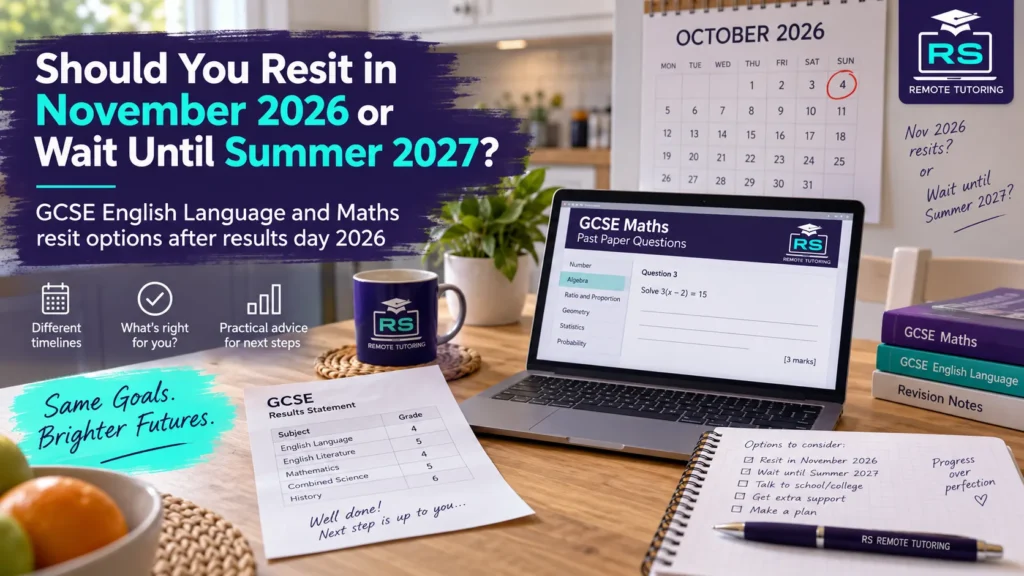
Results day was 20 August. The JCQ entry deadline for the November series is 4 October. That is 45 days to make a decision most families spend a month avoiding, and by the second week of September it has usually hardened into one line: should you resit in November 2026 or wait until summer 2027? Plenty of people are asking. The Department for Education’s provisional figures show 161,480 entries for GCSE English Language and maths in November 2025, up 5.8% on the year before (DfE, GOV.UK). For the right student it is the fastest route out of the resit cycle. For the wrong student it is a second grade 3 in January. Here are the dates, the rules, the pass-rate data, and the four questions I put to every resit family. I’ll say where I’d lean, because a neutral pros-and-cons list is no use with an entry form due in three weeks. What is the difference between the November 2026 and summer 2027 resit windows? November 2026 is a restricted series for GCSE English Language and maths only: exams 2 to 11 November, results 14 January 2027. Summer 2027 is the full series for every subject, from 10 May to 18 June, with results on 19 August 2027. Both windows award the same qualification at the same standard, since Ofqual pegs November grade boundaries to the summer performance standard. What differs is timing, subject scope, and how much of your year you spend on it. Which subjects can you resit in November 2026? Two, in England: GCSE English Language and GCSE Mathematics. That is the full list on the JCQ common timetable for the November 2026 series (Welsh centres add Cymraeg and Numeracy variants). English Literature, the sciences, humanities and languages all wait for summer 2027. Candidates must also have turned 16 by 31 August 2026; November exists for people who have already sat the exam once. How the two windows line up November 2026 series Summer 2027 series Subjects English Language, Maths only All GCSE subjects JCQ entry deadline 4 October 2026 Around 21 February 2027 (check your centre) Modified papers ordered by 20 September 2026 Confirm with centre Access arrangements processed by 1 November 2026 Confirm with centre First exam (common timetable) 2 November 2026 10 May 2027 English Language papers 3 and 5 November 24 May and 8 June Maths papers (AQA, Edexcel, OCR) 4, 6 and 9 November 14 May, 27 May, 14 June Final exam / contingency day 11 November 2026 18 June / 23 June 2027 Results to candidates 14 January 2027 19 August 2027 Review of marking deadline 18 February 2027 Late September 2027 Sources: JCQ key dates for the November 2026 series, AQA and Pearson Edexcel published timetables. Do you have to resit in November if you got a grade 3? No. The 16 to 19 condition of funding requires you to keep studying English or maths until you reach a grade 4, not to enter any particular series. Your college decides when you are ready. Many enter grade 3 students in November; none must. The Department for Education’s guidance for 2026 to 2027 calls it a study requirement, not a resit requirement, and says any entry should rest on the institution’s judgement that the student is ready to improve. Colleges must also offer 100 hours of English or maths teaching across the year. Grade 3 versus grade 2 or below The rules split at grade 3. Full-time students on a 3 must study towards the GCSE itself. Students on a 2 or below can work towards Functional Skills Level 2 instead, and for some that is the better path. A Functional Skills Level 2 pass is accepted as GCSE-equivalent by most employers and apprenticeship providers, though a handful of sixth-form courses still ask for the GCSE. How do November and summer resit pass rates compare? November resits have a markedly higher pass rate than summer resits. JCQ data for November 2025 shows 37.6% of English Language resitters reached grade 4, against 19.8% of post-16 English entries in summer 2026. Maths tells the same story at lower numbers. For 17-year-olds specifically, Ofqual’s summer 2026 figures show 21.0% reaching a 4 in English and 16.4% in maths, against 41% and 26.1% for the same age group in November 2025 (JCQ data reported by FE Week). Read those numbers carefully. The gap is not because November papers are easier. It is mostly selection: colleges put their nearest-miss students into November and hold the rest back. If your college thinks you belong in that group, the odds are decent. If you are pushing to enter against their advice, you are not in that 41%. And a 16.4% summer maths pass rate means five out of six resitters sat a full year of lessons and still missed. Whichever window you pick, treat it as a project, not a repeat of last year. When should you resit in November 2026? Enter for November if you were within roughly 10 marks of the grade 4 boundary, you know which topics cost you, your next step needs the grade before spring, and you will do weekly timed papers until 2 November. Miss two and summer is safer. I run the same four checks with every family: When is waiting until summer 2027 the better call? Wait for summer if you were 15 marks or more off, if a summer-only subject like English Literature is also on your list, if a second miss would dent your confidence, or if the knowledge needs rebuilding. Summer gives nine months, November eight weeks. There is no penalty for waiting. The grade you have stays on your record, a later result cannot lower it, and colleges do not mark you down for the longer route. Where I would steer someone away from November: That last point is where most of the November attempts I see go wrong. Rushed entry, thin preparation, and a January result that confirms the grade. What does the decision
Year 11 Mocks Went Badly? A 30-Day Recovery Plan for Parents
The results letter comes home, your child goes quiet, and dinner suddenly feels very long. If Year 11 mocks went badly in your house this term, you’re in a bigger club than you think. Mock grades of 2s, 3s and 4s land on kitchen tables across the UK every December and January, often in homes where nobody saw it coming. Here’s the part most schools don’t say out loud: mock results respond to targeted work faster than almost any other point in the GCSE cycle. The Education Endowment Foundation’s Teaching and Learning Toolkit finds that one-to-one tuition adds roughly five months of progress on average, and The Good Schools Guide reports that schools consistently see pupils lift their grades by one or two points between mocks and the real exams with steady work. This guide gives you a structured 30-day recovery plan. Not vague reassurance. A week-by-week sequence covering what to say, what to check, what to change, and when to bring in outside help. You’ll finish it knowing exactly what to do tomorrow morning. How Bad Are Bad Year 11 Mock Results, Really? Bad Year 11 mock results are a warning light, not a verdict. Mocks don’t count towards final GCSE grades, don’t appear on certificates, and are sat months before teaching finishes. Their main real-world weight is on predicted grades for sixth form applications, which can still be revised upwards. That last point deserves honesty rather than hand-waving. Teachers do use mock performance when setting predicted grades, and sixth forms do look at those predictions. So the results matter. But predictions aren’t locked the moment mock papers are marked. A student who shows visible improvement in class assessments between January and March will usually see teachers adjust their view, and final GCSE results are what sixth forms actually enforce in August. There’s another reason mock grades often understate ability. Schools frequently set mocks using the hardest recent past papers and mark them severely on purpose. Add the fact that the course isn’t fully taught yet, and a January grade 4 can genuinely represent a summer grade 6 in waiting. Many students revising in Year 11 have simply never been tested on the whole specification under timed conditions before, which is exactly why the wheels come off. If you want to understand how those raw marks translate into grades, it’s worth reading up on how GCSE grade boundaries work, because a paper that “felt like a disaster” is sometimes only six or seven marks off the next grade. One caveat. A whole set of grade 1s and 2s across every subject, paired with missing homework since September, is a different situation from a couple of unexpected 3s. The first needs a conversation with the head of year this week. The second needs the plan below. Why Did the Mocks Go Wrong in the First Place? Mocks usually go wrong for one of four reasons: knowledge gaps, weak exam technique, poor time management, or anxiety on the day. Identifying which applies to your child, subject by subject, is the single most useful thing a parent can do in the first week after results. Treating every disappointing grade as “not enough revision” is the classic parental mistake. It’s often wrong, and it poisons the conversation before it starts. Knowledge gaps The content simply wasn’t secure. Common in maths and the sciences, where Year 10 topics resurface in Year 11 papers. A student can revise hard for weeks and still fall over on material taught fifteen months ago that nobody flagged for review. Exam technique Your child knew the material but didn’t answer the question in front of them. Ignored command words like “evaluate” or “compare”, wrote three lines for a six-mark question, didn’t show working in maths. Technique problems are actually good news, because they’re the fastest to fix. Tutors see students gain a full grade in weeks purely by learning how examiners award marks against the mark scheme. Time management Ran out of time on paper 2, left the last two questions blank, spent twenty minutes on a four-mark question. You can spot this instantly by flicking to the back of the returned paper. Blank pages tell the story. Anxiety and blanking Some students know the content cold at home and freeze in the exam hall. If your child says “my mind went blank”, take it at face value rather than treating it as an excuse. There are practical, well-tested ways to manage GCSE exam anxiety, and the mock experience itself is part of the cure, because familiarity with exam conditions reduces the fear. Most students have a mix. A typical profile is one subject with genuine gaps, one with technique problems, and general timing issues across the board. What Should You Do in the First Week? (Days 1 to 7) In week one, stabilise the mood, get every marked paper back, and hold one short teacher conversation per weak subject. No timetables yet, no tutors yet, no punishments. The first seven days are for information gathering and rebuilding your child’s belief that recovery is possible. Rushing this stage is tempting and counterproductive. A revision timetable built on guesswork just schedules more of whatever wasn’t working. Work through these steps in order: By the end of week one you should be able to complete this sentence for each weak subject: “The grade was a ___ mainly because of ___, and the biggest single fix is ___.” If you can, week two becomes straightforward. How Do You Build the Recovery Plan in Week Two? (Days 8 to 14) Week two turns the diagnosis into a written, realistic revision plan: two or three priority subjects, specific topics rather than whole subjects, and a weekly schedule of roughly 10 to 14 focused hours that your child helped design and can actually sustain. The word “helped” is doing heavy lifting there. A timetable imposed by a parent lasts about nine days. A timetable your child built with your input tends to stick, because
GCSE Remark or Resit? What to Do After Results Day 2026

A grade 3 in maths, two marks off the boundary. Within an hour of opening the envelope on 20 August, somebody in the family will say “get it remarked” and somebody else will say “just resit in November,” and both will sound completely certain. Neither is automatically right. The GCSE remark or resit decision depends on one number almost nobody checks first: how many marks you actually were from the next grade. Ofqual’s data for summer 2025 shows that of the 5.66 million GCSE grades awarded, 4.3% were challenged and only 1.0% changed, which means roughly three out of four reviews came back with the same grade (Ofqual, GOV.UK). So this is a decision about odds, deadlines and money, not about which option feels less painful. This guide puts the two routes side by side, shows you when each one wins, and covers the third option most people forget exists. What’s the difference between a GCSE remark and a resit? A remark, officially a review of marking, is a check that your existing paper was marked correctly, done within weeks for a fee. A resit is sitting the exam again, in November 2026 for maths and English Language, or summer 2027 for everything else. The two routes answer different questions. A review asks “did the examiner make a mistake?” A resit asks “can I do better with another attempt?” Mixing those up is how people waste money on reviews for papers that were marked perfectly fine. Review of marking (remark) Resit What happens A reviewer checks the original marking for errors You sit a fresh paper Timescale Around 2 to 4 weeks; priority reviews faster November 2026 (maths and English Language) or summer 2027 (all subjects) Cost Roughly £45 to £68 per paper depending on board; usually refunded if the grade changes Entry fee if improving a grade; usually free if resitting a compulsory grade 4 in English or maths through a school or college Risk Grade can go up, stay the same, or go down Higher of the two grades stands, so the original is safe Success depends on A genuine marking error existing Your preparation between now and the exam Deadline 24 September 2026 for standard reviews Entry by around 4 October 2026 for November The risk line matters more than people realise. A review can lower your grade, though in practice fewer than 0.1% of challenged GCSE grades went down in summer 2025. A resit can’t touch your original result, because the better grade stands. GCSE Results & 2027 Support Got Your GCSE Results? Let’s Plan the Right Next Step Whether your child is preparing for GCSE 2027, considering a resit or wants to improve a particular subject, our expert tutors can help. Book a free 30-minute one-to-one assessment to discuss their current grade, target grade and the support they need. Book a Free GCSE Assessment × Free 30-Minute Assessment Turn GCSE Results Into a Clear Plan Tell us the subject, current grade and target grade. Our team will contact you to arrange a free online assessment and recommend the right tutoring support. When is a GCSE remark worth the money? A remark is worth it when you’re one to three marks below a grade boundary in a subject with extended writing, and a teacher who’s seen your marked script agrees the mark scheme may have been misapplied. Twenty marks off, it’s almost certainly wasted money. Start with the raw marks, not the grade. Your exams officer can tell you exactly how far each paper landed from the boundary, and your school can request a free copy of the marked script before committing to anything. That script is the whole decision. A teacher reading it can usually tell within ten minutes whether there’s a realistic case. Three things stack the odds: Reviewers don’t re-mark the paper from scratch, and they can’t add marks because a second examiner might have been kinder. They correct errors in how the mark scheme was applied, which is a narrower thing than most families expect. Understanding how grade boundaries are set also helps here, because boundaries move every year with paper difficulty, and being one mark short is not evidence of a mistake. Worth knowing: the most commonly challenged grade in combined science last summer was the 4-3, which tells you exactly what everyone is fighting for. The grade 4 in maths and English is where a review has the most practical value, because so much hangs on it. What does a GCSE remark cost in 2026, and what’s the deadline? Standard reviews of marking must reach the exam board by 24 September 2026 and cost roughly £45 to £68 per paper. Clerical re-checks are cheaper at £10 to £14. The marked script is free. Most boards refund the fee if the grade changes. Service Deadline AQA Pearson (Edexcel) OCR WJEC/Eduqas Copy of marked script 24 Sep 2026 Free Free Free Free Clerical re-check 24 Sep 2026 £9.70 £14.00 £12.00 £11.00 Review of marking 24 Sep 2026 £44.85 £50.00 £67.75 £45.00 Priority review (place at risk) Late Aug 2026, board-specific Varies Varies Varies Varies Per-paper fees as published by exam centres for summer 2026. Some schools add an admin charge, and only your centre can submit the request, so confirm exact figures with your exams officer. Two process points that catch families out. You must give written consent before a review goes in, because the grade can drop. And private candidates can’t apply directly to the board; the request goes through the centre that entered you. The full paperwork side, including what happens if the review fails and you want to appeal, is covered in our walkthrough of challenging a GCSE result and requesting a remark. If a sixth form or college place hangs on the outcome, tell them a review is in progress the day you find out, and ask your exams officer about a priority review. Some centres will hold a place or let you start provisionally while the
When Should You Start Revising for GCSEs for 2027 Exams?
It’s the question every Year 10 household eventually asks at the kitchen table. When should you start revising for GCSEs, and how early is too early? Ask five people and you’ll get five answers, which is exactly why so many students either panic-start in April or drift until it’s genuinely too late. There’s a reason timing matters this much, and it comes from memory research rather than opinion. Back in the 1880s, psychologist Hermann Ebbinghaus mapped what’s now called the forgetting curve. His work showed we lose a large share of new information within days unless we deliberately revisit it. Cram everything into a few weeks and you’re fighting that curve at the worst possible time. GCSE exams themselves run across roughly six weeks, from mid-May to late June, with dates set by the exam boards through the JCQ. Work backwards from there and the smart move becomes obvious. Revision isn’t a switch you flip in Year 11. It’s a slope you climb from Year 10, and the students who start early tend to arrive calm instead of frantic. This guide lays out that slope, stage by stage. Why does starting revision at the right time matter? Starting at the right time matters because memory is built through repetition over weeks, not a single burst. Space your revision out and each review strengthens what you know. Leave it late and you’re relearning whole topics under pressure, which raises stress and lowers recall exactly when you need it. Starting early, done well, buys you real advantages: The students who begin early usually perform better, and not because they grind more hours. They spend those hours understanding rather than cramming. If you want the science behind spacing, our guide to memory hacks for GCSE explains the forgetting curve in plain terms. When should you start GCSE revision in Year 10? Year 10 is for building the habit, not heavy revision. Short, regular reviews after each topic keep knowledge fresh and stop it slipping away. Thirty minutes a subject each week is enough to save you weeks of relearning later. Although exams sit at the end of Year 11, the foundation is poured in Year 10. This is the year to turn good lessons into lasting memory before the syllabus piles up. A light Year 10 routine looks like this: Students who skip this step usually pay for it in Year 11, when they’re relearning material rather than revising it. A gentle start keeps everything manageable. When should structured revision begin in Year 11? Structured revision should begin at the start of Year 11, ramping up through the autumn term. This is the shift from casual reviews to a real plan, aiming for one to two hours on school days and rotating subjects so nothing gets neglected. At this stage, blend content review with active practice rather than just reading notes. Start creating detailed summaries, drilling flashcards for key facts and formulas, and working through topic-based exam questions. The goal is steady, full coverage of the syllabus long before the final run-in. Here’s how the whole journey maps out. Stage Focus Rough daily time Year 10 Build habits, review as you go 10–30 min per subject, weekly Start of Year 11 Structured, rotating revision 1–2 hours most days Jan–Feb of Year 11 Intensive: recall, past papers 2–3 focused hours Study leave (May–Jun) Final review and exam performance 3–5 hours with breaks When should intensive GCSE revision start? Intensive revision should start three to four months before your exams, roughly January or February of Year 11. This is the phase for active recall, past-paper practice, targeting weak topics, and training your timing. By now you’re refining, not learning the course for the first time. Students who wait until this window to learn content, rather than revise it, almost always struggle. There’s simply too much to cover in too little time. If you reach this stage feeling behind, focus ruthlessly on high-mark topics; our post on how many hours you should study for GCSEs helps you set realistic targets without burning out. Notice the hours climb gradually. That gentle ramp is the whole point. Jump straight to five-hour days in May and you’ll burn out; build up from Year 10 and those hours feel normal by the time they matter. How do mock exams fit into your revision timeline? Mocks are checkpoints, not verdicts. Schools usually run them in late Year 10, the autumn of Year 11, and again in spring. Each one tells you which subjects need the most work and how you cope under real exam conditions, which is information you can’t get from notes. Treat every mock as free data. The grade matters far less than the gaps it reveals. Afterwards, go through the paper properly: This is where a second pair of eyes pays off. Our guides on preparing for a GCSE mock exam and using tutor feedback after mocks show how to turn a disappointing result into a targeted plan. What revision techniques work best once you’ve started? Knowing when to start only helps if you also know how to revise. The methods with the strongest evidence are spaced repetition, active recall, and interleaving, all of which beat re-reading by a wide margin. Timing gets you to the start line; technique wins the race. Spaced repetition Revisit each topic at growing intervals, so it sticks instead of fading: Active recall Close your notes and retrieve the answer from memory before checking. Write down everything you remember, quiz yourself, and use flashcards properly. Free quizzes on BBC Bitesize are handy for this. It’s harder than re-reading, which is exactly why it works. Interleaving Mix subjects within a session rather than blocking one for hours. Forty-five minutes of Maths, then Biology, then English trains the flexible recall a mixed exam paper demands. For a deeper toolkit, our roundup of proven GCSE revision hacks covers each method with examples. How can parents support GCSE revision? Parents help most by creating the conditions
How Online Tutors Teach Exam Techniques Effectively to GCSE Students
Every summer, thousands of GCSE students walk out of an exam hall knowing they understood the material and still lose marks. They ran out of time, misread a command word, or wrote everything they knew instead of what the question asked. The knowledge was there. The technique wasn’t. That gap between knowing and showing is what good GCSE exam techniques close, and it’s exactly where online tutoring earns its place. The Education Endowment Foundation rates targeted feedback as one of the highest-impact things you can do for a learner, worth roughly +6 months of additional progress over a year when it’s specific and acted on. A tutor watching how a student answers, not just whether they got it right, is feedback of exactly that kind. This post breaks down the exam techniques online tutors actually teach, why each one works, and how a good tutor delivers it week to week. Why do exam techniques matter more than knowledge alone? Exam techniques matter because GCSE marks reward performance under pressure, not private understanding. Most students who underperform aren’t missing content, they fail to retrieve it quickly, structure it clearly, and manage time. Technique is what turns what you know into marks on the page. Cognitive research is blunt about this: how you perform in an exam depends heavily on retrieval, structure and pacing, not memorisation alone. A student can re-read a textbook ten times and still freeze when a question is worded unexpectedly. That’s not a knowledge problem, it’s a technique problem, and technique can be taught far faster than a whole syllabus can be re-learned. Online tutors are well placed to spot this gap because they see the working, not just the answer. Our online tutoring sessions are built around watching a student think in real time, then coaching the specific habit that’s costing marks. What exam techniques do online tutors actually teach? Tutors teach a small set of high-leverage techniques: active recall, spaced repetition, timed past-paper practice, time management, structured answering, and confidence under pressure. Each one is evidence-based, and each is drilled until it becomes automatic rather than something a student has to remember to do. None of these are secrets. What changes results is a tutor building them into a routine, holding a student to it, and adjusting when something isn’t landing. Let’s take the ones that move the needle most. How does active recall beat re-reading notes? Active recall beats re-reading because retrieving information strengthens the memory far more than seeing it again. Every time a student pulls an answer from memory without looking, they deepen the pathway to it, which is precisely what an exam demands. Re-reading feels productive but builds weak, easily-forgotten familiarity. This is one of the most reliably supported findings in learning science. Instead of letting students highlight and re-read, tutors design sessions around retrieval: The verbal explanation matters more than people expect. If you can teach a method back clearly, you understand it; if you stumble, you’ve just found your next revision target. Tutors use this constantly, and it pairs naturally with the memory techniques we cover for GCSE. How do tutors use spaced repetition to stop forgetting? Tutors use spaced repetition by revisiting each topic at widening intervals, so it’s reviewed just as it’s about to fade. This works with the brain’s forgetting curve instead of against it, turning short-term cramming into durable long-term memory that survives the walk into the exam room. A typical spaced cycle for a single topic looks like this: The payoff is better retention, faster recall, and far less last-minute panic. Cramming the night before loads information into short-term memory that leaks away by morning; spacing banks it properly. Tutors track these review cycles across the term so nothing quietly slips, which is one reason a structured plan beats ad-hoc revision, something we go deeper on in how tutors build a GCSE study plan. Why is timed past-paper practice so effective? Timed past-paper practice is effective because it rehearses the exact conditions of the real assessment, the wording, the pressure, and the pacing. Doing papers under proper timing turns the exam from an unpredictable event into a familiar one, which is half the battle for both marks and nerves. Papers only pay off when they’re used deliberately, so tutors structure them: Done this way, students start to recognise question patterns and how marks are actually awarded not just whether their answer “feels right”. This is the single practice most competitors agree on, and for good reason. Past papers and mark schemes sit alongside free resources like BBC Bitesize, and we’ve written separately on getting the most from GCSE past papers if you want the full method. How do tutors teach time management in exams? Tutors teach time management with a simple, drillable anchor: roughly one minute per mark. A four-mark question earns about four minutes; if you’re stuck, you make your best attempt, mark it, and move on. Practised repeatedly, this pacing becomes automatic and stops one hard question sinking the paper. Time pressure is where a lot of avoidable marks disappear, students over-invest in one question, misjudge how much a question is worth, or simply run out of paper. Tutors train the fix directly: That last point matters most in essay subjects, where a 30-second plan usually earns more than the extra sentence it replaces. If a student consistently runs out of time, that’s a signal for more timed practice; if they lose marks mid-answer, it’s a structure problem instead, which is the next technique. How do tutors teach students to structure their answers? Tutors teach structure by giving students a reliable framework for each answer type, so they’re never staring at a blank page deciding how to begin. Different subjects reward different shapes of answer, and knowing the shape in advance frees up thinking for the actual content. The frameworks vary by subject, and a good tutor matches the tool to the paper: Subject What examiners reward Framework tutors drill English Analytical
How to Measure the Value of Online GCSE Tutoring
A few weeks into paying for tutoring, most parents ask themselves the same quiet question: is this actually working? The grades haven’t jumped yet, the invoices have, and it’s hard to tell whether the weekly sessions are moving anything. It’s a fair question and the honest answer is that the value of online GCSE tutoring is rarely captured by the next report card alone. Good tutoring is an investment, and like any investment it should be judged on measurable outcomes but the right measures are broader than a single grade. The Education Endowment Foundation rates one-to-one tuition as one of the more powerful interventions available, worth roughly +5 months of additional progress over a year when it’s well targeted. This guide gives parents and students a practical framework to judge whether their online tutoring is delivering real results, across grades, learning, engagement, confidence and return on investment. What does “value” actually mean in online tutoring? Value in online tutoring means measurable improvement over time, not just a higher final grade. It spans academic progress, faster learning, deeper engagement, growing confidence and stronger independent study habits. Judging tutoring on one exam misses most of what good tutoring is actually doing week to week. That matters because improvement isn’t always immediate or purely grade-based. A student who moves from a grade 3 to a grade 5 has gained more, in real terms, than a grade 8 student nudging to a 9, even though the second number looks more impressive. Real value lives in progress relative to the starting point, which is exactly why a broader set of signals is worth tracking. Dimension What to track A healthy sign Academic progress Mock scores, predicted grades, past papers A steady upward trend from the baseline Learning gains Topic mastery, repeated mistakes Fewer repeat errors, rising accuracy Engagement Attendance, homework, participation Consistent, active involvement Confidence Exam anxiety, willingness to try Calmer, more willing to attempt hard questions Return on investment Cost vs grade and skill gains Meaningful improvement for the outlay How do you measure academic performance properly? You measure academic performance by tracking the trend, not a single snapshot. Look at mock exam scores over time, changes in predicted grades, past-paper performance and subject-specific progress, then read all of it relative to where the student started rather than against a fixed target. Improved grades are the most obvious marker that tutoring is working, and they matter. Parents and students usually watch for: Targeted tutoring tends to lift exam performance most when sessions are aligned to the exam board and a structured revision plan, the sort of plan we cover in how tutors build a GCSE study plan. But grades alone can mislead. Someone climbing from a low baseline to a solid middle grade may be getting far more value than a high achiever making tiny gains, so always read performance as progress from the starting point. Why measure learning gains and not just results? You measure learning gains because they reveal genuine understanding, which final scores can hide. Learning gains capture how much a student improves over time regardless of their starting level, through before-and-after assessments, topic mastery, fewer repeated mistakes and rising accuracy on practice questions. Concretely, these are worth tracking: Tutoring is most effective when it closes knowledge gaps and reinforces understanding, rather than drilling a student to scrape a pass. That’s what makes learning stick for the long term, far more valuable than short-lived memorisation that evaporates a week after the mock. Is engagement a sign that tutoring is working? Yes, engagement is one of the clearest early signals, often visible long before grades move. A student who turns up regularly, completes the set work, participates actively and asks questions is far more likely to benefit. Rising engagement usually predicts rising results. Watch for four things in particular: Engagement tends to climb in one-to-one online sessions because the attention is personal and the pressure of a full classroom is gone. Consistency compounds it: students who attend steadily and follow a structured plan improve significantly more than those with stop-start sessions. In short, the more engaged the student, the more value the tutoring is creating. Does tutoring build confidence as well as grades? Yes, and confidence is one of the most overlooked returns on tutoring. Many students underperform not from a lack of ability but from self-doubt. Effective tutoring rebuilds self-belief, reduces exam anxiety, and makes students more willing to attempt hard questions, which then lifts performance across the board. The confidence signals to look for include self-belief when tackling difficult questions, less anxiety before exams, greater willingness to participate, and a more positive attitude to the subject overall. Confidence works as a multiplier: a student who stops fearing maths often carries that steadier mindset into science, and into the exam hall itself. We’ve written more about the family side of this in supporting your child through GCSEs. How can you tell if tutoring is building independence? You can tell tutoring is building independence when your child starts relying on the tutor less. The best tutoring teaches students how to learn, time management, structured revision, active recall and spaced repetition so they can eventually study effectively on their own. Growing independence is a sign of success, not redundancy. Strong tutoring develops self-regulated learning skills that matter well beyond GCSEs: The paradox of good tutoring is that it works towards its own redundancy. When a student begins driving their own revision, the investment has done something a grade can’t show, it’s created a capable independent learner. Those exam-technique habits are covered in how tutors teach exam techniques. Does the tutoring align with the GCSE exam? Alignment is itself a measure of value. Effective tutoring focuses on the specific exam board, AQA, Edexcel or OCR, all regulated by Ofqual teaches exam technique and mark schemes, improves timing, and drills targeted past papers. Two students with similar understanding can score very differently if only one knows how marks are actually awarded. If the sessions
How Online Tutors Create Exam-Focused GCSE Study Plans
Open a typical Year 11 revision timetable and it looks impressive. Neat colour-coded blocks, every subject squeezed in, a rainbow of good intentions. Then you watch what actually happens: the student spends the week on the subjects they already like and quietly skips the ones that scare them. A pretty timetable isn’t the same as an exam-focused GCSE study plan, and the gap between the two is where marks go missing. That gap is exactly what a good tutor closes. The Education Endowment Foundation, which reviews what genuinely improves results, rates feedback among the highest-impact approaches in education, linked in its Teaching and Learning Toolkit to around six months of extra progress over a year. A generic timetable gives a student none of that. A tutor-built plan is built around it. So a real study plan isn’t a grid of hours. It’s a system: diagnose the gaps, schedule around them, match the exam board, drill past papers, and adjust as the grades move. Here’s how tutors put that together, step by step. Why isn’t a generic revision timetable enough? A generic timetable tells a student when to sit down, but not what to fix. It spreads time evenly across strong and weak topics, rewards busywork over real learning, and ignores the exam board’s specific demands. Exam-focused plans do the opposite: they target weaknesses and marks. Left to their own devices, most students fall into three traps. They revise what they already know because it feels good, they lean on passive re-reading, and they leave real exam practice until far too late. A plan that doesn’t actively design those traps out will let them back in every single week. What does an exam-focused GCSE study plan actually include? An exam-focused plan combines five things: a diagnostic of strengths and gaps, a personalised schedule weighted toward weak areas, alignment with the exam board specification, structured past-paper practice, and regular progress checks. Hours are just the container; these five elements are the content. Miss any one of them and the plan wobbles. A schedule with no diagnosis is guesswork. Past papers with no feedback loop just repeat the same mistakes. The point of a tutor is to keep all five working together rather than leaving a stressed teenager to assemble them alone. How does a tutor start with a diagnostic assessment? Before writing a single timetable, a tutor works out where the student actually stands. That means topic-based assessments, past-paper analysis, quick skills quizzes, and concept checks, not assumptions. The goal is to separate “looks shaky” from “is genuinely weak,” because those need very different amounts of time. This is where surprises show up. One student understands the Maths but loses marks purely on exam timing. Another knows every historical fact yet can’t structure an essay under pressure. Once the real gaps are visible, the tutor can prioritise the topics that will add the most marks fastest, rather than the ones that simply feel productive. Our guide to how many hours you should study helps set realistic targets once those gaps are clear. How do tutors design a personalised revision schedule? A tutor builds the schedule around the diagnosis, giving weak subjects extra time and strong ones just enough to stay sharp. Sessions are short and focused, most experts suggest 30 to 60 minutes with breaks and every week includes review, not just new content. Balance and repetition are the point. A realistic week might look like this. Day Subject focus Monday GCSE Maths, problem-solving practice Tuesday English Literature, essay technique Wednesday Biology, recall and diagrams Thursday Chemistry, past-paper questions Friday Geography, case studies Weekend Full mock or mixed review Notice it rotates subjects rather than blocking one for days, which builds the flexible recall a mixed exam paper demands. The plan also stays flexible, it’s a living document, adjusted as some topics click and others don’t. How do tutors align revision with exam board specifications? Tutors map the plan to the student’s actual exam board, because AQA, Edexcel, OCR and the rest use different formats, command words, and mark schemes. Revising the right content in the wrong style still loses marks. Matching the specification means the student practises exactly what the examiner will reward. This changes how each subject is revised. English rewards analysis and interpretation. Science wants structured explanations and clear working. History turns on argument and evidence. A tutor teaches students to decode command words like analyse, evaluate and compare, so answers are written for marks rather than just written out. Our breakdown of how to answer GCSE exam questions digs into those command words, and free resources like BBC Bitesize are handy for checking topic coverage. How do past papers fit into the plan? Past papers are the engine of exam-focused revision, not an afterthought for the final week. They build familiarity with format, timing, and question patterns, and they turn vague knowledge into exam marks. Tutors weave them through the whole plan, not just the end. A tutor-run past-paper cycle usually runs like this: That fourth step is the one students skip on their own. Marking a paper and sighing at the score teaches nothing; sorting the mistakes and acting on them is where grades climb. Our guides on using GCSE past papers and preparing for a mock exam walk through the process in detail. How do tutors track progress and adjust the plan? A study plan isn’t fixed; it evolves as the student does. Tutors track progress with weekly quizzes, topic tests, mock exams, and simple progress reports, then adjust the schedule around what those show. A topic that’s now solid gets less time; a stubborn one gets more. There’s a motivation payoff here too. When a student can see a weak topic climb from 40% to 70% across a few weeks, revision stops feeling like a black hole and starts feeling like it’s working. Reviewing mock feedback with a tutor turns a disappointing paper into a clear list of next moves. Evidence-based methods like retrieval
GCSE Revision Hacks That Actually Boost Your Grades
Walk past any Year 11 bedroom in May and you’ll spot the same scene. A highlighter in one hand, a textbook open at the page it’s been open at for an hour, and almost nothing sticking. That’s the trap most revision falls into, and it’s why so many students work hard yet plateau. The GCSE revision hacks that move grades aren’t about more hours. They’re about what you do with the hours you’ve got. Here’s the part schools rarely spell out. In a widely cited 2013 review in Psychological Science in the Public Interest, psychologist John Dunlosky and colleagues rated ten popular study methods. Only two earned top marks for real learning: practice testing and spaced practice. Re-reading and highlighting, the two things students do most, landed near the bottom. So the students pulling grade 8s and 9s aren’t superhuman. They’ve swapped busywork for methods that make memory stick. Nine of those methods are below, along with how to start each one this week. Why do some revision methods work better than others? Some methods work because they force your brain to retrieve and rebuild information, which is what an exam demands. Passive methods like re-reading only ask your brain to recognise words on a page. Recognition feels easy, but it doesn’t survive exam pressure. That single distinction, active versus passive, sits underneath every hack on this list. Keep it in mind and most revision advice suddenly makes sense. How do you use active recall instead of passive reading? Active recall means closing your book and pulling the answer out of your own head. You test first, then check. It’s harder than re-reading, and that difficulty is the point, because retrieval is what strengthens memory and prepares you for the real thing. Passive reading is comfortable. You glide over familiar notes, nod along, and feel productive. The trouble comes in the exam hall, when the notes aren’t there and your brain has never practised working without them. To switch to active recall, try three things: If you want the science behind why this works, our guide to memory hacks for GCSE breaks down retrieval and the forgetting curve in plain English. What is spaced repetition and how do you schedule it? Spaced repetition means revisiting a topic several times with growing gaps between each review. Instead of one long cram, you meet the same material on day one, day three, day seven, and day twenty-one. Each return trip resets your memory just as it starts to fade. Cramming can hold facts in place for a morning. It falls apart over weeks, which is exactly the timescale GCSEs run on. Spacing beats it because every gap you survive makes the memory a little more permanent. A simple cycle looks like this: Apps like Anki and Quizlet automate the timing, but a wall calendar works just as well. The system matters more than the tool. Are past papers really the best way to revise? Past papers are the single closest thing to the real exam, which is why they belong at the centre of revision, not the end. They train you on question wording, command words, timing, and the mark scheme. Used well, they turn knowledge into marks. There’s a right order to them, though. Most students dive into a full timed paper too early, score badly, and feel deflated. Build up instead. Free question banks like BBC Bitesize make a decent warm-up before you commit to full timed papers. That last step is where the marks hide. If you want a full walkthrough, our post on how to use GCSE past papers shows how to squeeze real feedback out of every question, and the guide to answering GCSE exam questions decodes those command words examiners love. Does teaching someone else actually help you revise? Teaching a topic out loud forces you to organise it, simplify it, and spot the bits you only half understand. If you can explain photosynthesis to a bored sibling in plain words, you know it. If you stumble, you’ve just found your weak spot for free. You don’t need a real audience. Explain to an empty chair, record a voice note, or write a paragraph as if a Year 7 will read it. The gaps show up fast, which is the whole point. Which topics deserve the most revision time? Not every topic pays the same. Some appear on almost every paper and carry heavy marks, while others show up rarely. Smart revision front-loads the high-frequency, high-mark topics and refuses to spread time evenly. Work out where the marks live before you plan. Two moves help: A quick word of caution, because it catches people out every year. Students tend to revise what they already enjoy, which usually means revising their strengths and quietly avoiding their weaknesses. Flip that. How much does exam technique change your grade? Exam technique can be the difference between a 5 and a 7 on the same knowledge. Examiners reward structure, the right command word response, and clear working. Knowing the content is only half the job; showing it the way the mark scheme wants is the other half. Three habits carry most of the gain here. Learn what command words like “evaluate,” “analyse,” and “describe” are really asking for. Practise a repeatable answer shape such as PEEL for longer written responses. And rehearse timing so you never leave your best question unanswered because the clock ran out. Our roundup of common GCSE exam mistakes covers the small errors that quietly bleed marks. Why should you mix subjects instead of blocking them? Interleaving means switching between subjects or topics in a session instead of drilling one for hours. It feels less tidy, and it works better, because your brain has to keep reloading and applying different ideas, which is exactly what a mixed exam paper demands. A blocked session might be three hours of Maths. An interleaved one might run 45 minutes of Maths, 45 of Biology, then 45 of English.
How to Revise GCSE Chemistry: A Step-by-Step Revision Guide
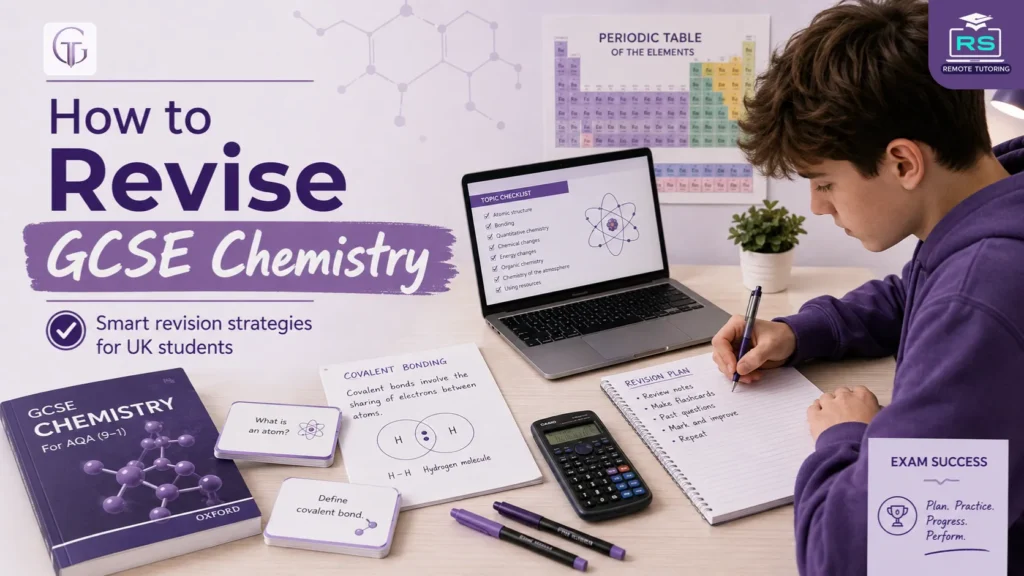
GCSE Chemistry can feel like one of the most confusing science subjects to revise. Unlike GCSE Biology, which often rewards strong memory, or GCSE Physics, which leans more towards logic and maths, Chemistry sits somewhere in the middle. One minute, you may need to memorise the colours in flame tests. The next, you may be calculating the concentration of a solution. As a tutor who has guided many students through GCSE revision, I have seen one thing again and again: most students do not struggle with Chemistry because it is impossible. They struggle because they revise it in the wrong way. I still remember one student who spent weeks rereading notes and highlighting textbooks. She felt productive, but when we started past paper practice, her score barely improved. That was when we rebuilt her entire approach. This guide is based on what I have seen work with real students preparing for UK GCSE Chemistry exams. It will show you how to revise GCSE Chemistry properly, avoid common mistakes, and build confidence before your mocks or final exams. Why GCSE Chemistry Feels So Difficult Before learning how to revise GCSE Chemistry, it is important to understand why students often find it challenging. Many students: One thing many students fail to realise is that Chemistry is not just a reading subject. It is a doing subject. You may think you understand a topic when reading your notes, but the real test comes when you have to apply that knowledge in an exam question. That is where proper revision makes the biggest difference. Step-by-Step Guide: How to Revise GCSE Chemistry The best way to revise GCSE Chemistry is not to read everything again and again. You need a clear system that helps you understand, remember, apply, and improve. Below is a practical step-by-step approach that works well for students who feel overwhelmed by GCSE Chemistry. 1. Start With a Simple GCSE Chemistry Revision Plan One of the biggest mistakes students make is creating unrealistic revision timetables. They plan to revise for five hours a day, cover every topic in one week, and complete full past papers before they have even understood the basics. This usually leads to stress and inconsistency. Another common mistake is topic tunnelling. This means spending too much time on topics that feel easy, such as Atomic Structure, while avoiding harder areas like Quantitative Chemistry or Organic Chemistry. When revising GCSE Chemistry, you need a balanced revision plan. A helpful method is the traffic light system: Red Topics These are your weakest or most difficult topics. Examples may include: Amber Topics These are topics you partly understand but still need to practise. Examples may include: Green Topics These are topics you feel more confident with. Examples may include: I would recommend starting with your red topics first. In my experience, the anxiety of avoiding hard topics often drains the energy students need for the easier ones. A realistic Chemistry revision session could include: Consistency matters more than trying to revise everything at once. 2. Focus on Understanding Before Memorising This is where GCSE Chemistry revision really starts to improve. Many students try to memorise everything straight away. They copy definitions, highlight paragraphs, and read revision guides repeatedly. The problem is that memorising without understanding does not help much when the exam question is worded differently. Instead of asking yourself: “Can I remember this?” Ask: “Can I explain this in simple words?” For example, if you are revising atomic structure, you should be able to explain: I often tell students this: If you cannot explain a topic without looking at your notes, you probably do not understand it well enough yet. Good ways to build understanding include: Once you understand the concept, memorising becomes much easier. 3. Use Active Recall for GCSE Chemistry Active recall is one of the most effective revision methods for GCSE Chemistry. Instead of rereading your notes, you force your brain to retrieve information from memory. This helps you remember more and identify gaps quickly. Here is a simple active recall method: For example, after revising electrolysis, close your book and try to answer: This is much more powerful than simply reading the same page multiple times. Students who use active recall usually improve faster because they are training for the way exams actually work. In the exam, you will not have your notes in front of you. You will need to retrieve and apply information under pressure. 4. Start GCSE Chemistry Past Papers Early Many students make the mistake of leaving past papers until the end of their revision. This is risky. Past papers should not only be used to test what you know. They should also be used to learn how examiners ask questions and how mark schemes reward answers. Start past paper questions as soon as you have covered the basic topics. Past paper practice helps because: For example, in GCSE Chemistry, students often lose marks because their answers are too vague. They may understand the topic, but they do not use the correct scientific language. Using mark schemes helps you learn phrases such as: These small details can make a big difference to your final grade. 5. Do Not Ignore Required Practicals Required practicals are one of the most commonly ignored parts of GCSE Chemistry revision. This is a mistake. GCSE Chemistry exams often test practical knowledge, even if you are not physically carrying out the experiment in the exam. You may be asked about: Students who revise required practicals properly often gain marks that others miss. For each required practical, make sure you know: Do not just memorise the practical. Understand why each step is done. 6. Learn GCSE Chemistry Equations the Smart Way GCSE Chemistry includes equations, formulae, calculations, and theoretical concepts. Many students try to memorise equations blindly, but this rarely works well. A smarter approach is to understand what each symbol means and practise applying the equation in exam questions. For example, when revising concentration, do not just