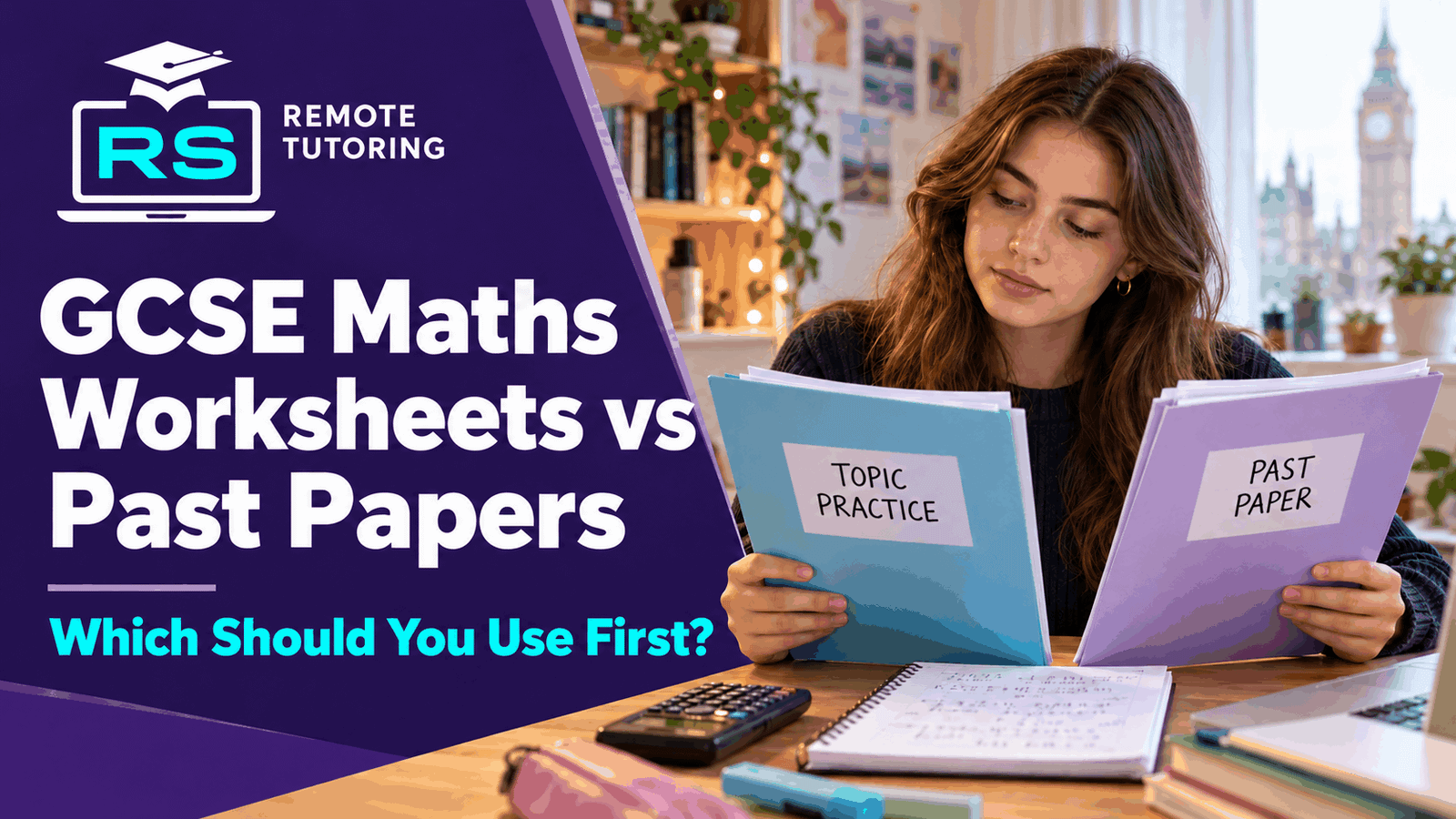
You’ve printed a maths paper, but the first algebra question stops you. Another evening goes into checking answers instead of learning the missing method. The GCSE maths worksheets vs past papers decision starts with what you can do independently, not how close the exam feels.
The Education Endowment Foundation reports an average of five additional months of progress from feedback at secondary-school level. That finding covers feedback approaches, not a direct trial of worksheets against past papers. The useful point is that practice needs a response, not just a score.
For London students preparing for mocks or GCSEs, the best sequence is usually a short check, focused topic practice and then mixed exam work. You don’t need to finish every worksheet before opening a paper.
On this Page
What is the difference between GCSE maths worksheets and past papers?
Worksheets usually focus on one topic or skill, while full past papers combine topics in the exam’s original format. Worksheets help you practise a method repeatedly. Past papers test whether you can choose the method, apply it and manage your time without a topic label.
Topic practice and exam practice do different jobs
A topic worksheet is a set of questions on an area such as fractions or equations. A past paper is an exam paper used in an earlier sitting. A specimen paper is an exam board’s sample assessment, rather than an exam previously taken by students.
Exam-style worksheets can bridge the gap. They use GCSE-like wording and mark allocations, but original questions are still original practice, not official past papers.
The GCSE maths assessment objectives include standard techniques, reasoning and problem solving. Repeating a method is useful, but you also need to recognise when to use it.
| Resource | Best use | What it cannot show on its own |
|---|---|---|
| Lesson notebook with worked examples | Learning or rebuilding a method | Whether you can work without hints |
| Single-topic worksheet | Improving accuracy on one skill | Whether you can select that skill in mixed questions |
| Exam-style topic questions | Applying a skill to different wording | Your performance across a whole exam |
| Full official past paper | Checking mixed knowledge, pace and exam habits | Why an error occurred without further review |
Should you use GCSE maths worksheets or past papers first?
Start with a short mixed check if you don’t know your weak topics. Use worksheets first when the method is missing or unreliable. Begin with past-paper practice when you can already solve varied questions independently and need to test topic selection, timing or exam technique.
Let the problem choose the resource
If you can’t solve a linear equation even when the worksheet says “linear equations”, you need teaching and focused practice. A full paper won’t explain the missing step.
If you solve equations correctly in a topic lesson but miss them inside word problems, move to mixed questions. The difficulty may be choosing the method rather than carrying it out.
Try a short check containing questions on fractions, percentages, equations, ratio, angles and probability. Mark each answer and record where you couldn’t start. This is a practical starting check, not a complete syllabus assessment.
Choose the first weak area from the free GCSE maths resource library, then select your board and tier. Download the section you need. Collecting six books is not the same as using one.

How do you choose the right exam board and tier?
Check your exam board, qualification code and tier before downloading practice. Match full papers to the course you’re taking, and use topic sheets covering the right content. Foundation and Higher resources overlap, but they are not interchangeable across every topic, grade target or exam format.
Match the paper, not just the subject name
Your mock-paper cover or maths department can confirm the details. Codes such as AQA 8300, Pearson Edexcel 1MA1 and OCR J560 identify the qualification. Eduqas also offers GCSE maths for England; WJEC’s Wales qualifications need separate checking.
The choice between Foundation and Higher tier affects both content and the grades available. Don’t switch worksheets because a harder-looking pack seems more impressive.
Foundation offers grades 1 to 5; Higher targets grades 4 to 9.
For an AQA Foundation learner rebuilding a method, the AQA Foundation lesson notebooks provide explanations, worked examples and practice. They are independently written resources aligned to AQA, not AQA publications.
How should you use GCSE maths worksheets to improve weak topics?
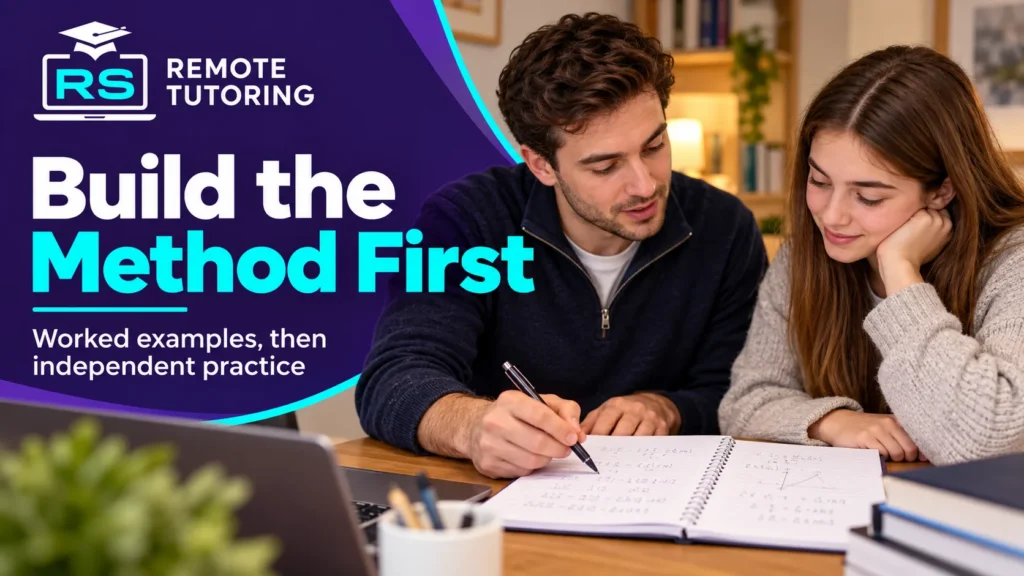
Use a worksheet after learning the method, then attempt questions without looking at the worked solution. Check the steps as well as the answer, explain each error and try a fresh question later. Move towards varied wording so progress reflects understanding rather than remembered answers.
A worked example is a starting point
Suppose a price rises from £80 to £92. The increase is £12, so the percentage increase is 12 ÷ 80 × 100 = 15%. Dividing by £92 instead uses the final price as the wrong comparison point.
After studying that example, cover it. Try a different percentage-change question and explain which value belongs in the denominator. Then try a decrease or a question with extra context.
The Edexcel Foundation exam-style topic questions pair original practice with worked answers. Use the answers after an attempt, rather than leaving them visible beside the question.
Check whether the method survives a change
- Change the numbers without changing the method.
- Change the wording so the topic is less obvious.
- Return after a gap and try without notes.
- Explain why your method fits the question.
No single worksheet score proves a topic is secure. Correct answers on fresh, differently worded questions give a better reason to move on.
When should you move from worksheets to GCSE maths past papers?
Move to mixed questions once you can use the method without prompts, then build towards full papers. You don’t need perfect knowledge of every topic first. Keep returning to worksheets when a paper reveals a specific gap, rather than treating revision as a one-way sequence.
Make the jump in stages
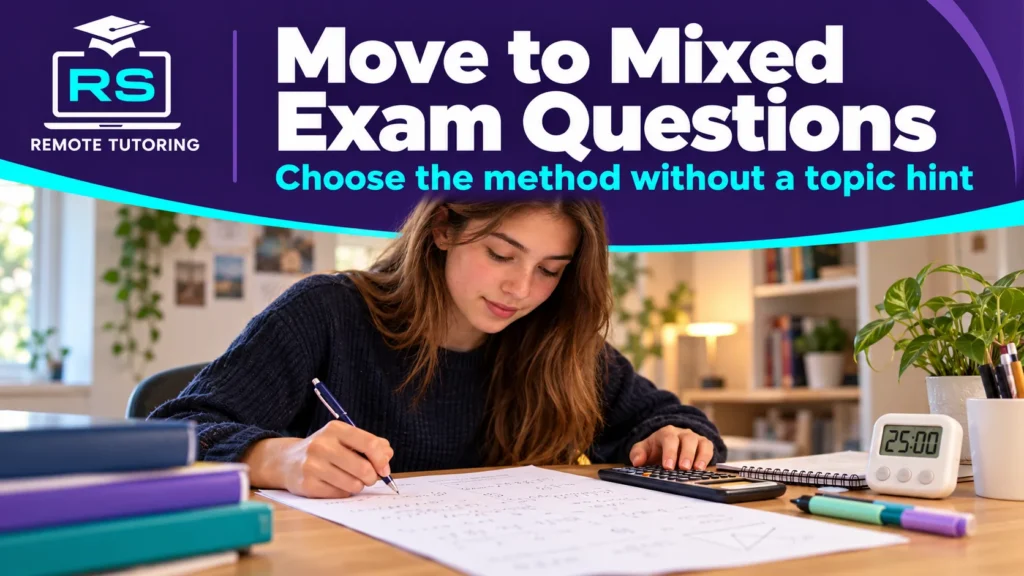
- Try mixed questions untimed. Remove topic headings and see whether you can select the method.
- Practise a timed section. Check whether pace changes your accuracy or leaves questions unfinished.
- Attempt a full paper. Follow its printed time and calculator instructions, including your agreed access arrangements where relevant.
- Review before the next paper. Choose the gaps that need teaching, practice or a change in exam habits.
Get genuine papers and matching mark schemes from the exam board’s official assessment resources. Check the series and paper code before marking.
Timed work and learning work should be recorded separately. A paper completed with notes or paused for explanations can teach you something, but its score isn’t a like-for-like comparison with an unaided timed attempt.
Keep an unseen paper for a later check. Familiar questions can make progress look stronger than it is.
What could a practice week look like?
For a learner who has found a percentage-change gap, this three-session example keeps the next task tied to the last result. Each session lasts 30 minutes. Adjust the time around schoolwork and teacher advice; the schedule is a starting suggestion, not a fixed revision requirement.
| Session | Task | Evidence to keep |
|---|---|---|
| First session | Study the percentage method, then attempt fresh topic questions | Your working and the step that went wrong |
| Second session | Retry without notes and add a differently worded problem | Whether you chose the starting amount correctly |
| Third session | Attempt a mixed section with no topic headings | Whether you recognised percentage change among other skills |
If the same error returns, use the next session to rebuild the explanation. If the method holds, choose another gap or extend the mixed practice. The next worksheet should have a reason behind it.
How do you turn worksheet and past-paper mistakes into a study plan?
Record the cause of each mistake, not just the topic or mark lost. Separate missing knowledge, a wrong method, calculation slips and unfinished work. Choose the next task from that evidence, then check a fresh question to see whether the problem has actually been resolved.
Give each error a useful name
“Bad at percentages” doesn’t tell you what to practise. “Used the final amount when finding percentage change” does. A blank answer might show missing knowledge, but it might also mean you ran out of time. Check before deciding.
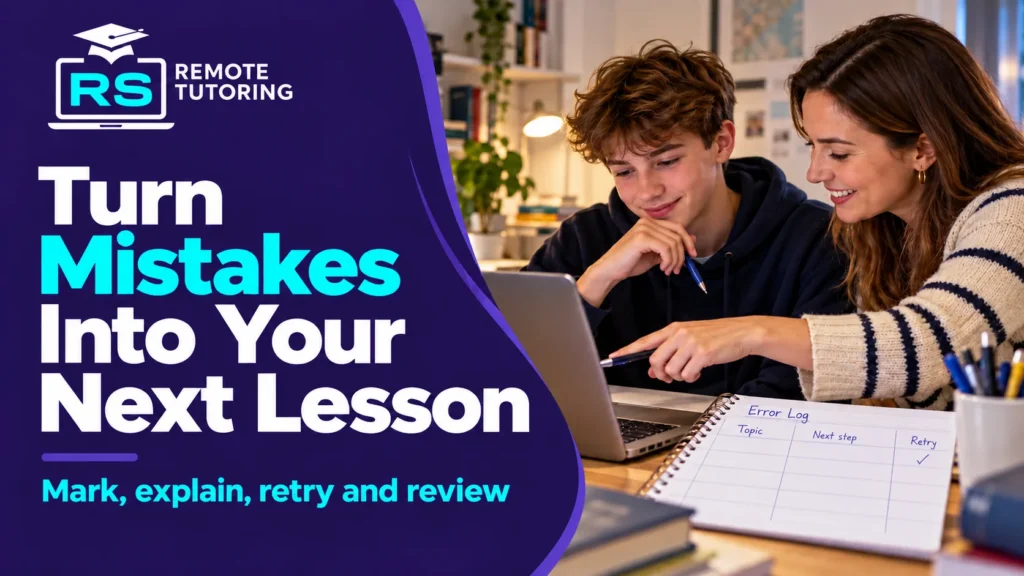
Keep a simple error log with the question, cause, next task and retry result. For the percentage example, the next task could be three fresh questions where you identify the starting amount before calculating anything.
A GCSE mark scheme shows how marks are awarded, including any credit for valid working. A worked solution explains a route to the answer. Neither automatically explains your own mistake, so ask a teacher when the gap remains unclear.
If you get the same error on two separate attempts, pause the repetition. Revisit the explanation or get the method checked. Two attempts are a useful review point, not a rule that every learner needs tuition.
How can free maths resources and tutoring work together?
Use free resources to identify what you can’t do independently. If the same misunderstanding remains after checking the explanation and retrying, bring that work to a teacher or tutor. Individual help is useful when it addresses a clear problem rather than replacing all independent practice.
Bring the evidence to the lesson
Keep the question, your working and the answer that confused you. A tutor can then check whether the issue is the maths, the wording or an earlier skill. “I need help with algebra” is a much less useful starting point.
Choose one weak-topic section from the downloadable maths practice books and complete a short attempt before seeking help. The library’s original questions let you practise alongside official papers without calling the books past papers.
If you want an individual review, online GCSE maths tutoring can focus on that marked attempt during RS Remote Tutoring’s free 30-minute trial. Bring your board, tier and error log so the session has a clear purpose.
Frequently asked questions
Are worksheets better than past papers for GCSE maths?
Worksheets are better for focused skill practice; past papers are better for testing mixed knowledge and exam habits. Choose the resource that addresses the problem your latest attempt revealed.
Can I start past papers before finishing every topic?
Yes, you can use a paper or selected questions to find gaps before finishing the syllabus. Treat untaught content as something to learn, rather than proof that revision has failed.
Do topic questions count as past papers?
Only questions taken from actual earlier exams are past-paper questions. Original exam-style questions can be useful practice, but they should be labelled accurately.
Should I time every maths worksheet?
No, learning a method may need untimed work first. Add timing when you want to check pace, and record whether you used hints or notes.
Are RS Remote Tutoring’s maths books official exam-board resources?
No, they are independently written practice books and lesson notebooks aligned to the relevant specifications. They are not produced or endorsed by the exam boards.
How do I know when I need help from a tutor?
Ask for help when you can’t explain a repeated mistake or use the method on a fresh question. A teacher may resolve it; tutoring is another option for individual feedback.
Raja specializes in Physics and Maths, with over 5 years of experience. He offers KS2, KS3, and GCSE Science and Maths lessons. He graduated from one of the top universities in the UK.