
The last paper is over. Your calculator goes back in the drawer, but your college timetable carries on. After the November GCSE resit exams, the next job is to confirm how you’ll receive your results and what your course needs from you.
Ofqual recorded 161,480 provisional English Language and maths entries for November 2025, a 5.8% increase on the previous November. Those are exam entries, not individual students or a prediction of your result.
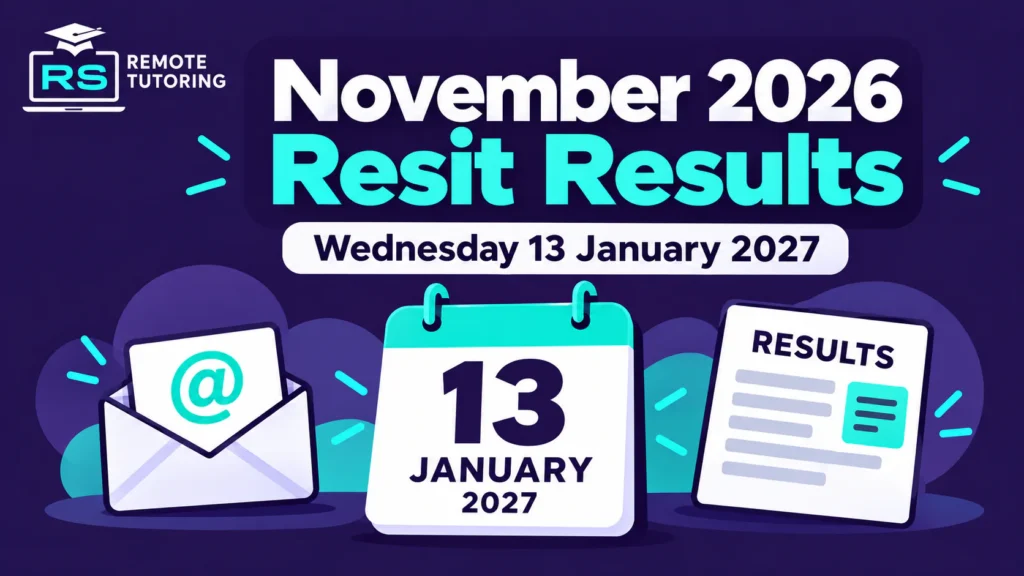
For the November 2026 series, results reach students on Wednesday 13 January 2027. The original 14 January date has changed. London students follow the same national dates as other GCSE candidates in England, but each centre sets its collection arrangements.
The weeks between exams and results matter. You’ll need a plan for the wait, a clear reading of your marks and a next step that fits your actual goal.
On this Page
What happens to your papers after November GCSE resit exams?
Your exam board marks the papers and awards a subject grade before sending results to your exam centre. You receive a statement of results in January. After that, you can discuss your marks, consider a review and confirm whether further study is needed.
Marking, grades and certificates are separate stages
Your exam board, such as AQA or Pearson Edexcel, awards the qualification. Your exam centre is the school, college or approved centre that entered you. A tutor can help you prepare and interpret feedback, but tuition does not replace the centre’s role.
A grade boundary is the minimum mark needed for a particular grade in that exam series. Check the boundary for your exact qualification and maths tier. Last summer’s figures cannot tell you your November grade.
Your January statement shows the result available at that point. The formal certificate follows later. Don’t expect both documents to arrive together.
Keep a small results folder with your entry confirmation, centre contact and the grade your next course requires. Add the January statement when it arrives. If a provider asks for evidence before the certificate is ready, ask exactly what it will accept and whether your centre must verify it. Sending the right document once is easier than chasing an incomplete application later.
The November GCSE resit exams discussed here are English Language and maths in England. English Literature and science resits normally use the summer series. International GCSEs and qualifications regulated in Wales have different arrangements, so check the qualification name before using these dates.
When do November GCSE resit results come out?
Results for the November 2026 GCSE series are released to students on Wednesday 13 January 2027. Centres receive them under restricted release on Tuesday 12 January. Confirm your collection time and method with the centre, because an email or appointment is not automatic.
Use the revised January date
The updated November 2026 results-day notice confirms the one-day change across JCQ awarding bodies. An old calendar screenshot may still show Thursday 14 January. Replace it now.
| Stage | Confirmed date or arrangement | Your action |
|---|---|---|
| Results reach centres under restriction | Tuesday 12 January 2027 | Wait for candidate release; staff access is not student access |
| Results released to students | Wednesday 13 January 2027 | Follow your centre’s collection instructions |
| November review-of-results deadline | Thursday 18 February 2027 | Ask about the centre’s earlier internal deadline |
| Summer 2027 GCSE entry deadline | Sunday 21 February 2027, awarding-body deadline | Arrange entry earlier with your centre |
| AQA November certificates sent to centres | By 28 February 2027 | Ask when collection or secure delivery will be available |
These deadlines serve different jobs. The review deadline is not a summer booking deadline, and certificate dispatch is not a student collection appointment. Other boards have their own certificate schedules.
Confirm the details before Christmas
Ask whether results will arrive by email, through a centre portal or in person. Check the email address on your record and save the exams office’s contact details. If you’re collecting, confirm the room and any ID requirement.
Private candidates should contact the GCSE resit exam centre in London that made their entry. Agree on a named contact and a backup contact. A tutoring company’s inbox is not necessarily the inbox that will send your grade.
Should you keep revising while you wait for January results?
Keep attending the lessons your college requires until it confirms a timetable change. You can reduce independent revision after the exams, then maintain a light routine if another attempt remains possible. Focus on your main course too, rather than trying to predict your grade daily.
Take a break without losing the thread
A short break from exam practice is reasonable. Packing away every book until January is less useful if you’re still unsure whether you reached your target. Keep your notes, marked practice work and board details together.
You don’t need another full revision sprint while the papers are being marked. Try two 20-minute sessions each week as a starting routine, then adjust with your teacher. That schedule is a practical suggestion, not a college attendance rule.
For maths, revisit a method you found difficult and complete a short set of questions. For English, read a short text and write one clear paragraph about its argument or language. Mark the work so the session produces feedback.
Using GCSE past papers works best when you check errors and retry the questions. Completing another paper without looking at the answers can hide the same gaps.
Record what you remember, then leave it alone
Write a brief note about the exam experience: unfinished questions, unfamiliar topics or a section that took too long. Separate those observations from guesses about marks. “I left the last question blank” is useful; “everyone thought it was easy” isn’t.
Avoid rebuilding your answers from social-media discussions. You cannot change the submitted paper, and another student’s memory is not a mark scheme.
Keep your current course deadlines visible. A resit result matters, but letting two months of coursework slip while you wait creates another problem to solve in January.
[IN-BODY IMAGE 1: waiting-for-gcse-resit-results.png]
Alt: GCSE student doing a short maths practice session at a home desk while waiting for January resit results.
Title: Waiting for GCSE Resit Results
How should you read your GCSE resit results slip?
Check your name, subject, qualification code and grade first. Then ask for marks and the correct series boundaries if they aren’t shown. A grade tells you what you achieved; paper-level feedback helps you understand whether the next step is progression, a review or further study.
Read the target as well as the grade
Grade 4 is a standard pass and grade 5 is a strong pass. Neither label settles every course requirement. A course asking for grade 6 in maths still needs grade 6, even if a grade 4 satisfies a separate funding requirement.
The GCSE grade boundaries must match your board, specification, series and tier. Don’t compare a Foundation mark with a Higher boundary. Don’t compare one paper’s mark with the total subject threshold either.
| Result | What to check next | Sensible first action |
|---|---|---|
| You reached the required grade | Whether your provider needs evidence | Send the statement and confirm the next step |
| You passed but missed a higher course target | The exact admissions requirement | Ask whether the provider will consider your achieved grade |
| You passed one subject but not the other | Each subject’s requirement separately | Confirm which lessons and qualifications remain |
| You’re close to the required boundary | Whether the marked script shows an error | Discuss evidence with a teacher before paying for a review |
| Your result is missing or pending | Whether there is an administrative query | Contact the exams office; don’t treat it as a fail |
Ask for an explanation if a code on the statement isn’t clear. Your candidate number identifies you within the centre; the qualification code identifies the course assessed. Having both ready makes an enquiry easier to handle.
Keep a secure copy of the full statement. A cropped photo of one grade may omit the information an admissions team needs.
What changes if you pass your November GCSE resit?
If you achieve the required grade, send the result to the provider that needs it and ask your college to confirm any timetable change. Passing can end the relevant maths or English funding requirement, but it doesn’t automatically change a course place or admissions decision.
Confirm the change instead of skipping lessons
DfE’s 2026/27 funding guidance allows the relevant study requirement to end when an eligible Level 2 qualification is achieved during the funding year. Your college needs to record the result and confirm your programme. Don’t simply stop attending.
If you pass maths but still need English, deal with each subject separately. One successful result is worth recognising. It doesn’t erase the remaining requirement.
Ask how the released lesson time will be used. Your college may adjust your programme rather than leave those hours empty. Get the revised timetable before changing your weekly routine.
Check the course’s wording
An admissions condition might specify English Language, a particular maths grade or a deadline for providing evidence. Send the statement to the named admissions contact and ask for written confirmation that it meets the condition.
January success does not guarantee an immediate course transfer. Places, course content and the provider’s transfer rules still matter. Ask whether the change can happen now or at the next intake.
For an apprenticeship or university application, use the provider’s instructions for updating qualifications. Don’t assume that your exam centre will handle every application update for you.
What happens if your November resit grade is still too low?
A result below your target means you need a discussion about the next route, not an automatic repeat of November’s plan. Your college should check the study requirement, your readiness for another exam and your course goal. Summer 2027 is the next normal GCSE opportunity.
Check which rule applies to you
For eligible study programmes in England, full-time students with prior GCSE grade 3 must study towards the relevant GCSE. Students with grade 2 or below have approved alternatives, including Functional Skills Level 2. Part-time rules differ, and eligibility depends on your circumstances and qualification history.
The policy also covers students aged 19 or over continuing a 16-to-19 programme, and eligible students with an education, health and care plan up to age 25. A birthday doesn’t automatically end the requirement.
College staff should assess readiness before making an exam entry. Continuing to study and being entered for every available sitting are different decisions.
Separate a study route from an entry requirement
Compare Functional Skills Level 2 and GCSE against the wording of your intended course. Functional Skills is a separate qualification. Being suitable for a study programme doesn’t prove that a university or employer accepts it for a specific place.
For example, a student whose course requires GCSE maths grade 5 still needs to discuss that GCSE target. Another learner may have written confirmation that Functional Skills Level 2 meets an employment requirement. Their next steps needn’t be identical.
If you’ve failed a GCSE resit again, ask what will change before agreeing to another attempt. More hours alone aren’t an answer. You need to know which skills, teaching approach or exam habits will be different.
Can you request a review of marking after November results?
Yes, a November GCSE result can be reviewed if there may be a marking error. Discuss the marked paper with a teacher and contact your centre promptly. Marks can fall, rise or stay unchanged, so being close to a boundary isn’t enough reason by itself.
Choose the correct post-results service
An exam script is your submitted answer paper. Access to scripts lets you inspect it. A clerical re-check checks matters such as adding and recording marks. A review of marking checks whether the marking was applied correctly; it isn’t a fresh attempt at the exam.
The November 2026 post-results rules set 18 February 2027 as the review-of-results deadline. Your centre may need your decision earlier. Script-copy deadlines vary by board and service, so ask straight after results.
For internal candidates, the centre submits the review request. JCQ also allows private candidates to approach the awarding body directly, although going through the centre is encouraged. Check the board’s process before sending forms or payment.
Use evidence before spending money
The choice between a review of marking and another resit starts with the script. Ask the teacher to identify the question and possible error, rather than simply calculate how close you were to the boundary.
Request the total cost, including any centre administration charge, and the refund terms in writing. A fee quoted for one exam board or one paper is not a universal price. Candidate consent is required because the result can go down.
Tell an admissions team if a review affects a condition they are considering. Ask what evidence they need and whether they can wait for the outcome.
Keep the summer-entry conversation moving while a review is pending. A review requested near the February deadline may finish after the normal summer entry deadline. Ask your centre how it will manage that overlap.

How can you prepare differently for a summer GCSE resit?
Start with November feedback, then build a plan around the gaps it reveals. Confirm the subject, board, tier and summer entry with your centre. Use targeted practice before full timed papers, and measure progress through corrected work rather than hours spent at a desk.
Build the plan in this order
- Identify the missing marks. Separate weak knowledge, misunderstood instructions, unfinished answers and timing problems. Use the marked script where available and teacher feedback where it isn’t.
- Choose two priorities. For example, practise percentage change and linear equations in maths, or evidence selection and paragraph development in English. These are examples, not a universal list of weaknesses.
- Teach, practise and retry. Work through the method, answer fresh questions and return to errors after a gap. Copying a correct answer once isn’t a useful check of learning.
- Add timed sections. Build pace without making every lesson a full mock. Record whether accuracy drops when the clock is running.
- Review progress and entry. Check the plan with your teacher, confirm centre deadlines and decide whether you are ready for the intended sitting.
Your choice of Foundation or Higher tier should reflect your target and performance. Switching to Higher simply because its grade-4 boundary looks lower ignores the different difficulty of the questions.
Use online GCSE resit tutoring when you need individual feedback alongside your college teaching. Bring your board, target grade and marked work so the tutor can work on a defined problem. RS Remote Tutoring provides tuition; exam entries remain with a school, college or approved centre.
The awarding-body summer entry deadline is 21 February 2027. Private centres may close bookings sooner. Start the conversation in January, including any access arrangements, instead of leaving it until revision feels complete.

How can parents help after the November GCSE resit exams?
Help your child organise the practical steps and make space for an honest conversation about the result. Ask what support they want, confirm centre arrangements and keep the discussion focused on options. A parent can support decisions, but the student’s involvement matters throughout the process.
Make the conversation useful
Start with “What do you need from me?” rather than a running comparison with another student’s grades. Your child may want company when opening the result, help contacting college or time to read the statement alone.
If exam anxiety is disrupting daily life, involve the college’s pastoral team or student support service. The aim is to keep the learner supported and engaged. A longer revision timetable isn’t the only response to a difficult result.
Agree on one manageable task for results week. That might be a teacher appointment or an email to admissions. Solving the whole year at the kitchen table in one evening is an ambitious target.
Keep a short results-week checklist
- Save the statement somewhere secure and check that it includes the subject and candidate details.
- Send evidence to the course provider that requested it, using its stated process.
- Ask the teacher for a feedback appointment if another attempt or marking review is being considered.
- Confirm the centre’s internal deadlines for scripts, reviews and summer entry.
- Write down the agreed next step, who will arrange it and when you’ll check progress.
Let your child send an email themselves if they can. Help them make the question clear, then leave space for their teacher’s answer. A practical conversation usually achieves more than another speech about working harder.
Frequently asked questions
Do November GCSE resit results come out in December?
No, November 2026 GCSE resit results are released to students on 13 January 2027. Confirm the time and delivery method with the centre that entered you.
Has the January 2027 GCSE resit results date changed?
Yes, candidate release moved from 14 January to Wednesday 13 January 2027. Centres receive restricted results on Tuesday 12 January. The post-results deadlines remain unchanged.
Can I stop maths lessons as soon as the resit ends?
Don’t stop attending required lessons just because the exam is over. Wait for the result and your college’s confirmation of any timetable change.
What if I pass maths but not English Language?
Deal with the two subjects separately and ask your college which requirements remain. A maths pass doesn’t satisfy an English requirement, and a course may specify its own English Language target.
Is my results slip the same as my GCSE certificate?
No, your results statement and certificate are different documents. The certificate follows later through your centre. Keep your statement and ask any provider what evidence it will accept meanwhile.
Can I take another GCSE resit after November?
Yes, the next normal opportunity is the summer 2027 series. Agree on readiness, entry and preparation with your centre; another sitting won’t happen automatically.

Raja specializes in Physics and Maths, with over 5 years of experience. He offers KS2, KS3, and GCSE Science and Maths lessons. He graduated from one of the top universities in the UK.