

Results day was 20 August. The JCQ entry deadline for the November series is 4 October. That is 45 days to make a decision most families spend a month avoiding, and by the second week of September it has usually hardened into one line: should you resit in November 2026 or wait until summer 2027?
Plenty of people are asking. The Department for Education’s provisional figures show 161,480 entries for GCSE English Language and maths in November 2025, up 5.8% on the year before (DfE, GOV.UK). For the right student it is the fastest route out of the resit cycle.
For the wrong student it is a second grade 3 in January.
Here are the dates, the rules, the pass-rate data, and the four questions I put to every resit family. I’ll say where I’d lean, because a neutral pros-and-cons list is no use with an entry form due in three weeks.
Jump to Section
What is the difference between the November 2026 and summer 2027 resit windows?
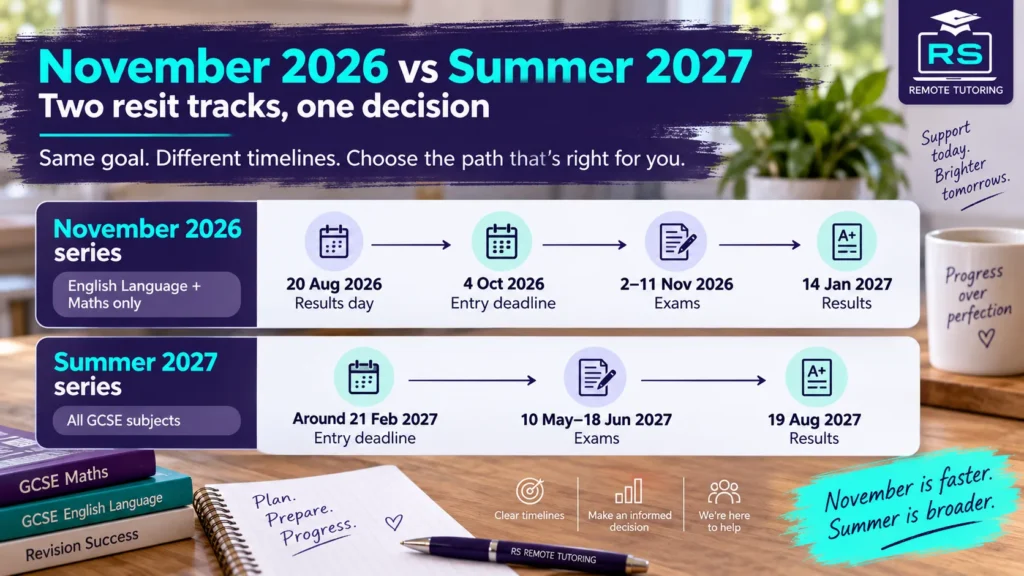
November 2026 is a restricted series for GCSE English Language and maths only: exams 2 to 11 November, results 14 January 2027. Summer 2027 is the full series for every subject, from 10 May to 18 June, with results on 19 August 2027.
Both windows award the same qualification at the same standard, since Ofqual pegs November grade boundaries to the summer performance standard. What differs is timing, subject scope, and how much of your year you spend on it.
Which subjects can you resit in November 2026?
Two, in England: GCSE English Language and GCSE Mathematics. That is the full list on the JCQ common timetable for the November 2026 series (Welsh centres add Cymraeg and Numeracy variants). English Literature, the sciences, humanities and languages all wait for summer 2027.
Candidates must also have turned 16 by 31 August 2026; November exists for people who have already sat the exam once.
How the two windows line up
| November 2026 series | Summer 2027 series | |
| Subjects | English Language, Maths only | All GCSE subjects |
| JCQ entry deadline | 4 October 2026 | Around 21 February 2027 (check your centre) |
| Modified papers ordered by | 20 September 2026 | Confirm with centre |
| Access arrangements processed by | 1 November 2026 | Confirm with centre |
| First exam (common timetable) | 2 November 2026 | 10 May 2027 |
| English Language papers | 3 and 5 November | 24 May and 8 June |
| Maths papers (AQA, Edexcel, OCR) | 4, 6 and 9 November | 14 May, 27 May, 14 June |
| Final exam / contingency day | 11 November 2026 | 18 June / 23 June 2027 |
| Results to candidates | 14 January 2027 | 19 August 2027 |
| Review of marking deadline | 18 February 2027 | Late September 2027 |
Sources: JCQ key dates for the November 2026 series, AQA and Pearson Edexcel published timetables.
Do you have to resit in November if you got a grade 3?
No. The 16 to 19 condition of funding requires you to keep studying English or maths until you reach a grade 4, not to enter any particular series. Your college decides when you are ready. Many enter grade 3 students in November; none must.
The Department for Education’s guidance for 2026 to 2027 calls it a study requirement, not a resit requirement, and says any entry should rest on the institution’s judgement that the student is ready to improve. Colleges must also offer 100 hours of English or maths teaching across the year.
Grade 3 versus grade 2 or below
The rules split at grade 3. Full-time students on a 3 must study towards the GCSE itself. Students on a 2 or below can work towards Functional Skills Level 2 instead, and for some that is the better path. A Functional Skills Level 2 pass is accepted as GCSE-equivalent by most employers and apprenticeship providers, though a handful of sixth-form courses still ask for the GCSE.
How do November and summer resit pass rates compare?
November resits have a markedly higher pass rate than summer resits. JCQ data for November 2025 shows 37.6% of English Language resitters reached grade 4, against 19.8% of post-16 English entries in summer 2026. Maths tells the same story at lower numbers.

For 17-year-olds specifically, Ofqual’s summer 2026 figures show 21.0% reaching a 4 in English and 16.4% in maths, against 41% and 26.1% for the same age group in November 2025 (JCQ data reported by FE Week).
Read those numbers carefully. The gap is not because November papers are easier. It is mostly selection: colleges put their nearest-miss students into November and hold the rest back. If your college thinks you belong in that group, the odds are decent. If you are pushing to enter against their advice, you are not in that 41%.
And a 16.4% summer maths pass rate means five out of six resitters sat a full year of lessons and still missed. Whichever window you pick, treat it as a project, not a repeat of last year.
When should you resit in November 2026?
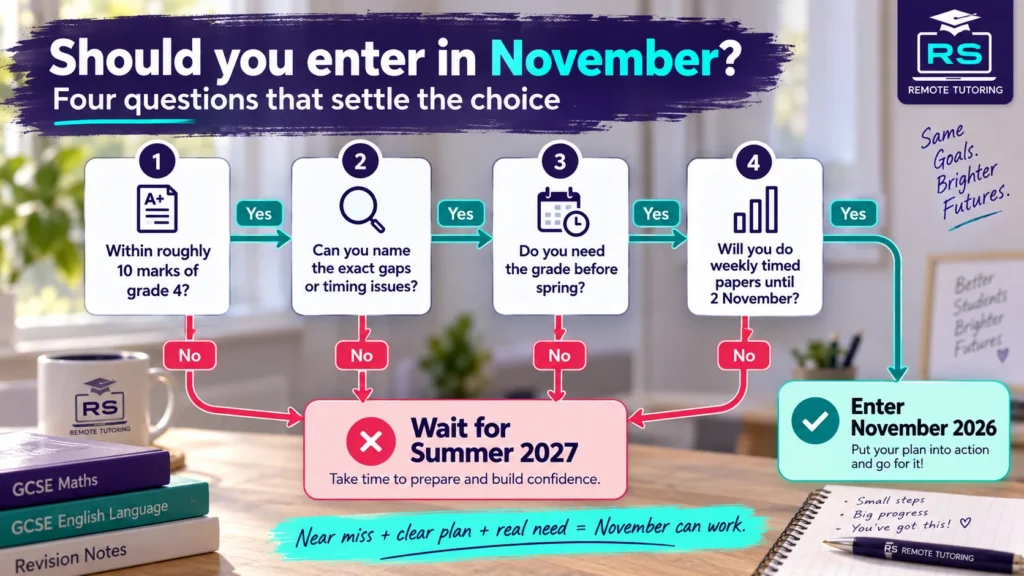
Enter for November if you were within roughly 10 marks of the grade 4 boundary, you know which topics cost you, your next step needs the grade before spring, and you will do weekly timed papers until 2 November. Miss two and summer is safer.
I run the same four checks with every family:
- How many marks short were you?
Your results statement shows the raw mark; the board publishes the grade 4 boundary for your tier. Single figures in maths, or under 10 in English, is November territory. Twenty-plus is not. - Can you name what went wrong?
“Ran out of time on Paper 2” or “lost every mark on ratio” is fixable in eight weeks. “I just don’t get maths” is not a diagnosis. - Does the next step need the grade now?
Some apprenticeships, Level 3 courses and January college transfers want a 4 this academic year. If yours does, November is worth attempting even on fair odds, because summer is still there as a backstop. - Will you actually do the work?
The students who pass in November are doing two or three timed past-paper sittings a week from mid-September.
When is waiting until summer 2027 the better call?
Wait for summer if you were 15 marks or more off, if a summer-only subject like English Literature is also on your list, if a second miss would dent your confidence, or if the knowledge needs rebuilding. Summer gives nine months, November eight weeks.
There is no penalty for waiting. The grade you have stays on your record, a later result cannot lower it, and colleges do not mark you down for the longer route. Where I would steer someone away from November:
- Big gaps in the foundations. If Paper 1 fell apart because number work is shaky, eight weeks will not rebuild it. Nine months can.
- Two or more subjects to retake. If English Literature or a science is going to summer anyway, splitting your energy across a November sprint and a summer campaign rarely helps either.
- A recent bad exam experience. Some students walk out of a November paper they were not ready for and stop believing they can pass at all.
- Access arrangements not yet in place. Extra time or a reader must be processed by 1 November. If you have moved centre and it is not sorted by mid-October, do not gamble on it.
- You are a private candidate still hunting for a centre. November places are limited and London centres fill early. Anyone who has worked through how to enter a GCSE resit as a private candidate knows the admin alone can eat two of your eight weeks.
That last point is where most of the November attempts I see go wrong. Rushed entry, thin preparation, and a January result that confirms the grade.
What does the decision look like for London students?
London students face the same national dates with more centre choice and tougher competition. Ofqual’s 2026 data put London at 71.7% of grades at 4 or above, the highest region, so sixth forms and colleges here can be firm about the grade 4 requirement.
Most London sixth forms and FE colleges run the November series in-house, and many enter grade 3 students by default unless you opt out. Ask for the college’s view of your readiness and the mock data behind it. A good exams officer will tell you plainly whether they expect you to pass.
Private candidates have more centre options in London than elsewhere, but centres set their own deadlines ahead of 4 October and the reputable ones are usually full by late September. Ring three this week rather than one next week.
Whichever window you pick, working with an online GCSE resit tutor who knows your exam board, tier and target boundary matters more than the brand name on the website. We teach students across London and the UK from Feltham on Zoom, at £30 a lesson, with a free 30-minute first session.

How should you prepare once you have picked a window?
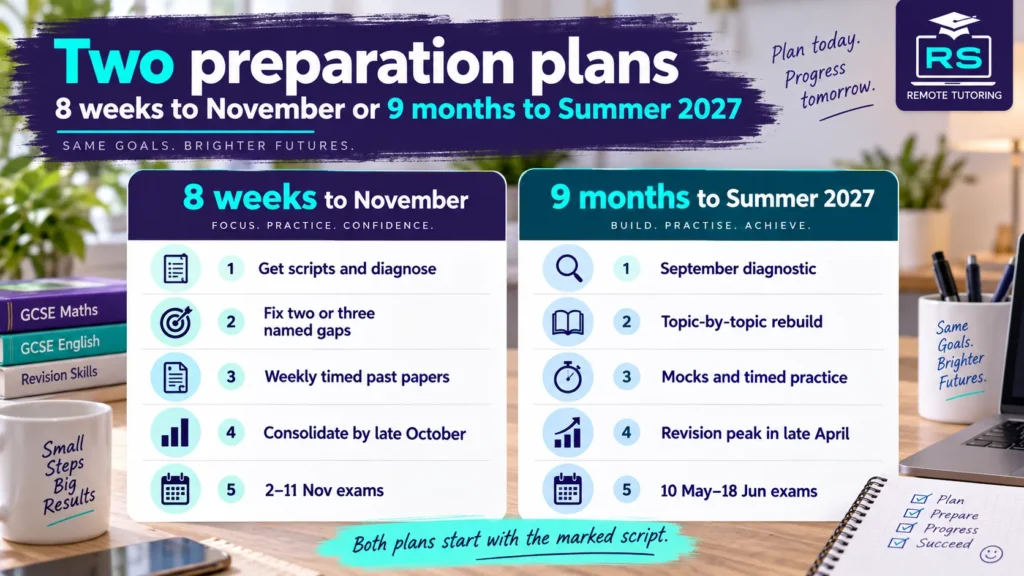
Prepare for November as a targeted repair on two or three named weaknesses, with weekly timed past papers. Prepare for summer as a full rebuild: diagnostic in September, topic work to Easter, then exam practice. Both start by getting your marked script back.
The eight-week November plan
Request access to your summer script in the first week. A student who left the last four questions blank needs timing work. A student who attempted everything and dropped method marks needs technique.
From there: two lessons a week on the named gaps until mid-October, one full timed paper each weekend from late September, and the final fortnight on exam practice under real conditions. Our free GCSE maths past-paper packs for AQA, Edexcel and OCR come with full worked answers, which matters when you are marking your own Saturday paper. For English Language, it is one writing task a week, marked against the board’s mark scheme rather than against how it felt.
Do not add new topics after 20 October. Consolidate.
The nine-month summer plan
Summer buys time, and the risk is spending it the way last year was spent. The students who pass in May treat September to December as a second go at the content: a diagnostic in September, a topic-by-topic rebuild to February, mocks in December and March, then exam practice after Easter. The 2027 GCSE exam timetable puts maths Paper 1 on 14 May and English Language Paper 1 on 24 May, so the revision peak needs to land in late April.
One more thing. If the summer result was a surprise and you believe the marking was wrong rather than the performance, the choice between remark or resit comes first. It has its own deadline and its own odds, and it is a different question from this one.
Frequently asked questions
Can I resit GCSE maths in November 2026 and again in summer 2027 if I fail?
Yes. There is no limit on attempts, and a November entry does not use up your summer one. The summer 2027 entry deadline is around 21 February 2027, which leaves time to regroup after January results.
What is the deadline to enter for the November 2026 GCSE resits?
The JCQ deadline is 4 October 2026, but that is when the exam board must receive the entry. Schools, colleges and private centres set earlier internal cut-offs, often mid to late September. Late entries after 4 October attract higher fees and are not always accepted.
Can I resit English Literature in November 2026?
No. The November series covers GCSE English Language and Mathematics only. English Literature, combined science, separate sciences, history, geography and languages can only be resat in the summer 2027 series.
Will a lower grade in November replace my summer grade?
No. Each result stands on its own. Universities, colleges and employers look at the highest grade you hold, so a 3 in November does not erase a 3 from the summer, and a 4 in November supersedes it for all practical purposes.
How much does a November GCSE resit cost?
Usually nothing if you are in full-time education and the resit is required under the condition of funding. Voluntary resits to improve a 4 or higher, and private candidate entries, carry the board’s fee plus any centre admin charge, which varies by centre.

Raja specializes in Physics and Maths, with over 5 years of experience. He offers KS2, KS3, and GCSE Science and Maths lessons. He graduated from one of the top universities in the UK.




2 Comments
[…] weighing November against summer resits should separate the subjects: eligible students can tackle English Language or maths in November, […]
[…] languages and everything else wait until May and June 2027, which changes the whole shape of the choice between November 2026 and summer 2027 for anyone resitting more than the two core […]