Every summer, thousands of GCSE students walk out of an exam hall knowing they understood the material and still lose marks. They ran out of time, misread a command word, or wrote everything they knew instead of what the question asked. The knowledge was there. The technique wasn’t.
That gap between knowing and showing is what good GCSE exam techniques close, and it’s exactly where online tutoring earns its place. The Education Endowment Foundation rates targeted feedback as one of the highest-impact things you can do for a learner, worth roughly +6 months of additional progress over a year when it’s specific and acted on. A tutor watching how a student answers, not just whether they got it right, is feedback of exactly that kind.
This post breaks down the exam techniques online tutors actually teach, why each one works, and how a good tutor delivers it week to week.
Jump to Section
Why do exam techniques matter more than knowledge alone?
Exam techniques matter because GCSE marks reward performance under pressure, not private understanding. Most students who underperform aren’t missing content, they fail to retrieve it quickly, structure it clearly, and manage time. Technique is what turns what you know into marks on the page.
Cognitive research is blunt about this: how you perform in an exam depends heavily on retrieval, structure and pacing, not memorisation alone. A student can re-read a textbook ten times and still freeze when a question is worded unexpectedly. That’s not a knowledge problem, it’s a technique problem, and technique can be taught far faster than a whole syllabus can be re-learned.
Online tutors are well placed to spot this gap because they see the working, not just the answer. Our online tutoring sessions are built around watching a student think in real time, then coaching the specific habit that’s costing marks.
What exam techniques do online tutors actually teach?
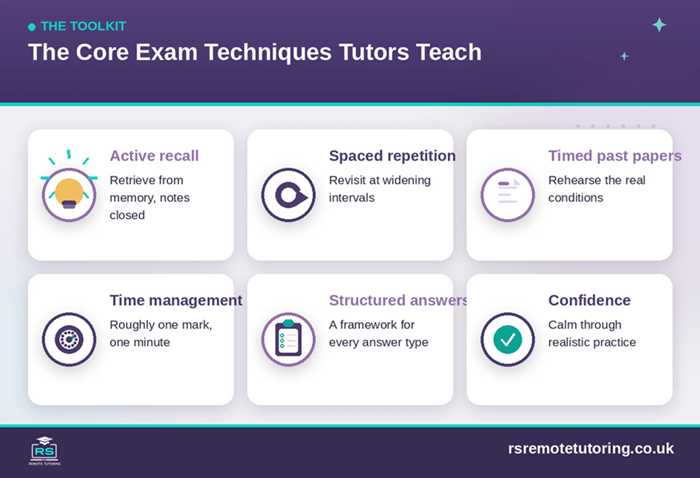
Tutors teach a small set of high-leverage techniques: active recall, spaced repetition, timed past-paper practice, time management, structured answering, and confidence under pressure. Each one is evidence-based, and each is drilled until it becomes automatic rather than something a student has to remember to do.
None of these are secrets. What changes results is a tutor building them into a routine, holding a student to it, and adjusting when something isn’t landing. Let’s take the ones that move the needle most.
How does active recall beat re-reading notes?
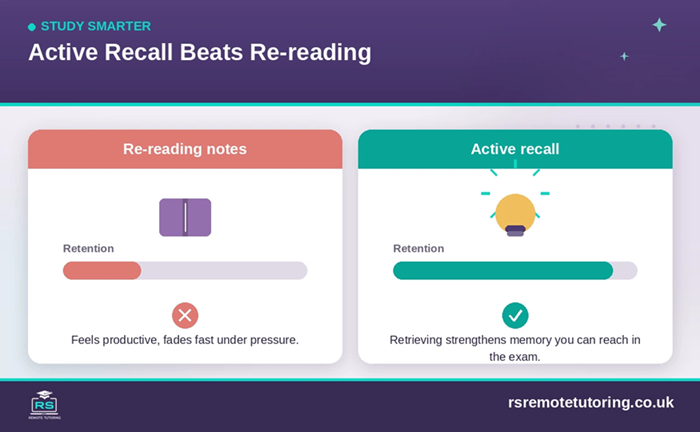
Active recall beats re-reading because retrieving information strengthens the memory far more than seeing it again. Every time a student pulls an answer from memory without looking, they deepen the pathway to it, which is precisely what an exam demands. Re-reading feels productive but builds weak, easily-forgotten familiarity.
This is one of the most reliably supported findings in learning science. Instead of letting students highlight and re-read, tutors design sessions around retrieval:
- Answering questions with notes closed
- Short, timed low-stakes quizzes
- “Brain dumps” writing everything you can recall on a topic before the lesson
- Explaining a concept out loud, in the student’s own words
The verbal explanation matters more than people expect. If you can teach a method back clearly, you understand it; if you stumble, you’ve just found your next revision target. Tutors use this constantly, and it pairs naturally with the memory techniques we cover for GCSE.
How do tutors use spaced repetition to stop forgetting?
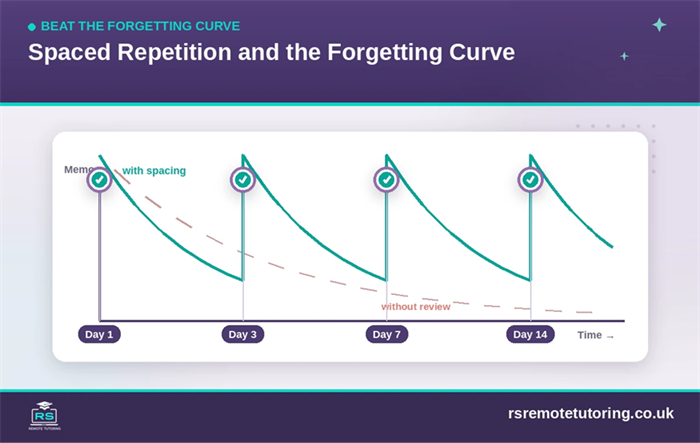
Tutors use spaced repetition by revisiting each topic at widening intervals, so it’s reviewed just as it’s about to fade. This works with the brain’s forgetting curve instead of against it, turning short-term cramming into durable long-term memory that survives the walk into the exam room.
A typical spaced cycle for a single topic looks like this:
- Day 1: learn and understand the concept
- Day 3: review and self-test
- Day 7: practise exam-style questions
- Day 14: apply it under timed, exam-style conditions
The payoff is better retention, faster recall, and far less last-minute panic. Cramming the night before loads information into short-term memory that leaks away by morning; spacing banks it properly. Tutors track these review cycles across the term so nothing quietly slips, which is one reason a structured plan beats ad-hoc revision, something we go deeper on in how tutors build a GCSE study plan.
Why is timed past-paper practice so effective?
Timed past-paper practice is effective because it rehearses the exact conditions of the real assessment, the wording, the pressure, and the pacing. Doing papers under proper timing turns the exam from an unpredictable event into a familiar one, which is half the battle for both marks and nerves.
Papers only pay off when they’re used deliberately, so tutors structure them:
- Full papers sat under strict timing, no notes
- Section-by-section breakdowns to isolate weak areas
- Marking against the official scheme, together
- Reviewing examiner expectations and common traps
Done this way, students start to recognise question patterns and how marks are actually awarded not just whether their answer “feels right”. This is the single practice most competitors agree on, and for good reason. Past papers and mark schemes sit alongside free resources like BBC Bitesize, and we’ve written separately on getting the most from GCSE past papers if you want the full method.
How do tutors teach time management in exams?
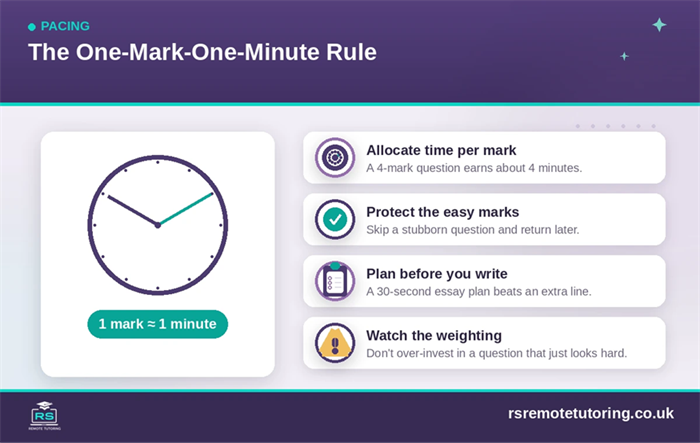
Tutors teach time management with a simple, drillable anchor: roughly one minute per mark. A four-mark question earns about four minutes; if you’re stuck, you make your best attempt, mark it, and move on. Practised repeatedly, this pacing becomes automatic and stops one hard question sinking the paper.
Time pressure is where a lot of avoidable marks disappear, students over-invest in one question, misjudge how much a question is worth, or simply run out of paper. Tutors train the fix directly:
- Allocate time per mark, not per question that “looks hard”
- Use timed drills so pacing becomes a habit, not a decision
- Skip and return, protect the easy marks first
- Plan longer answers briefly before writing
That last point matters most in essay subjects, where a 30-second plan usually earns more than the extra sentence it replaces. If a student consistently runs out of time, that’s a signal for more timed practice; if they lose marks mid-answer, it’s a structure problem instead, which is the next technique.
How do tutors teach students to structure their answers?
Tutors teach structure by giving students a reliable framework for each answer type, so they’re never staring at a blank page deciding how to begin. Different subjects reward different shapes of answer, and knowing the shape in advance frees up thinking for the actual content.
The frameworks vary by subject, and a good tutor matches the tool to the paper:
| Subject | What examiners reward | Framework tutors drill |
| English | Analytical depth, evidence | PEEL — Point, Evidence, Explain, Link |
| Science | Precise terminology, clear logic | Keyword-led points + correct units |
| Maths | Method, not just the answer | Step-by-step working, every line shown |
In maths especially, showing every step protects method marks even when the final number is wrong — a point echoed across examiner reports. Students practise these frameworks until they’re second nature, which is where clarity, precision and confidence come from. There’s more on this in our guide to answering GCSE exam questions, and it links tightly to avoiding common GCSE exam mistakes.
Can online tutoring reduce exam anxiety?
Yes, online tutoring reduces exam anxiety mainly by building familiarity. Most exam nerves come from uncertainty, and repeated practice under realistic conditions removes the unknown. When the format, timing and question styles already feel routine, there’s simply less to be afraid of on the day.
Tutors chip away at anxiety by simulating exam conditions, practising under timed pressure, and building genuine mastery through repetition. Confidence isn’t a pep talk, it’s the by-product of having done the thing, correctly, many times. A calmer student reads more carefully, thinks more clearly, and performs closer to their real ability.
The other advantage of one-to-one work is personalisation. A classroom teacher can’t retune the lesson for one learner mid-flow, but a tutor can: more timed drills for the student who runs out of time, structure work for the one losing essay marks, retrieval practice for the one whose recall is shaky. That targeting is why progress often comes faster than families expect and it’s the heart of how our GCSE revision tutors work.
Frequently Asked Questions
Why are exam techniques important for GCSEs?
They decide how well a student converts knowledge into marks. Two students can understand a topic equally, but the one with stronger technique, better timing, clearer structure, sharper recall will usually score higher, because GCSE grades measure performance, not private understanding.
What are the most important GCSE exam techniques?
Active recall, spaced repetition, timed past-paper practice, one-minute-per-mark time management, and structured answering are the core five. Reducing anxiety through realistic practice underpins all of them. Together they turn revision into exam-ready skill rather than passive review.
How can I improve my time management in GCSE exams?
Practise with the roughly one-mark-per-minute rule, use timed drills so pacing becomes automatic, and learn to skip and return rather than getting stuck. Securing easy marks first protects your score and steadies your nerves for the harder questions.
Does re-reading notes actually help?
Not much on its own. Re-reading feels productive but builds weak familiarity that fades under pressure. Testing yourself from memory, active recall, strengthens the pathways you’ll rely on in the exam far more effectively, even though it feels harder.
How quickly can a tutor improve exam technique?
Technique often improves faster than content, because it’s a set of habits rather than a whole syllabus. Many students see a noticeable difference within a few weeks of focused, feedback-driven practice, especially on timing and answer structure.
Is online tutoring as effective as in-person for exam skills?
For exam technique, online works particularly well. Tutors can share papers on screen, watch working in real time, and give immediate feedback. You can read more about the format on our how it works page.
Final thoughts
Online tutors aren’t just re-teaching content, they’re teaching students how to perform. Active recall, spaced repetition, timed papers, disciplined pacing and clear structure are grounded in cognitive science and shaped around real exam demands, then personalised to the individual in front of them. In a system where success depends on both understanding and delivery, that combination is a real advantage. If your child knows more than their grades show, exam technique is usually the missing piece and it’s a teachable one. Book a free trial or get in touch to see how a tutor would approach it.

Raja specializes in Physics and Maths, with over 5 years of experience. He offers KS2, KS3, and GCSE Science and Maths lessons. He graduated from one of the top universities in the UK.