The results letter comes home, your child goes quiet, and dinner suddenly feels very long. If Year 11 mocks went badly in your house this term, you’re in a bigger club than you think. Mock grades of 2s, 3s and 4s land on kitchen tables across the UK every December and January, often in homes where nobody saw it coming.
Here’s the part most schools don’t say out loud: mock results respond to targeted work faster than almost any other point in the GCSE cycle. The Education Endowment Foundation’s Teaching and Learning Toolkit finds that one-to-one tuition adds roughly five months of progress on average, and The Good Schools Guide reports that schools consistently see pupils lift their grades by one or two points between mocks and the real exams with steady work.
This guide gives you a structured 30-day recovery plan. Not vague reassurance. A week-by-week sequence covering what to say, what to check, what to change, and when to bring in outside help. You’ll finish it knowing exactly what to do tomorrow morning.
Jump to Section
How Bad Are Bad Year 11 Mock Results, Really?
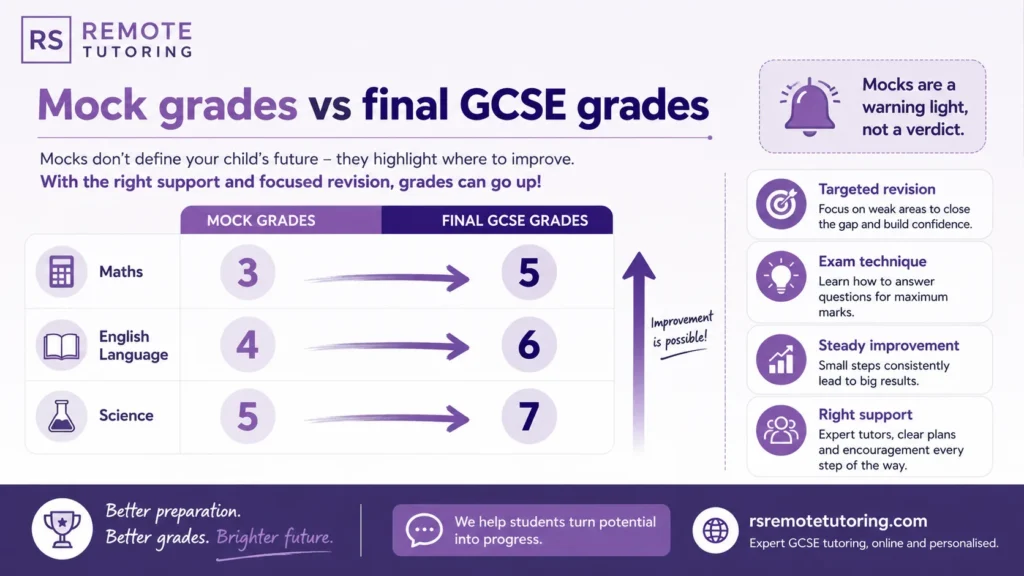
Bad Year 11 mock results are a warning light, not a verdict. Mocks don’t count towards final GCSE grades, don’t appear on certificates, and are sat months before teaching finishes. Their main real-world weight is on predicted grades for sixth form applications, which can still be revised upwards.
That last point deserves honesty rather than hand-waving. Teachers do use mock performance when setting predicted grades, and sixth forms do look at those predictions. So the results matter. But predictions aren’t locked the moment mock papers are marked. A student who shows visible improvement in class assessments between January and March will usually see teachers adjust their view, and final GCSE results are what sixth forms actually enforce in August.
There’s another reason mock grades often understate ability. Schools frequently set mocks using the hardest recent past papers and mark them severely on purpose. Add the fact that the course isn’t fully taught yet, and a January grade 4 can genuinely represent a summer grade 6 in waiting. Many students revising in Year 11 have simply never been tested on the whole specification under timed conditions before, which is exactly why the wheels come off. If you want to understand how those raw marks translate into grades, it’s worth reading up on how GCSE grade boundaries work, because a paper that “felt like a disaster” is sometimes only six or seven marks off the next grade.
One caveat. A whole set of grade 1s and 2s across every subject, paired with missing homework since September, is a different situation from a couple of unexpected 3s. The first needs a conversation with the head of year this week. The second needs the plan below.
Why Did the Mocks Go Wrong in the First Place?
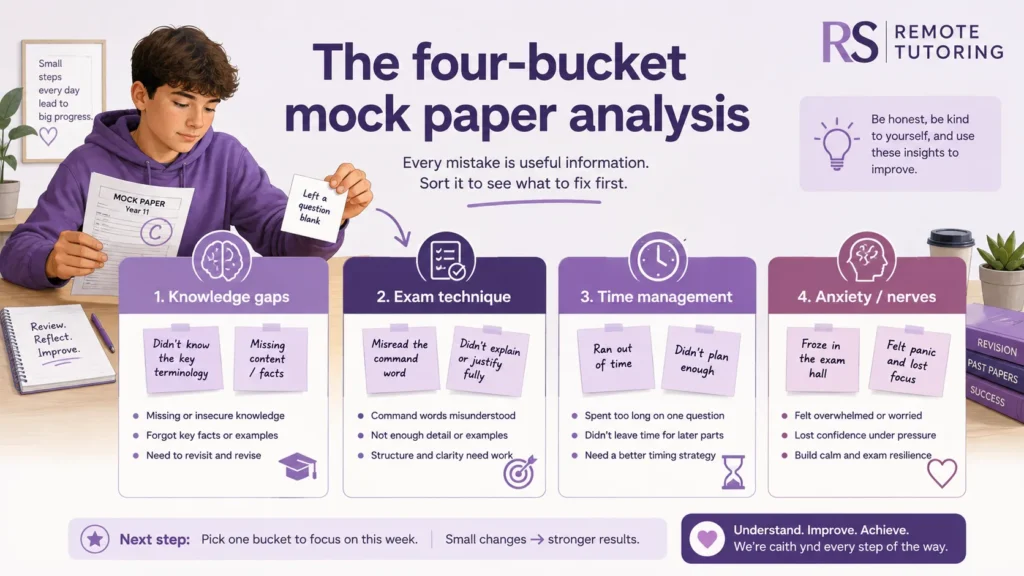
Mocks usually go wrong for one of four reasons: knowledge gaps, weak exam technique, poor time management, or anxiety on the day. Identifying which applies to your child, subject by subject, is the single most useful thing a parent can do in the first week after results.
Treating every disappointing grade as “not enough revision” is the classic parental mistake. It’s often wrong, and it poisons the conversation before it starts.
Knowledge gaps
The content simply wasn’t secure. Common in maths and the sciences, where Year 10 topics resurface in Year 11 papers. A student can revise hard for weeks and still fall over on material taught fifteen months ago that nobody flagged for review.
Exam technique
Your child knew the material but didn’t answer the question in front of them. Ignored command words like “evaluate” or “compare”, wrote three lines for a six-mark question, didn’t show working in maths. Technique problems are actually good news, because they’re the fastest to fix. Tutors see students gain a full grade in weeks purely by learning how examiners award marks against the mark scheme.
Time management
Ran out of time on paper 2, left the last two questions blank, spent twenty minutes on a four-mark question. You can spot this instantly by flicking to the back of the returned paper. Blank pages tell the story.
Anxiety and blanking
Some students know the content cold at home and freeze in the exam hall. If your child says “my mind went blank”, take it at face value rather than treating it as an excuse. There are practical, well-tested ways to manage GCSE exam anxiety, and the mock experience itself is part of the cure, because familiarity with exam conditions reduces the fear.
Most students have a mix. A typical profile is one subject with genuine gaps, one with technique problems, and general timing issues across the board.
What Should You Do in the First Week? (Days 1 to 7)
In week one, stabilise the mood, get every marked paper back, and hold one short teacher conversation per weak subject. No timetables yet, no tutors yet, no punishments. The first seven days are for information gathering and rebuilding your child’s belief that recovery is possible.
Rushing this stage is tempting and counterproductive. A revision timetable built on guesswork just schedules more of whatever wasn’t working.
Work through these steps in order:
- Day 1 to 2: Have the calm conversation. Open with something like “These results are information, not a judgement. Let’s work out what they’re telling us.” Avoid “what went wrong?”, which invites defensiveness. Try “which papers surprised you most?” instead. If your child is visibly upset, split the emotional conversation from the practical one by a day or two.
- Day 3 to 4: Get every paper back. Ask the school for the marked scripts, not just the grades. If the school won’t release papers, ask for a question-by-question mark breakdown. You cannot plan a recovery from a single number on a results sheet.
- Day 4 to 6: Sort the losses into the four buckets. Sit with your child and label each lost mark: gap, technique, timing, or nerves. Use three highlighter colours if it helps. Fifteen minutes per paper is enough. This exercise alone changes how students see their results, because “I’m rubbish at chemistry” becomes “I lost 11 marks on electrolysis and 8 marks to blank questions at the end.”
- Day 6 to 7: Speak to teachers. Five minutes per subject, either your child alone or with you at a parents’ evening. Two questions only: “Where did the most marks go?” and “What one thing would move the grade most?” Teachers give sharper answers to specific questions, and there’s a longer set of smart ways to use mock exam feedback once the basics are in place.
By the end of week one you should be able to complete this sentence for each weak subject: “The grade was a ___ mainly because of ___, and the biggest single fix is ___.” If you can, week two becomes straightforward.
How Do You Build the Recovery Plan in Week Two? (Days 8 to 14)
Week two turns the diagnosis into a written, realistic revision plan: two or three priority subjects, specific topics rather than whole subjects, and a weekly schedule of roughly 10 to 14 focused hours that your child helped design and can actually sustain.
The word “helped” is doing heavy lifting there. A timetable imposed by a parent lasts about nine days. A timetable your child built with your input tends to stick, because they own it.
Prioritise ruthlessly. English and maths come first if either is below a grade 4, since those grades gatekeep sixth form and college entry. After that, weight time towards subjects where the mock sat one grade below target, because one-grade jumps are the most reliable wins. Resist spreading effort evenly across ten subjects. Recovery plans fail through dilution more than laziness.
Then fix the topics, not the subject. “Revise chemistry” is not a plan. “Master electrolysis, moles, and rates by day 21, checked with past paper questions” is a plan. Ten to fifteen named topics across all priority subjects is usually the right size for 30 days. On volume, don’t let panic push your child into five-hour evening sessions. There’s decent evidence on how many hours of GCSE revision actually pay off, and it’s less than most anxious households assume. Consistency beats heroics every single week.
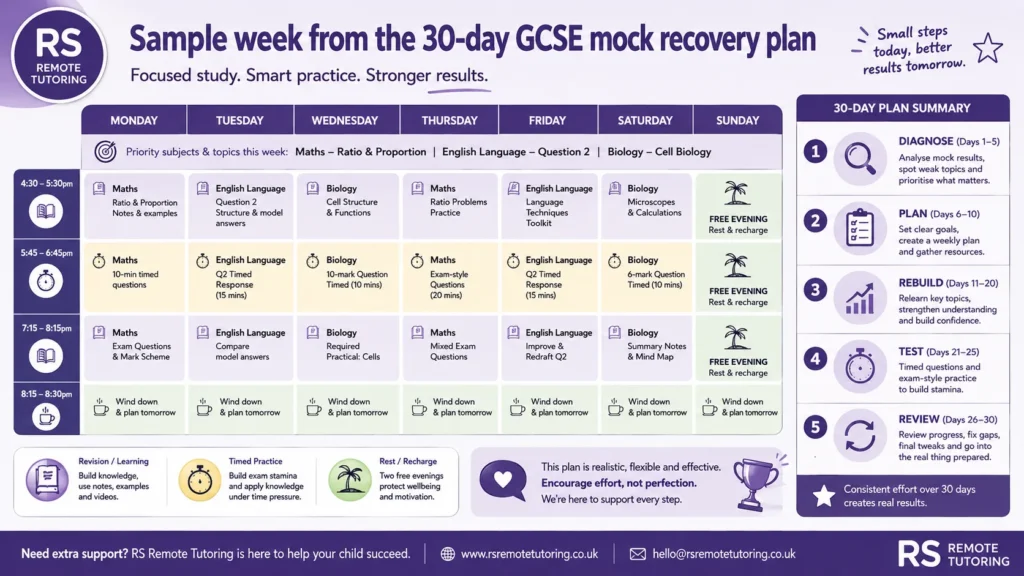
Here’s the full 30 days at a glance:
| Days | Phase | What happens | Parent’s role |
| 1 to 7 | Diagnose | Calm conversation, papers back, four-bucket analysis, teacher input | Lead gently, take notes |
| 8 to 14 | Plan | Pick 2 to 3 priority subjects, list target topics, build weekly timetable | Co-design, sanity-check the load |
| 15 to 21 | Rebuild | Active recall on gap topics, technique drills with mark schemes | Quiz for 10 minutes, protect the routine |
| 22 to 28 | Test | Timed past paper sections, self-marking, fix remaining weak spots | Print papers, time sections, stay calm |
| 29 to 30 | Review | Compare against mock performance, set the next 30-day cycle | Celebrate progress, adjust the plan |
Put the timetable somewhere visible, build in two completely free evenings a week, and agree up front what happens when a session gets missed. Missed sessions get moved, not stacked. Stacking is how plans die.
What Do Weeks Three and Four Look Like? (Days 15 to 28)
Weeks three and four are where marks are actually won: days 15 to 21 rebuild knowledge through active recall on the gap topics, and days 22 to 28 shift to timed past paper practice with self-marking, because retrieving under pressure is the skill the real exam tests.
The method matters more than the hours. Rereading notes and highlighting feel productive and achieve almost nothing, a finding that’s been replicated so many times it’s barely worth debating. What works is retrieval: flashcards, blurting (write everything you remember about a topic on a blank page, then check), practice questions, and teaching the topic back to you at the dinner table. If your child’s default mode is rereading a pristine folder of notes, that’s very possibly why the mocks went badly in the first place. A short detour through proven GCSE revision techniques like active recall and spaced repetition will repay itself within a week.
From day 22, past papers become the main event. Not full three-paper marathons every night, but timed sections: 25 minutes on a set of algebra questions, 45 minutes on an English Language Paper 1 Section A. Then, and this is the step most students skip, mark it against the official mark scheme and write down why each mark was lost. Working through GCSE past papers properly means the marking takes as long as the writing. That’s normal and it’s where the learning lives.
Your role in this fortnight is smaller and harder than in weeks one and two. Protect the routine, feed them, quiz them for ten minutes when asked, and stay off their back the rest of the time. Checking in twice a night reads as surveillance to a 15-year-old, and surveillance breeds secrecy, not marks.
Keep one eye on the calendar too. The GCSE exam timetable for 2027 means a student sitting mocks in December still has four to five months of runway. That’s two or three full 30-day cycles before the real papers. Frame it that way to your child. Time pressure is real but it is not a crisis.
When Should Parents Bring in Outside Help?
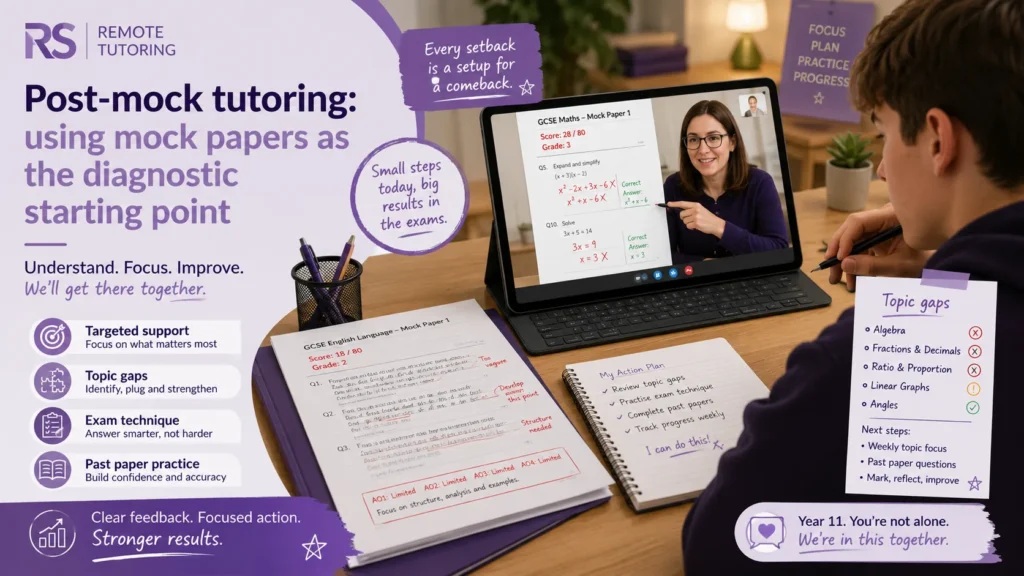
Bring in a tutor when the four-bucket analysis shows genuine knowledge gaps your child can’t close alone, when the same topic keeps failing despite honest effort, or when the parent-child revision dynamic has turned every session into an argument. Those three signals separate “needs support” from “needs more time”.
That last one is underrated. Plenty of capable parents make poor tutors for their own teenagers, not through lack of knowledge but because the relationship carries too much freight. A neutral third party can say “that answer wouldn’t score” without it landing as criticism from Mum.
The evidence on targeted tuition is solid rather than miraculous. The EEF’s one-to-one tuition research points to around five additional months of progress on average, with short, regular sessions over a defined period producing the best results. Notice how well that maps onto a mock recovery: a fixed block of weekly sessions aimed at named topics, starting in January, reviewed at Easter. That’s precisely the structure good GCSE revision tutoring is built around, a diagnostic first session, a topic-level plan, and past paper work under someone who knows the exam board’s mark schemes inside out.
Timing matters more than most parents realise. The post-mock window is the highest-value moment in the whole GCSE cycle to start tuition, because the mock papers hand the tutor a ready-made diagnosis, and there’s still enough runway for the work to compound. Leave it until after Easter and you’re paying the same money for half the effect. If you’re unsure whether your situation crosses the line, there’s a fuller checklist of signs your child needs a GCSE tutor worth ten minutes of your time.
One honest caution: a tutor is an accelerant, not a substitute. A weekly hour of tuition wrapped around zero independent revision moves nothing. The 30-day plan above still applies; tuition slots into weeks three and four as the expert layer on top.
How Do You Protect Your Child’s Wellbeing During the Recovery?
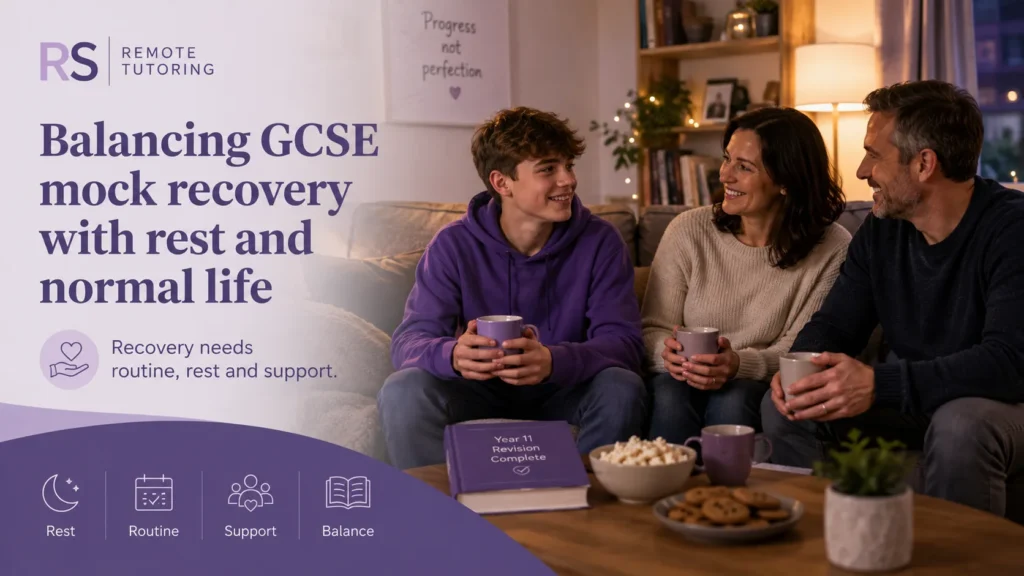
Protect wellbeing by keeping sleep at eight to nine hours, leaving friendships and one hobby untouched, and watching for warning signs like avoidance of a subject, headaches, or sleep problems, which signal it’s time to ease off rather than push harder.
The instinct after bad mocks is to cancel everything: football, weekend plans, screens, the lot. It backfires. Total lockdown raises anxiety, and anxious brains revise badly. The NHS guidance on helping your child beat exam stress makes the same point: balance, sleep and someone to talk to do more for exam performance than an extra hour of late-night cramming.
Watch your own language too, because children take their emotional cues from parents far more than either side admits. “We’ll sort this together” and “these grades don’t define you” cost nothing and change the atmosphere of a whole revision season. Comparing them to a sibling, a cousin, or “Priya next door who got all 8s” costs a lot.
And keep some perspective in your back pocket for the hard evenings. Students recover from bad mocks every single year. Grade 3s in January become grade 5s and 6s in August, quietly and unremarkably, in thousands of households. If the recovery cycle needs repeating, repeat it. Two 30-day cycles between January and May, with a structured plan for the final run-in to the exams, is a genuinely strong position, whatever December’s results letter said.
Frequently Asked Questions
Do Year 11 mock results affect sixth form applications?
Indirectly, yes. Teachers use mock results as one input when setting predicted grades, and sixth forms consider predictions when making offers. But predictions can rise if classwork improves after mocks, and final GCSE results in August are what offers are actually conditional on.
How much can a student improve between mocks and real GCSEs?
One to two grades per subject is common with consistent, targeted work, and schools report this pattern year after year. Bigger jumps happen, especially where the mock problem was exam technique or timing rather than deep knowledge gaps, because those fixes come quickly.
Should my child resit the mock exams?
Usually no. Formal resits eat revision time for little gain, since the diagnostic value is already in the marked paper. The exception is where a school offers a spring mock, which is worth taking seriously as a progress check for the recovery plan.
Is it too late to get a tutor after bad December or January mocks?
No, it’s close to the ideal moment. The marked mock papers give a tutor an instant diagnosis, and four to five months remain before the real exams, enough for weekly sessions to compound into one or two grades in a priority subject.
What if my child refuses to talk about the results?
Give it 48 hours, then try a side-by-side setting like a car journey rather than a face-to-face sit-down. Lead with a question about how the exams felt, not what the grades were. If the shutdown lasts weeks or comes with low mood, loop in the school’s pastoral team.
Should I take away my child’s phone until GCSEs?
Blanket bans tend to trigger conflict that costs more revision than the phone did. A better deal is phone-free revision sessions, agreed together, with the phone in another room, and free use in breaks. Most students accept that trade when they helped set it.

Raja specializes in Physics and Maths, with over 5 years of experience. He offers KS2, KS3, and GCSE Science and Maths lessons. He graduated from one of the top universities in the UK.