Your child revises for hours, knows the diagrams and can talk through the topic, yet the marked paper comes back with answers that are “not precise enough”. An A-Level Biology tutor from RS Remote Tutoring shows them how examiners want the answer worded, then practises it until the habit sticks.
Each hour is live on Zoom with only your child and the tutor, built around the specific Biology course your child’s school follows, from AQA to Salters-Nuffield. We cover biological molecules, cells, genetics, physiology and ecology, along with the data, maths and extended answers that decide the higher grades.
No card details for the trial. No obligation to continue.
Live one-to-one lessonsPersonal tutor matchingFree 30-minute trialEnhanced DBS checked tutorsTeaching since 2020
What lessons cover
What does A-Level Biology tutoring cover?
Our A-Level Biology tutoring covers the full course, from biological molecules and cells to genetics, physiology and ecology. Lessons also train the skills that separate grades: precise wording, data and statistics questions, practical theory and, on boards that set one, the extended essay.
Molecules, cells and genetics
Proteins, enzymes, DNA, cell structure, the cell cycle and immunity come early, and everything later depends on them. Genetics then adds inheritance crosses, mutation, gene expression and populations.
These topics punish loose language. Saying an enzyme is “killed” rather than denatured, or confusing a gene with an allele, costs marks that a tutor can stop your child losing.
Physiology and how organisms respond
Gas exchange, transport, respiration, photosynthesis, nerves, muscles and homeostasis are long processes with many steps. Students often know the start and the end but blur the middle.
We break each process into stages your child can explain in order, then test it with the kind of question that asks why one step matters.
Ecology, evolution and classification
Ecosystems, energy transfer, nutrient cycles, biodiversity, evolution and speciation all appear on the papers, often inside unfamiliar contexts.
Lessons practise applying familiar ideas to examples your child has never seen, which is what A-Level questions regularly ask them to do.
Data, maths and practical theory
Every board tests graphs, calculations, statistical tests and the method behind experiments. Many students lose more marks here than on content, especially when asked to describe a trend or evaluate a conclusion.
We work through real exam data, so your child learns to quote figures, spot anomalies and name the limits of a study.
Molecules, cells, genetics, physiology and ecology, taught one-to-one and matched to your child’s exam board.
Your board and papers
Which A-Level Biology course is your child taking?
A-Level Biology courses differ more than most: Pearson Edexcel and OCR each run two separate Biology specifications, and only some set an essay or a pre-released article. The coordinator checks the specification code before the trial so the tutor prepares the right papers.
All of these Biology courses are linear: your child sits three written papers at the end of Year 13. The differences that matter for tuition are how content is split, which papers carry essays or pre-released material, and how long each paper lasts.
Board and specification
How the written papers are set
AQA A-Level Biology (7402)
Paper 1 covers topics 1 to 4 and Paper 2 topics 5 to 8; Paper 3 draws on all eight and includes a 25-mark essay chosen from two titles. Each paper is two hours
Pearson Edexcel Biology A, Salters-Nuffield (9BN0)
Three two-hour papers; Paper 3 includes a section based on a scientific article released eight weeks before the exam
Pearson Edexcel Biology B (9BI0)
Paper 1 Advanced Biochemistry, Microbiology and Genetics and Paper 2 Advanced Physiology, Evolution and Ecology, 1 hour 45 minutes each; Paper 3, 2 hours 30 minutes
OCR A-Level Biology A (H420)
Two papers of 2 hours 15 minutes (Biological processes; Biological diversity) and a 1 hour 30 minute Unified biology paper that draws on every module
OCR Biology B, Advancing Biology (H422)
Advancing Biology is taught through contexts and has its own papers; name it on the form so we can confirm a tutor knows it
Practical endorsement
Signed off by your child’s teachers in the lab; it appears beside the A-Level grade as pass or not classified, not inside it
No online tutor can complete the endorsement for your child. What lessons cover is the practical knowledge examined on paper: core practical methods, apparatus choices, and how to analyse and evaluate biological results. If you are not sure which course your child takes, send the code from a mock paper and we will check it.
Year 12 and Year 13
What is different about Year 13 Biology compared with Year 12?
Year 12 lays the groundwork in molecules, cells, exchange and genetic information, while Year 13 adds energy transfer, control systems and gene expression, then tests both years together. Lessons follow the school’s teaching sequence, so new topics are practised while they are fresh.
Year 12: building precise foundations
The step up from GCSE is mostly in detail. Your child now needs to explain enzyme action, membrane transport and the immune response in exact language, often linked to a graph.
A typical Year 12 lesson might take the fluid mosaic model, then practise a data question on how temperature affects membrane permeability.
Year 13: longer processes and synoptic papers
Year 13 content such as respiration, photosynthesis, nerve impulses, homeostasis and gene expression is long and connected. The final papers mix it with Year 12 material, so revision has to keep both alive.
A typical Year 13 lesson might cover the stages of aerobic respiration, then a question asking why fewer ATP molecules are made without oxygen.
Essays and extended answers
Where the board sets an essay, as AQA does in Paper 3, we practise planning it in a few minutes, choosing relevant examples from across the course and keeping every paragraph biological rather than general.
The first lessons show which of these is costing your child the most marks.
Is it right for your child
Who is one-to-one A-Level Biology tuition for?
One-to-one A-Level Biology tuition suits students who know the content but lose marks on wording, who freeze on data and statistics questions, or whose mock grades fall below their offers. It also helps students aiming for an A or A* who need essay practice.
A private A-Level Biology tutor may help if your child:
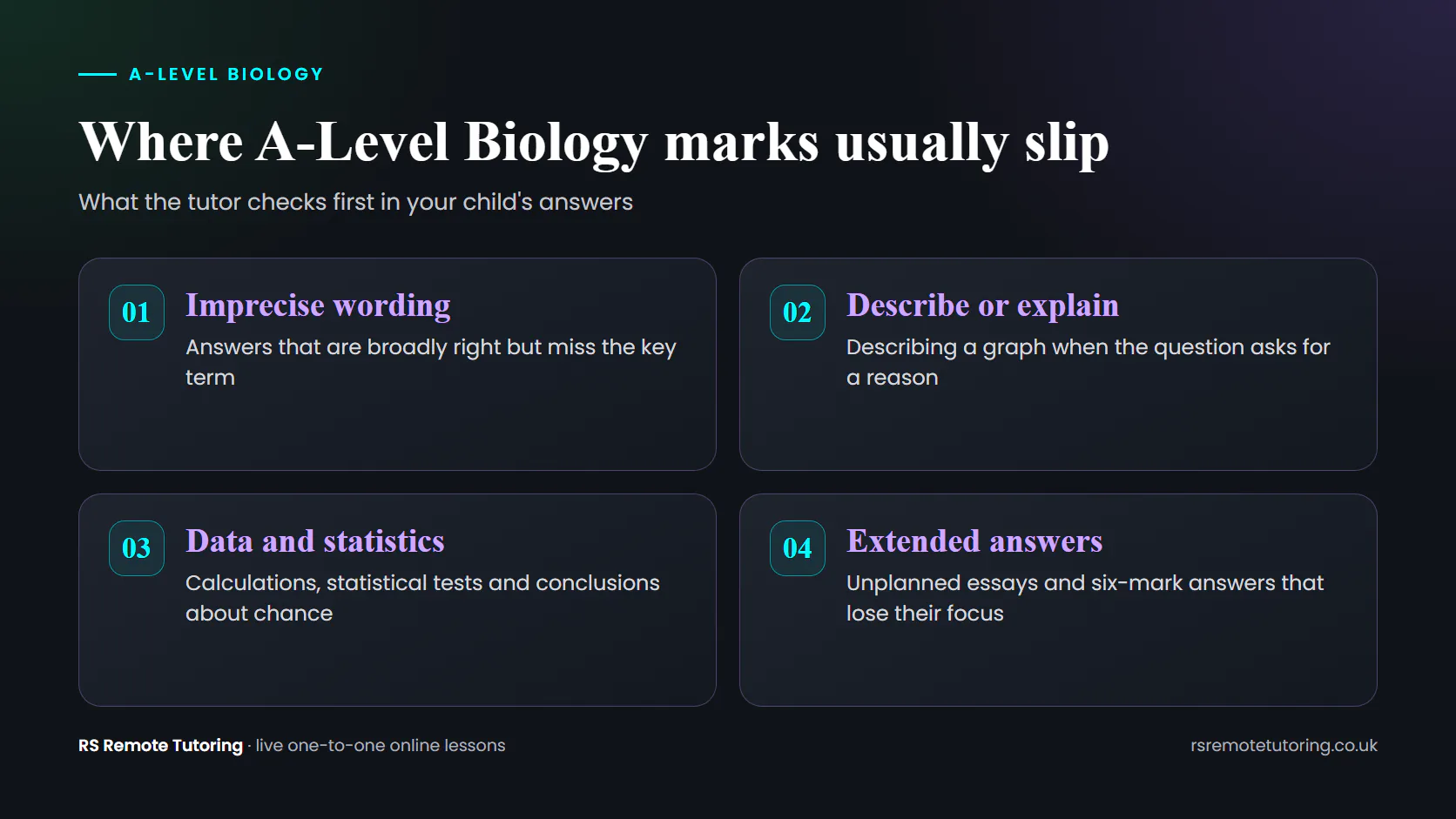
writes answers that are broadly right but lack the key terms;
describes a graph when the question asks them to explain it;
struggles with statistical tests, percentage change or magnification;
finds long processes such as respiration or the nervous system hard to sequence;
needs Biology for a university course and the mock grade is below the offer;
has never planned or timed an extended answer or essay.
The first lessons work out which of these applies. A student who knows everything but writes vaguely needs a very different plan from one who has fallen behind on Year 12 content.
Each lesson follows the same rhythm, so you can see progress from week to week.
Inside a lesson
What does a typical A-Level Biology lesson look like?
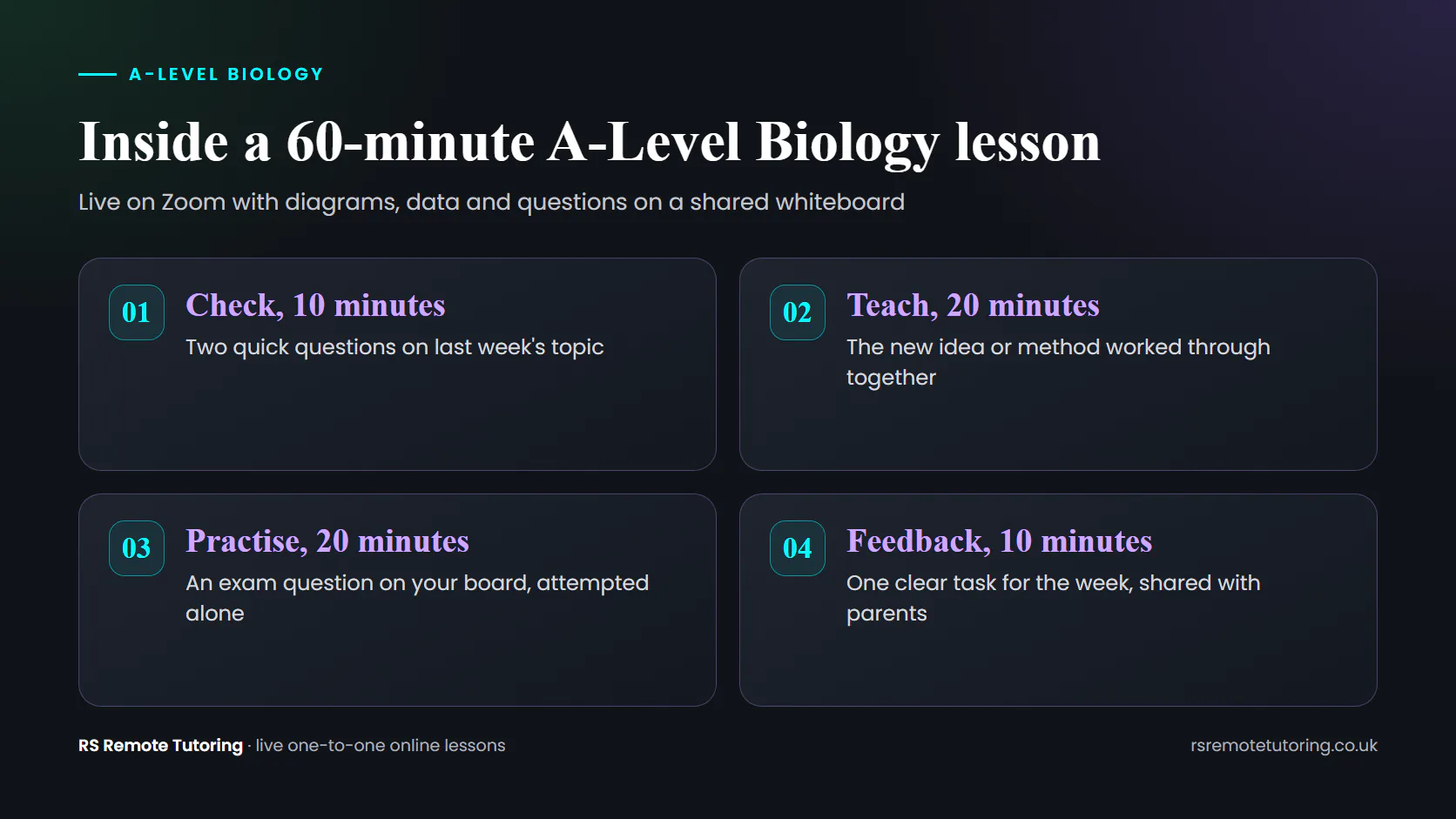
Picture one 60-minute Year 13 genetics hour on Zoom: a quick recap of dihybrid crosses, the chi-squared test worked through together on the whiteboard, an exam question your child does unaided, then feedback that reaches you as well.
CheckAbout 10 minutesTwo quick dihybrid cross questions from last week. If the expected ratio is wrong, the tutor fixes it first, because today’s test depends on it.
TeachAbout 20 minutesThe chi-squared test: stating the null hypothesis, calculating the value, using degrees of freedom and comparing it with the critical value. Your child does each step on the whiteboard.
PractiseAbout 20 minutesAn exam-style question with real cross data, attempted alone. The tutor watches the working and checks the conclusion is written in terms of chance.
FeedbackAbout 10 minutesWhether the null hypothesis and conclusion are now worded correctly, what still needs work, and one genetics question for the week. You receive the same note.
Lessons on content-heavy topics follow the same rhythm, with the practice stage used for a six-mark explanation or part of an essay plan. The tutor keeps a note of where marks go, so later lessons target the pattern rather than a single mistake.
Who teaches A-Level Biology
Who will teach my child A-Level Biology?
Three tutors cover A-Level Biology: a first-class dentistry graduate, a biotechnologist with examining experience, and a biochemist with a teaching degree. The coordinator picks the one whose strengths fit your child’s board and weak spots, and your child meets them in the free trial.
Mahin Khan
Biology and Science, to A-Level
BDS, First Class
5+ years online teaching
Mahin holds a first-class dental surgery degree and has taught online for more than five years. Her lessons focus on the precise wording that Biology mark schemes reward, and she also covers IGCSE and O-Level for families on international courses.
Priya Nair
Biology and Science, to A-Level
MTech Biotechnology
MA Education, University of Bath
Examining experience
Priya holds two Master’s degrees, an MTech in Biotechnology and an MA in Education from the University of Bath, and has examined at higher level. Knowing how answers are marked shapes how she prepares students in the final term. She also teaches IGCSE and IB.
Nadia Rahman
Science and Maths, GCSE and A-Level
MSc Biochemistry and Chemistry
B.Ed
8+ years teaching
Biochemistry is where Nadia’s MSc sits, and a B.Ed plus more than eight years of teaching shape how she explains it. She covers A-Level Biology and Chemistry, which suits students taking both and wanting one tutor for the overlap.
Mahin, Priya and Nadia each went through identity, certificate and reference checks before teaching for us, and all three hold a current enhanced DBS check for work with under-18s.
Four steps to start
How does booking an A-Level Biology tutor work?
Tell us where the Biology marks vanish, whether that is wording, data or the essay, and the coordinator proposes one tutor with a reason. After a free 30-minute trial, you and your child decide whether to carry on with weekly lessons.
Describe the lost marksFill in the trial form with your child’s year, exam board, latest and target grades, and the kind of question that goes wrong: six-markers, statistics, the essay or a topic such as the nervous system. Add when your child is free.
Get one suggested tutorOur coordinator weighs your answers against the strengths of Mahin, Priya and Nadia and suggests one of them, with the reason, so you are not comparing profiles yourself.
Try a free 30-minute lessonOver Zoom, your child answers a real A-Level Biology question, perhaps a data item or a six-mark explanation, while the tutor reads the wording. Nothing is paid and no card is taken.
Fix a weekly Biology slotWhen the trial suits, that tutor teaches your child at an agreed time every week. When it does not, we suggest another tutor at no cost.
Bring a marked Biology test or mock to the trial if you have one. The examiner’s comments show the tutor straight away whether the problem is knowledge, wording or data skills.
One 60-minute A-Level Biology lesson costs £30, whichever of the three tutors teaches it. Lessons drop to £27.50 each once your child books three or more a week, the annual plan paid upfront brings them to £25, and the trial is free.
Meet your tutor first
Free
30-minute one-to-one trial on Zoom
No card details. No obligation to continue.
Standard lesson
£30
60-minute one-to-one online lesson
The same rate for every tutor and every level.
Three or more a week
£27.50
Per 60-minute lesson
For families booking three or more lessons each week.
Annual plan
£25
Per 60-minute lesson, paid upfront
48 weekly lessons for £1,200.
For £30 a week, an AQA student in Year 13 can spend one lesson planning a 25-mark essay and the next writing and marking it, with no sign-up, matching or planning fees on top. The coordinator explains booking and rescheduling before you pay.
Biology marks often hinge on one missing key term, and a tutor who reads your child’s answers every week learns which terms they drop. You also get plain feedback after each lesson from a team that has taught UK students online since 2020.
The same tutor every week
Your child keeps one tutor at a fixed slot. That tutor learns which explanations your child gives well and which they rush, and builds on it each week.
Honest updates after lessons
Each lesson finishes with a note for you: the topic covered, which answers are becoming precise, which are still vague and what to practise. You never need to sit in on the Zoom call.
Vetted tutors and free rematches
Before anyone teaches, we see their ID, degree certificates and references, and an enhanced DBS check is required for anyone teaching under-18s. A pairing that is not working can be changed at any point, free, with no lessons lost.
A-Level Biology sits within our wider A-Level tutoring. Many Biology students also take Chemistry, and A-Level Chemistry tuition can run alongside with the same coordinator.
London and UK families
Do you teach A-Level Biology students outside London?
Yes. Lessons are online, so a student in Birmingham, Norwich or Exeter gets the same Biology tutors as one in Hounslow. We are a Feltham business in Greater London, and each weekly time is set around sixth form or college and the tutor’s availability.
Labelling a heart diagram or drafting a six-mark answer works best on a laptop, tablet or desktop computer with a camera; a phone will join but feels cramped. Normal home internet is fine, Zoom is free, and the tutor shares diagrams, graphs and exam questions on screen.
Biology enquiries are read around the clock, every day, and a WhatsApp message usually gets the quickest answer. Year 11 students can start with our GCSE Biology tutoring, which trains the exact terminology A-Level markers look for before Year 12 begins.
Common questions
Frequently Asked Questions
Common questions from parents about A-Level Biology tuition: the AQA essay, data skills, the practical endorsement, price and booking.
How much does an A-Level Biology tutor cost?
£30 per 60-minute lesson. Each lesson falls to £27.50 when three or more are booked in a week, and to £25 on the annual plan paid upfront. The free 30-minute trial needs no card.
Which exam boards do your A-Level Biology tutors cover?
AQA, Pearson Edexcel (both Biology A Salters-Nuffield and Biology B) and OCR. If the course is unclear, the front of a mock paper usually names it; send it over and we will pair your child with a tutor who knows that specification.
Can a tutor help with the AQA Biology essay?
Yes. We practise choosing between the two titles, planning quickly and picking examples from across the course, then writing paragraphs that stay specific. The tutor marks the plan and the writing during the lesson.
Do you help with data and statistics questions?
Yes. Lessons use real exam data for graph interpretation, percentage change, magnification and statistical tests such as chi-squared. Your child learns to quote figures and to explain a trend rather than only describe it.
Does an online Biology tutor cover practicals and the endorsement?
Lessons cover the practical knowledge the written papers examine: methods, apparatus and analysing biological data. The endorsement is signed off by your child’s school or college through lab work, so it cannot be done online.
How can a Biology tutor help in the run-up to mocks?
When you book, share the exam dates, the board and the weakest topics. Lessons then focus on the areas worth the most marks and on timed questions from your child’s papers.
Will my child see the same Biology tutor each week?
Yes. The tutor from the trial stays with your child at a fixed weekly time. If the pairing is not right, tell us and a different tutor is arranged at no cost.
How do we book an A-Level Biology trial?
On the trial form, set the level to A-Levels and the subject to Biology, then add the board, the hardest topic or skill and your child’s free times. We will suggest a tutor and confirm the trial slot.
Free 30-minute trial
Turn knowing the Biology into scoring the marks
Bring a marked paper or the topic your child dreads most. A free 30-minute trial with one of our A-Level Biology tutors shows where the wording, data or essay marks are going and what to tackle first.