Your child sits down to Maths homework, looks at a fractions question and says they don’t get it. Twenty minutes later the page is still blank. A KS3 Maths tutor from RS Remote Tutoring tracks down the step your child skipped, often back in Year 5 or 6, and reteaches it until they can make a start on their own.
Every lesson is a live Zoom hour with one tutor and one student in Year 7, 8 or 9. We work from the Maths topics on your child’s school calendar this term, so each hour pays off on the next homework sheet and the next class test.
No card details for the trial. No obligation to continue.
Live one-to-one lessonsPersonal tutor matchingFree 30-minute trialEnhanced DBS checked tutorsTeaching since 2020
What lessons cover
What does KS3 Maths tutoring cover?
KS3 Maths tutoring covers number, fractions, ratio, algebra, geometry, graphs and data, the same areas your child meets in Years 7 to 9. Lessons spend most time on the topic that is holding your child back, then practise it until they can work without help.
Number, fractions and percentages
Most KS3 Maths problems start here. We work on place value, negative numbers, the order of operations, and converting between fractions, decimals and percentages.
If your child still counts on their fingers or guesses with fractions, the tutor rebuilds the method from the point where it stops making sense. Everything later in KS3 depends on it.
Ratio, proportion and rates of change
Ratio questions look simple and catch many students out. Lessons cover sharing in a ratio, scaling a recipe, best-value comparisons, percentage change and speed.
Your child learns to set the numbers out in a table or bar model first, so the calculation follows rather than being guessed.
Algebra: expressions, equations and sequences
Algebra is where many Year 8 students decide they are not a maths person. We start with what a letter stands for, then move to simplifying, expanding brackets, solving equations and finding the rule in a sequence.
Each step is written down on the whiteboard, so the tutor can see exactly where a sign or a term goes missing.
Geometry, graphs and data
Geometry lessons cover angles, area, perimeter, volume, transformations and, by Year 9, Pythagoras’ theorem. Graph work moves from plotting coordinates to drawing straight lines from an equation.
Statistics and probability are included too: averages, charts and simple probability. These are often rushed at school and easy marks to win back.
Number, fractions, ratio, algebra, geometry and graphs, taught one-to-one for Years 7 to 9.
Year 7, 8 and 9
What does a KS3 Maths tutor do in each year?
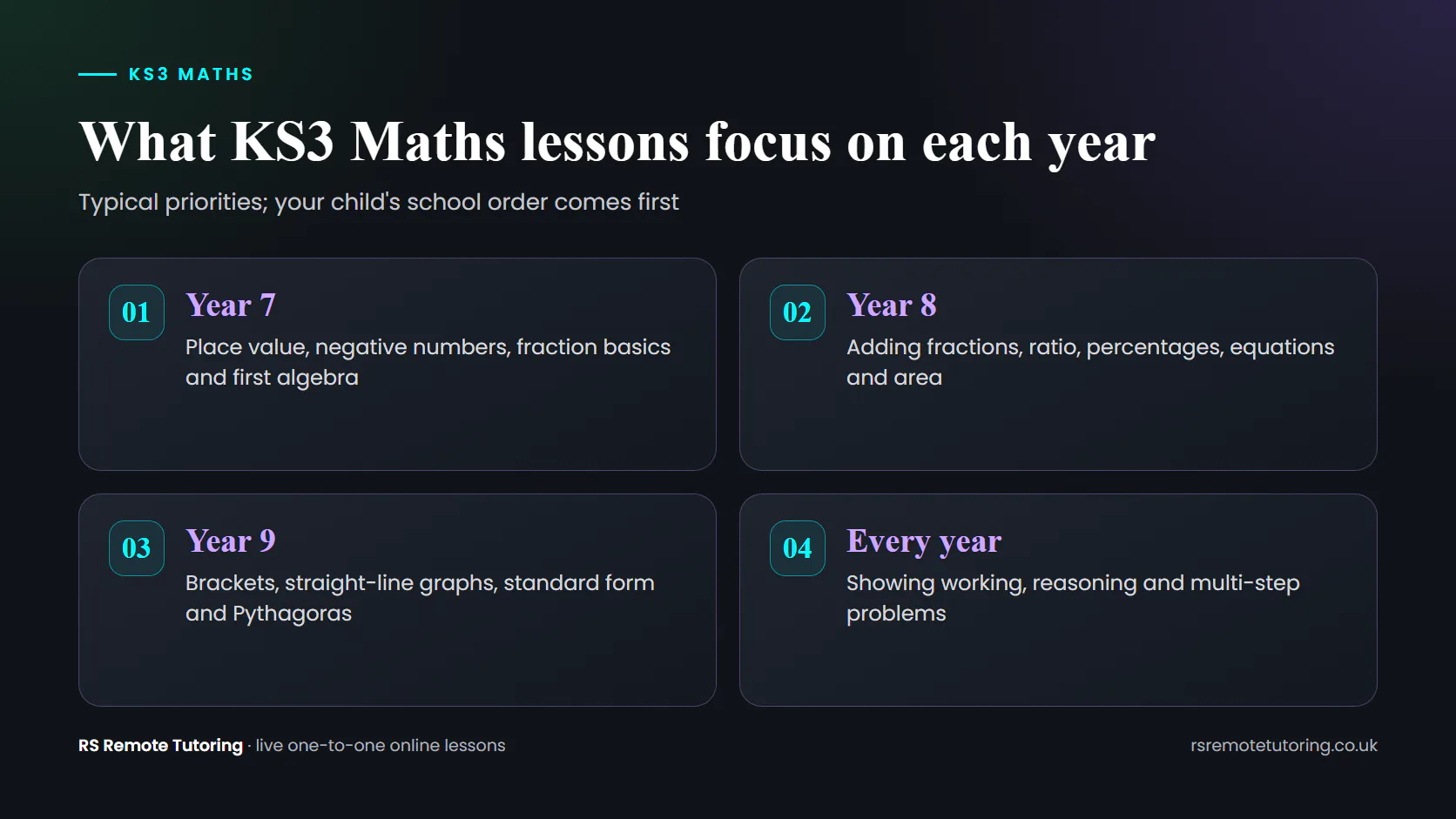
Each year of KS3 needs a different kind of help. Year 7 is about securing primary number skills, Year 8 about fractions, ratio and algebra holding up, and Year 9 about readiness for GCSE. Schools order topics differently, so we follow your child’s actual scheme.
Year 7: closing gaps from primary
The move to secondary school shows up any gaps from primary within a term. Year 7 lessons often go back to times tables, place value, negative numbers and fraction basics, then move forward to the first algebra your child meets in class.
A Year 7 maths tutor checks what is secure before teaching anything new. A typical lesson might take equivalent fractions, then use them to compare and order fractions on a number line.
Year 8: making the methods stick
Year 8 is when work gets harder and many students stop saying they are stuck. Lessons focus on adding and subtracting fractions, ratio, percentages, solving equations and the area of compound shapes.
A Year 8 maths tutor looks for the habit behind repeated mistakes. Is it the method, the arithmetic or a rushed reading of the question? Each needs a different fix.
Year 9: getting ready for GCSE
Year 9 content leads straight into GCSE. Lessons cover expanding two brackets, straight-line graphs, standard form, Pythagoras’ theorem and longer problems with several steps.
A Year 9 maths tutor also helps your child explain their working, which GCSE papers reward. When your child moves on, our GCSE Maths tutoring can continue with the same tutor.
The tutor adjusts these priorities to match the order your child’s school teaches.
Matched to school
How do lessons match what my child learns at school?
KS3 has no exam board. Schools teach the National Curriculum for Maths in their own order and sets, so lessons follow your child’s scheme of work. Share a recent homework sheet, test or topic list and the tutor plans around it from the first lesson.
The National Curriculum groups KS3 Maths into six content areas. It also expects students to become fluent, to reason mathematically and to solve problems. Here is how lessons approach each area.
Curriculum area
What your child practises in lessons
Number
Place value, negative numbers, powers and roots, fractions, decimals, percentages and mental methods
Algebra
Using letters, simplifying, expanding brackets, solving equations, sequences and straight-line graphs
Ratio, proportion and rates of change
Sharing in a ratio, scale, percentage change, best value and speed
Geometry and measures
Angles, area, perimeter, volume, constructions, transformations and Pythagoras’ theorem
Probability
Listing outcomes, probability scales and the chance of events happening
Statistics
Averages, range, charts and reading information from tables and graphs
Problem solving and reasoning
Choosing a method, showing each step and explaining why an answer makes sense
If your child is in a lower set and wants to move up, or a top set and finding the pace hard, tell us when you book. The tutor will look at the work their set is doing and plan around that, not a generic textbook.
Is it right for your child
Who is KS3 Maths tuition right for?
KS3 Maths tuition is a good fit for a Year 7, 8 or 9 student who started secondary behind, now dodges Maths homework, or repeats the same slips in every test. Confident students who want harder problems before GCSE benefit too.
A key stage 3 maths tutor can help if your child:
takes far longer over Maths homework than other subjects;
still finds fractions, negative numbers or times tables unreliable;
follows the teacher in class but cannot start a question alone;
has had test results drop since moving to secondary school;
says they hate Maths but cannot say which part is hard;
is coping well and wants stretch before starting GCSE.
KS3 is not examined, so gaps can sit unnoticed until Year 10. Fixing them now usually takes fewer lessons than fixing them under GCSE pressure later.
Inside a lesson
What does a Year 8 fractions lesson look like?
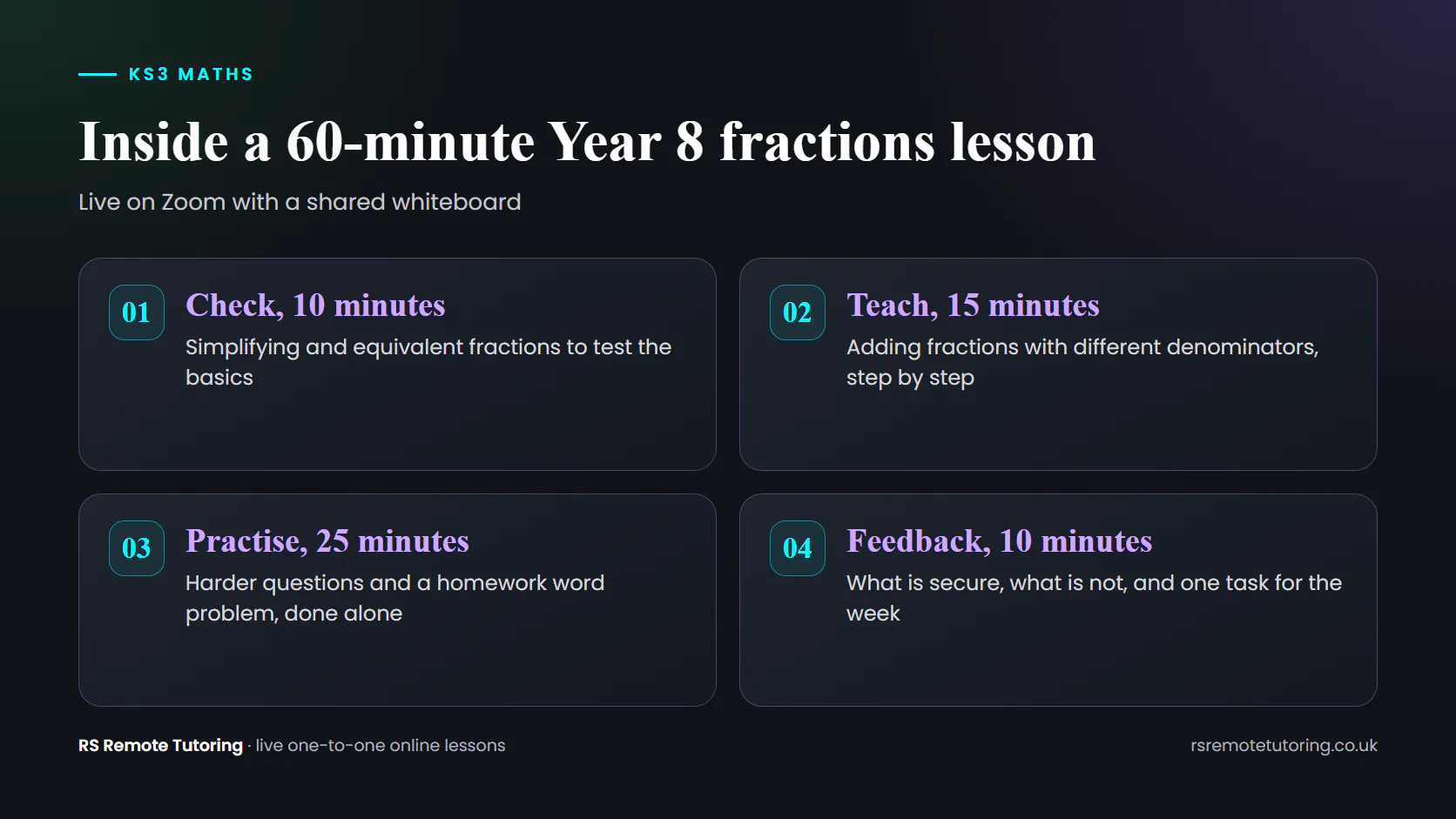
Our Year 8 fractions hour on Zoom opens with three warm-up questions on the whiteboard, then one method taught with a bar model, then a harder set your child tackles alone while the tutor reads every line, and closes with one homework target.
CheckAbout 10 minutesThree short questions, such as simplifying 12/18 and finding a fraction of an amount. Your child’s answers show whether equivalent fractions are secure before anything new is taught.
TeachAbout 15 minutesAdding fractions with different denominators, like 2/3 + 3/4. The tutor draws a bar model, then your child finds the common denominator and writes each step on the whiteboard.
PractiseAbout 25 minutesA set of questions that gets harder, ending with a word problem from the school’s homework. The tutor stops a line that goes wrong and asks what should come next.
FeedbackAbout 10 minutesA short recap of what is now secure and what still needs work, plus one task to practise. Parents get the same summary after the lesson.
The first lessons also show where marks are going. A child who adds the top and bottom numbers needs a different lesson from one who knows the method but slips on times tables.
Every lesson follows a similar rhythm, so you can see progress from week to week.
Who teaches KS3 Maths
Who will teach my child KS3 Maths?
All 16 of our Maths tutors teach KS3, including three qualified teachers and a primary-to-secondary transition specialist. The coordinator weighs your child’s year, maths set, confidence and your free times, and your child works with that tutor in the free trial before you commit.
Tamanna Hussain
KS3 Maths foundations
10+ years teaching
Primary and transition specialist
After ten years teaching Years 4 to 6, Tamanna knows exactly which primary skills a Year 7 is meant to arrive with. When a Year 7 or 8 student is working below age expectation, she is usually our first suggestion.
Imran Sadiq
Maths, KS3 to A-Level
PGCE Secondary Maths
Qualified teacher
Imran has spent his career in secondary and further education. Year 7 arithmetic and Year 9 algebra are familiar ground, and he marks your child’s working as they go.
Lily Chen
Maths, KS3 to A-Level
PGCE with QTS
Qualified teacher
Lily holds QTS and has taught in a mainstream secondary classroom. She is good at spotting the misconception behind a mistake your child keeps repeating.
Daniyal Hassan
Maths, KS3 and GCSE
QTS, secondary maths
BSc Accounting and Finance
Daniyal teaches through modelling and guided practice. He suits students who can follow a method in class but cannot yet explain why it works.
Each of these tutors showed us proof of identity, had their certificates checked against the qualifications they listed and gave references we followed up, all before a first Maths lesson. Anyone teaching under-18s, and so every KS3 student, holds a current enhanced DBS check.
Four steps to start
What happens after I ask for a KS3 Maths tutor?
Send your child’s year, set and the Maths topic causing tears at homework time. A coordinator suggests a single tutor and says why, your child tries a free 30-minute lesson that works as a gap check, and weekly Maths lessons begin only if you agree.
Share the last maths testOn the trial form, give the year group and set, the topic your child dreads, the mark from the last maths test if you have it, and the evenings that work.
Get one named tutorOur coordinator reads your note and picks one Maths tutor rather than sending a list, then tells you why that person suits your child’s year and set.
Free 30-minute gap checkOn Zoom, the tutor tries questions from below and at your child’s year level to find where the method breaks. No card is taken and there is nothing to cancel afterwards.
Settle into a weekly slotIf you’re happy, lessons continue with that tutor in one regular weekly slot. If the pairing feels off, the coordinator offers a different Maths tutor, free of charge.
Keep the latest homework sheet or marked class test beside the laptop for the trial. Real questions from school show the tutor where to begin and let you watch how they explain a method.
Each 60-minute one-to-one KS3 Maths lesson is £30, exactly what a GCSE or A-Level hour costs with us. With three or more lessons in a week, each costs £27.50, and the upfront annual plan brings it to £25. Your first 30 minutes cost nothing.
Meet your tutor first
Free
30-minute one-to-one trial on Zoom
No card details. No obligation to continue.
Standard lesson
£30
60-minute one-to-one online lesson
The same rate for every tutor and every level.
Three or more a week
£27.50
Per 60-minute lesson
For families booking three or more lessons each week.
Annual plan
£25
Per 60-minute lesson, paid upfront
48 weekly lessons for £1,200.
A Year 8 having one Maths lesson a week at £30 would spend £120 over a four-lesson month. We charge nothing to sign up, nothing for matching and nothing for the tutor’s planning time. Booking just a handful of lessons to sort out fractions or equations before a test is fine, and nobody will steer you towards a bigger plan.
Why trust RS Remote Tutoring with your child’s KS3 Maths?
Three things win parents over: one Maths tutor who learns which steps your child skips, lessons pinned to the school’s own topics instead of a separate course, and a plain update after each session. Founder Rumaan Aslam has led our online teaching since 2020.
One tutor who knows your child
Lessons happen with the same Maths tutor at the same time every week. By about the fourth session, that tutor can predict which step your child will rush and which method has finally clicked.
Updates without a fake score
Each lesson ends with a message to you: the topic covered, what your child now does unaided, what still trips them up and the practice set for the week. There’s no KS3 grade to quote, so we describe skills instead of inventing one.
Checked tutors and a free rematch
Every Maths tutor was vetted before their first lesson with us, and anyone teaching under-18s holds an enhanced DBS check. If your child doesn’t click with their tutor, we swap at no cost, whenever that happens.
One parent wrote: “My sons confidence in Maths has increased significantly.” She added: “I will be coming back for Math lessons for my son who is currently in year 8.” (Mali’ika, verified review). KS3 Maths is part of our wider KS3 tutoring, which also covers KS3 Science tuition and KS3 English tuition.
London and UK families
Can my child take online KS3 Maths lessons anywhere in the UK?
Yes. KS3 Maths lessons all run on Zoom, so a Year 7 in Cumbria joins in exactly the same way as one in Feltham, Greater London, where RS Remote Tutoring is based. We agree lesson times around school, clubs, homework and the tutor’s availability.
Kit-wise, any webcam-equipped laptop, desktop or tablet will do, plus ordinary home broadband and the free Zoom app. A phone will connect, but plotting a graph or lining up a column of fractions is far easier on a larger screen.
Some parents stay within earshot for the first session or two while their child gets used to working on screen. Most Year 7 to 9 students then concentrate better on their own, and the written update still reaches you after every lesson. A recording of a Maths lesson can be arranged if you ask, subject to safeguarding, privacy and consent.
Common questions
Frequently Asked Questions
Quick answers for parents on KS3 Maths: which years we teach, falling behind after primary, homework help, tutors, cost and booking the free trial.
How much does a KS3 Maths tutor cost?
Each 60-minute KS3 Maths lesson costs £30, which is also our GCSE and A-Level rate. Choosing three or more weekly lessons cuts each to £27.50, and the annual plan, paid upfront, takes it to £25. The first 30 minutes are free, with no card needed.
Which years do your KS3 Maths tutors teach?
Years 7, 8 and 9, so students aged 11 to 14. The focus shifts as they move up: number skills in Year 7, fractions, ratio and algebra in Year 8, and readiness for GCSE in Year 9.
My child is behind after primary school. Can you help?
Yes. Tamanna Hussain, who taught Years 4 to 6 for ten years, is often our match for a Year 7 or 8 student below age expectation. She goes back to the missing skill, then builds forward to whatever the class is doing now.
Will lessons follow what my child is doing at school?
Yes. There’s no exam board at KS3, so the tutor works from your child’s own Maths scheme of work and set. Send a homework sheet, a test or the topic list and lessons will track the class.
Is one lesson a week enough for KS3 Maths?
For most students it is. Gaps at KS3 are usually narrower than they feel at the kitchen table, and a term of weekly lessons tends to show in homework and confidence. If your child is far behind, the tutor will tell you honestly after the trial.
Does my child see the same Maths tutor each week?
Yes, at the same time each week, which lets the tutor build on last week’s work. Should the pairing not work out, a quick message gets your child a new tutor at no cost, and no paid lessons are lost.
Can the tutor help with Maths homework?
Yes, but the aim is the method behind it. Your child does the working with guidance, so they can do the next question alone. The tutor will not simply hand over answers.
How do I book a free KS3 Maths trial lesson?
Fill in the trial form with KS3 as the level and Maths as the subject. Add the year group, the topic that’s causing trouble and the times you can do, and our team will come back with a tutor and a time, usually within minutes.
Free 30-minute trial
Fix the Maths gap while it is still small
Start with the topic that turns homework into a battle. In a free 30-minute session, a matched KS3 Maths tutor pinpoints the missing step and sketches out the next few weeks.