Your child got a good grade at GCSE, then hit Year 12 and found that the algebra suddenly carries everything. A single slip in rearranging now costs a whole calculus question. An A-Level Maths tutor from RS Remote Tutoring traces those lost marks back to the line where the working went wrong, then drills that step until it holds inside full-length questions.
Each lesson is a live Zoom hour with only your child and the tutor, set to the three papers their board will put in front of them and the grade they are aiming for. Our A-Level Maths tutoring covers pure maths, statistics and mechanics, with corrections made while your child works, not in a report a week later.
No card details for the trial. No obligation to continue.
Live one-to-one lessonsPersonal tutor matchingFree 30-minute trialEnhanced DBS checked tutorsTeaching since 2020
What lessons cover
What does A-Level Maths tutoring cover?
Our A-Level Maths tutoring covers the full course: pure maths, statistics and mechanics. Most time goes where your child is losing marks, which is usually algebra inside longer problems. Every topic is practised through exam-style questions, with corrections made during the lesson.
Pure maths: algebra, functions and calculus
Pure maths makes up most of the marks on every board, and the rest of the course leans on it. We work on algebra and functions, coordinate geometry, sequences and series, trigonometry, exponentials and logarithms, differentiation and integration.
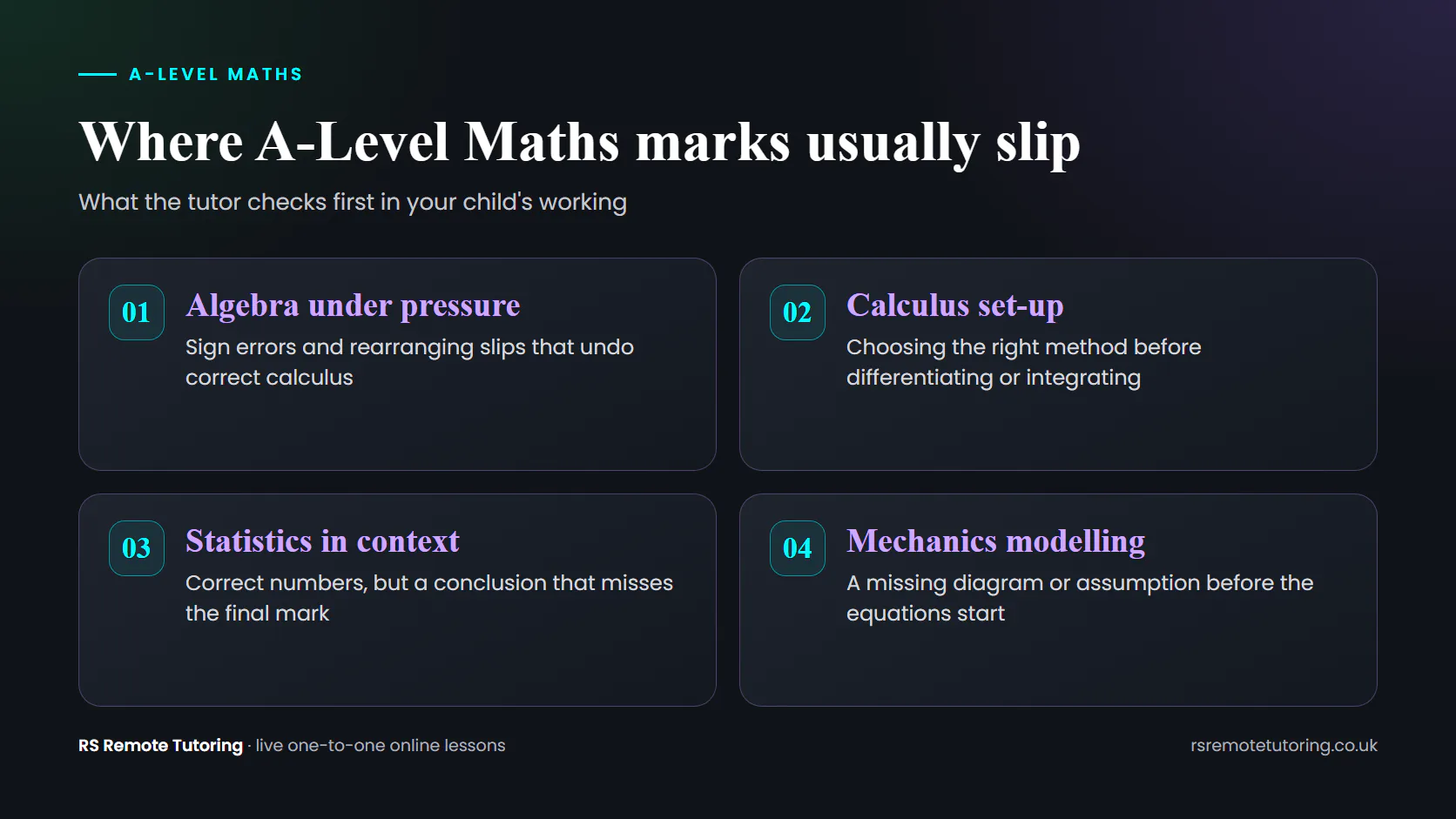
When a calculus answer goes wrong, the cause is often earlier: a sign error, a fraction rearranged badly or an index law misremembered. The tutor watches the working and stops at that step.
Statistics: data, probability and hypothesis tests
Statistics questions reward reading the context as much as the calculation. Lessons cover sampling, data presentation, probability, the binomial and normal distributions and hypothesis testing, including how to word a conclusion so it earns the final mark.
Questions can also draw on the large data set your child studied in class, so we practise interpreting it rather than memorising it.
Mechanics: modelling motion and forces
Mechanics is where many strong students lose confidence, because the maths is fine but the diagram is not. We practise kinematics, forces and Newton’s laws, and moments, starting every problem with a clear diagram and a stated modelling assumption.
Once the set-up is right, the equations usually follow. That habit is what the tutor checks first.
Proof, problem solving and exam technique
A-Level papers include proof and unstructured problems that do not tell your child which method to use. We work on choosing a starting point, setting out each line so method marks are secured, and checking an answer against the question.
As mocks get closer, the tutor switches to timed sets drawn from your child’s own board, so the pace of a two-hour maths paper stops feeling unfamiliar.
Pure maths, statistics and mechanics, taught one-to-one and matched to your child’s exam board.
Your board and papers
Which A-Level Maths papers will your child sit?
Every board sets three A-Level Maths papers, but AQA, Pearson Edexcel and OCR place statistics and mechanics in different papers. Tutors work from your child’s own specification, so the practice questions look like the ones on exam day.
All three main boards set three written papers for A-Level Maths, with calculators allowed. What changes is where statistics and mechanics appear, which affects how revision is planned in Year 13.
Board and specification
How the papers are split
AQA A-Level Mathematics (7357)
Paper 1 Pure Mathematics; Paper 2 Pure Mathematics and Mechanics; Paper 3 Pure Mathematics and Statistics
Pearson Edexcel A-Level Mathematics (9MA0)
Paper 1 and Paper 2 Pure Mathematics; Paper 3 Statistics and Mechanics; each paper two hours
OCR A-Level Mathematics A (H240)
Paper 1 Pure Mathematics; Paper 2 Pure Mathematics and Statistics; Paper 3 Pure Mathematics and Mechanics
Large data set
Statistics questions can refer to the data set your child’s board publishes and the school studies in class
Not sure of the board
Photograph the front of a maths mock or send the course title, and our coordinator will work out the specification
Our tutors work across AQA, Pearson Edexcel and OCR. Further Maths, an international A-Level or any other maths specification needs a quick tutor check first, so mention it on the enquiry form and we will confirm cover before a trial goes in the diary.
Year 12 and Year 13
How does A-Level Maths change from Year 12 to Year 13?
Year 12 is about making GCSE algebra hold up under harder content, while Year 13 adds the heavier calculus and puts every topic under exam conditions. The tutor follows your child’s school teaching order, so lessons support class work rather than racing ahead.
Year 12: building the foundations properly
The jump from GCSE is real. Indices, surds, quadratics and straight-line work now appear inside bigger questions, so small gaps start costing marks. Early Year 12 lessons often spend time making that algebra automatic.
A typical Year 12 lesson might take differentiation from first principles, then use it to find stationary points and explain what the gradient means.
Year 13: harder pure and full papers
Year 13 brings integration by parts and substitution, parametric equations, further trigonometry and harder statistics and mechanics. Lessons keep the new content moving while revisiting Year 12 topics that will appear on the same papers.
One Year 13 hour might open with a substitution integral and finish on a mixed question where that integral only appears once a trig identity has been applied.
Retakes and late starts
Some students are retaking the qualification or start support late in Year 13. With fewer weeks to work with, the tutor ranks topics by how many marks your child drops on each, then moves to full timed papers and the line-by-line layout that keeps method marks safe even when a final answer is wrong.
The first lessons identify which of these is costing your child the most marks.
Is it right for your child
Who is one-to-one A-Level Maths tuition for?
One-to-one A-Level Maths tuition suits students who understand lessons at school but lose marks in their own working, find mechanics or statistics confusing, or need a steady plan before mocks. It also helps students aiming at the top grades who need harder practice.
Your child may benefit from a private A-Level Maths tutor if they:
follow the teacher’s examples but cannot start a question on their own;
make algebra slips that undo otherwise correct calculus;
struggle to draw a mechanics diagram or state a modelling assumption;
get the statistics calculation right but word the conclusion badly;
are aiming for an A or A* and need unstructured problem-solving practice;
have mock results that do not match the grade their offers require.
We start with whatever is not working. A student who freezes on proof needs a very different lesson from one who knows the methods but runs out of time.
Each lesson follows the same rhythm, so progress is easy to see from week to week.
Inside a lesson
What does a typical A-Level Maths lesson look like?
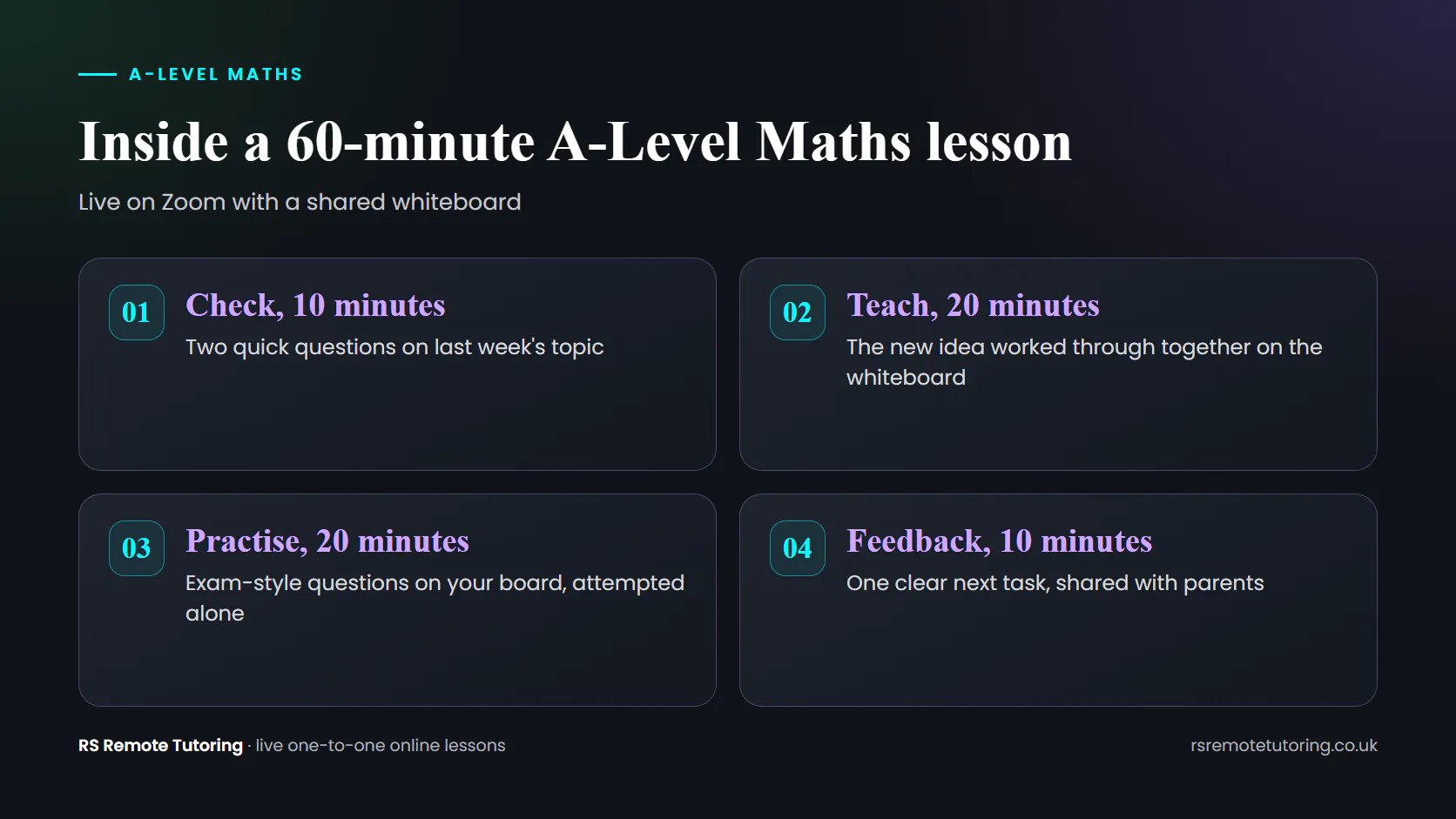
Each A-Level Maths lesson is a 60-minute Zoom session built around the whiteboard. It opens with a quick recall check, moves to the new method, then gives your child exam questions to attempt solo while the tutor follows every line of algebra.
CheckAbout 10 minutesTwo short questions on last week’s topic. If the method has slipped, the tutor fixes it now rather than building on a weak step.
TeachAbout 20 minutesThe new idea, explained and worked through together, with your child doing the algebra on the whiteboard rather than watching.
PractiseAbout 20 minutesExam-style questions on your child’s board, attempted alone. The tutor stops a line that is going wrong and asks what should come next.
FeedbackAbout 10 minutesThe tutor names the method that is now secure, the one that is still shaky and a short set of questions for the week. Parents get the same summary.
Your child’s first few lessons double as a map of where marks leak. The tutor notes where marks go, whether that is algebra, a misunderstood topic or exam technique, and plans the following weeks around it.
Who teaches A-Level Maths
Who will teach my child A-Level Maths?
Our A-Level Maths tutors include two qualified secondary teachers and a mathematician who has taught at undergraduate level. The coordinator picks one for your child by board, target grade and the hours you have free, and you watch them teach in the trial.
Imran Sadiq
Maths, KS3 to A-Level
PGCE Secondary Maths
Qualified teacher
Imran’s teaching career has run through secondary schools and further education, so he sees exactly which GCSE habits follow a student into calculus. He covers pure and applied A-Level content against the specification and marks each line as your child writes it.
Asia Ashraf
Maths and Statistics, up to A-Level
MS Mathematics
6+ years teaching
With teaching experience at secondary and undergraduate level, Asia treats A-Level content as familiar territory. Students who have given up on algebraic manipulation, calculus or statistics are the ones she works with best.
Lily Chen
Maths, KS3 to A-Level
PGCE with QTS
Qualified teacher
Lily holds QTS, has taught in secondary classrooms and takes A-Level Maths students on request. Her strength is catching a misconception early, before it hardens into a habit that costs marks on every paper.
Imran, Asia and Lily each passed identity, certificate and reference checks before their first lesson with us. Because they teach learners under 18, each one holds a current enhanced DBS check.
Four steps to start
How do you set up A-Level Maths lessons for your child?
Send us the board, the year group and the topic that keeps costing marks. We reply with one A-Level Maths tutor and why we chose them; your child has a free 30-minute lesson with them, and weekly lessons start only if the pairing works.
Name the topic that slipsThe trial form asks for the basics. Add Year 12 or Year 13, the board, the last mock grade against the grade needed, and where the working collapses: integration, mechanics diagrams, hypothesis tests or something else.
Get one named maths tutorOur coordinator reads it and proposes a single tutor, with a short reason linked to what you told us, so you are not left comparing profiles.
Try a free 30-minute lessonIn the trial your child solves an A-Level question on the whiteboard while the tutor watches how it is set out. No card is taken, so nothing needs cancelling afterwards.
Settle into a weekly slotHappy with the fit? Your child stays with that tutor in a fixed weekly slot. Not quite right? A different maths tutor is lined up at no charge.
A marked mock script or a calculus homework your child got stuck on is the most useful thing to bring, because the tutor can start from real working instead of guessing.
Each 60-minute A-Level Maths lesson is £30, the same as our KS3 and GCSE hours. Three or more lessons a week drop to £27.50 apiece; the annual plan, paid upfront, is £25 a lesson, and the 30-minute trial costs nothing.
Meet your tutor first
Free
30-minute one-to-one trial on Zoom
No card details. No obligation to continue.
Standard lesson
£30
60-minute one-to-one online lesson
The same rate for every tutor and every level.
Three or more a week
£27.50
Per 60-minute lesson
For families booking three or more lessons each week.
Annual plan
£25
Per 60-minute lesson, paid upfront
48 weekly lessons for £1,200.
A weekly hour through Year 12 and Year 13 costs £120 over four weeks, with nothing added for matching, signing up or the tutor’s planning time. Some families add a second weekly lesson as the summer papers approach, and the coordinator talks through booking and rescheduling before any money changes hands.
What makes RS Remote Tutoring a good fit for A-Level Maths?
A maths tutor who sees your child’s working every week spots the same slip before it costs marks again. We pair that continuity with plain updates after each lesson, and have taught UK students online since 2020 under founder and head tutor Rumaan Aslam.
One maths tutor, one weekly slot
Your child works with the same tutor at the same time each week. By the third or fourth lesson that tutor knows whether the trouble is sign errors, integration choices or mechanics set-up, knowledge a rotating cast would have to rebuild.
Updates you can act on
After every lesson you get a short note: the topics covered, which methods are getting stronger, which still are not and the questions to try before next week. It’s written for parents, so there is no jargon and no colour-coded chart.
Vetted tutors and a free rematch
Nobody teaches for us until we have seen ID, original certificates and references, and tutors of under-18s also hold a current enhanced DBS check. If the match stops working, we switch tutor at no cost and your child loses no lessons.
Can students outside London take A-Level Maths lessons?
Yes. Lessons happen on Zoom, so a sixth former in Leeds, Cardiff or central London can work with the same tutors. Our base is in Feltham, Greater London, and the weekly slot is set around the school timetable and when the tutor is free.
For written maths, a laptop or tablet with a webcam is the practical minimum; a phone connects, but setting out an integral on one is painful. Ordinary home broadband is enough, Zoom costs nothing and the whiteboard opens in a browser tab, so there is no extra software to buy.
If your child is still closing gaps from Year 11, our GCSE Maths tutoring uses the same approach and can run alongside A-Level preparation.
Common questions
Frequently Asked Questions
Questions parents ask before booking A-Level Maths support: cost, boards, Year 12 timing, mocks and how the trial works.
How much does an A-Level Maths tutor cost?
£30 for each 60-minute lesson. If your child has three or more lessons a week, the rate drops to £27.50, and paying a year upfront on the annual plan makes it £25. The 30-minute trial costs nothing and needs no card.
Which exam boards do your A-Level Maths tutors cover?
AQA, Pearson Edexcel and OCR. If you are unsure which one your child sits, a mock paper usually shows it, and we will pick a tutor who knows how that board splits pure, statistics and mechanics.
Can a tutor help with both pure and applied maths?
Yes, the tutor teaches all three strands. Time is weighted towards whichever one is dropping marks, so a student who is solid on pure but lost in mechanics will spend more lessons on force diagrams.
Should my child start A-Level Maths tuition in Year 12 or wait?
It often helps most in Year 12, because Year 13 content builds on it. Starting early gives time to secure the algebra and calculus that every later paper relies on, before exam pressure arrives.
Is it too late to get a maths tutor before the summer papers?
No. When you book the trial, list the exam dates, the board and the topics your child avoids; the tutor then starts on the highest-mark topics before moving to timed past-paper questions.
Does my child keep the same maths tutor all year?
Yes. The tutor you meet in the trial teaches every weekly lesson at the slot you agree. If the pairing is not working, say so and we will find another maths tutor at no cost.
Can lessons use my child’s school homework and marked mocks?
Yes. Recent homework, school feedback and mock papers show the tutor exactly where marks are being lost. Your child works through the question with guidance and corrections during the lesson.
How do we book an A-Level Maths trial?
Fill in the trial form, picking Maths in the subject field and A-Levels in the level field, then mention the board, the topic giving most trouble and when your child is free. The coordinator matches a tutor and confirms a time with you.
Free 30-minute trial
Find the step that keeps costing your child marks
Start with the topic or paper that worries your child most. In a free 30-minute trial, an A-Level Maths tutor works through it with your child and tells you which step is leaking marks and how the coming weeks would tackle it.