Enquiries answered 24/7, we usually reply within minutes +44 7377 137585 WhatsApp admin@rsremotetutoring.co.uk
Online tutoring across the UK
Hiring tutors Book Free Trial

One-to-one online KS3 English tuition for Years 7 to 9

KS3 English Tutor Online

Secondary school English asks for something new almost overnight: read a whole novel, find evidence, then explain it in a proper paragraph. That jump is where a KS3 English tutor from RS Remote Tutoring comes in, sorting out reading, grammar, vocabulary and paragraph writing while Years 7 to 9 still leave time to fix them.

Each lesson is a live Zoom session with one tutor, planned from this term’s class novel, play or poetry unit. Our KS3 English tuition covers comprehension, analytical paragraphs and creative writing for Year 7, Year 8 and Year 9, with written work corrected as your child writes.

No card details for the trial. No obligation to continue.
Live one-to-one lessonsPersonal tutor matchingFree 30-minute trialEnhanced DBS checked tutorsTeaching since 2020

What lessons cover

What does KS3 English tutoring cover?

KS3 English tutoring covers the four skills secondary English is built on: reading comprehension and inference, grammar and vocabulary, analytical paragraphs about texts, and creative writing. Lessons follow the novel, play or poems your child’s class is studying, so tutoring supports school work directly.

Reading comprehension and inference

Many students can read the words but miss what a writer suggests. Lessons practise reading between the lines: how a character feels, why a detail matters and which words prove it.

Your child reads short extracts aloud and discusses them with the tutor, which builds fluency as well as understanding.

Grammar, punctuation and vocabulary

Sentence control decides how clear a piece of writing is. We work on sentence boundaries, commas, apostrophes and paragraphing, using your child’s own writing rather than worksheets.

New vocabulary comes from the texts your child reads, so words are learned in context and then used in their own sentences.

Analytical paragraphs

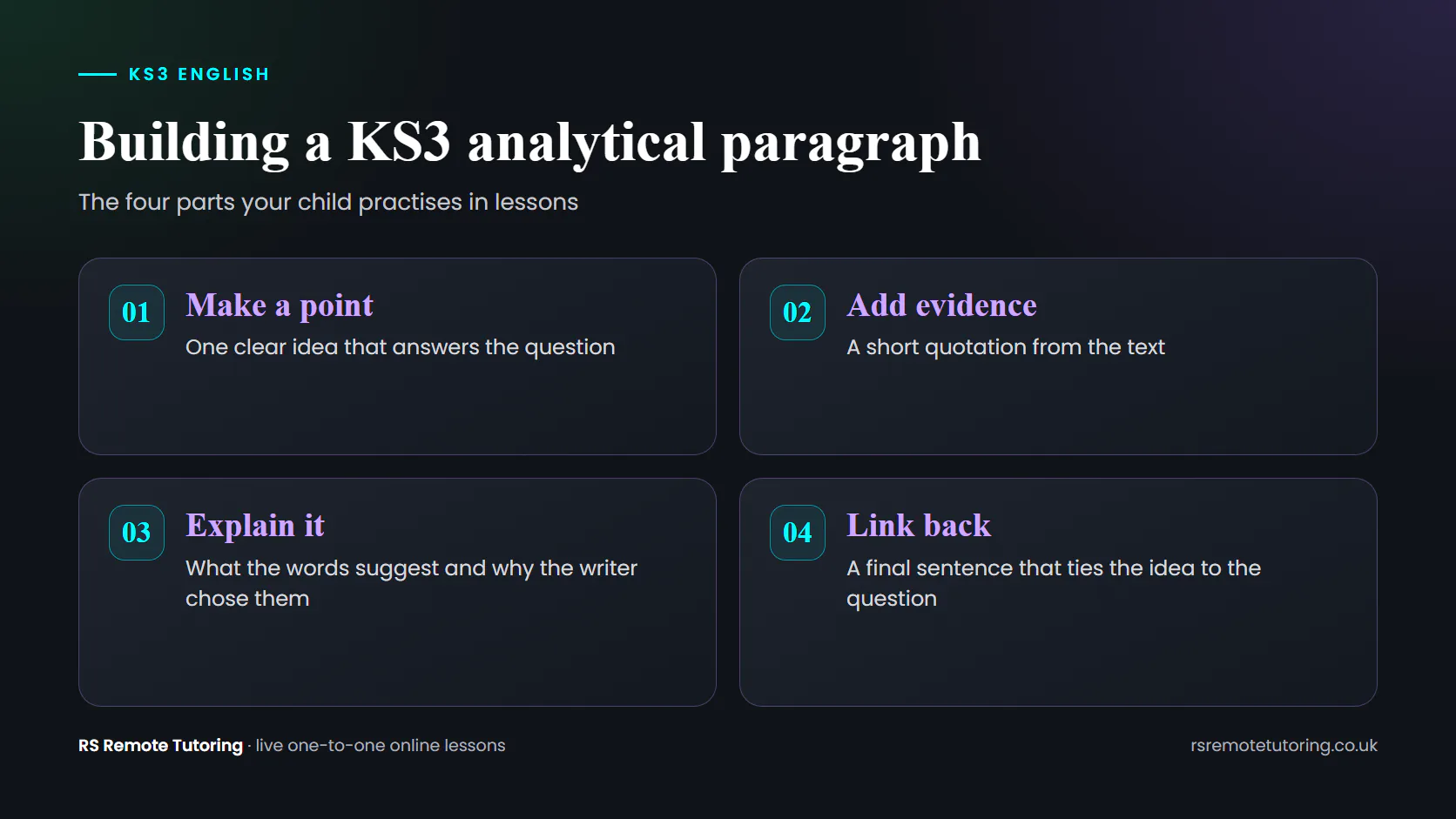
From Year 7, schools expect a paragraph that makes a point, supports it with a quotation and explains it. Your child learns to do that in whatever structure the school uses.

The tutor pays most attention to the explanation, because that is where a paragraph moves from describing to analysing.

Creative and descriptive writing

Stories and descriptions improve with a few practised techniques: a strong opening, varied sentences and precise detail. Lessons build these one at a time.

Your child drafts in the lesson, gets live feedback and redrafts, which teaches the planning and editing habits the curriculum asks for.

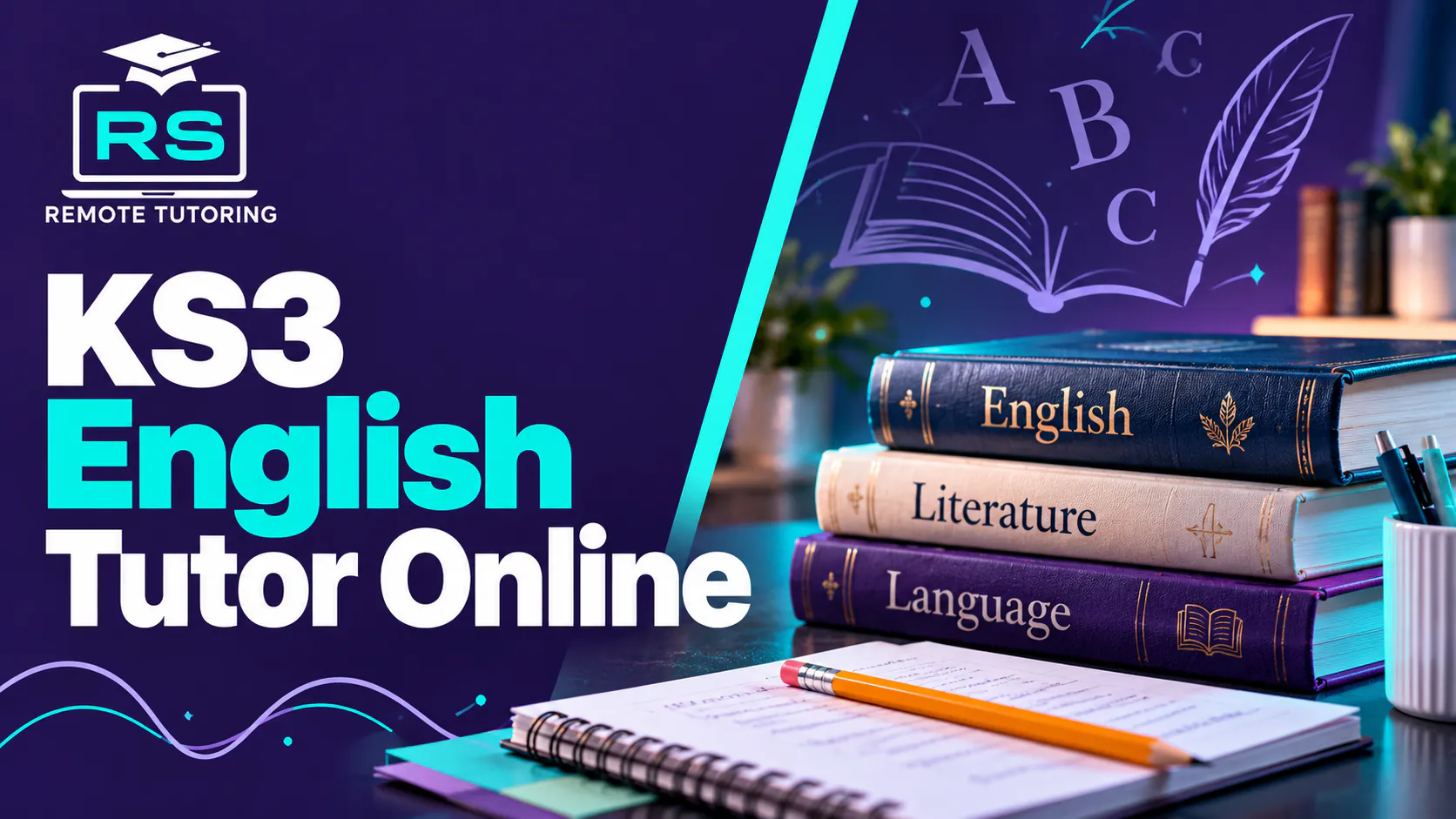
RS Remote Tutoring banner reading KS3 English Tutor Online, with books labelled English, Literature and Language, a spiral notebook and a pencil
Reading, grammar and writing for Years 7 to 9, taught one-to-one around your child’s school topics.

Year 7, Year 8 and Year 9

What changes between Year 7, Year 8 and Year 9?

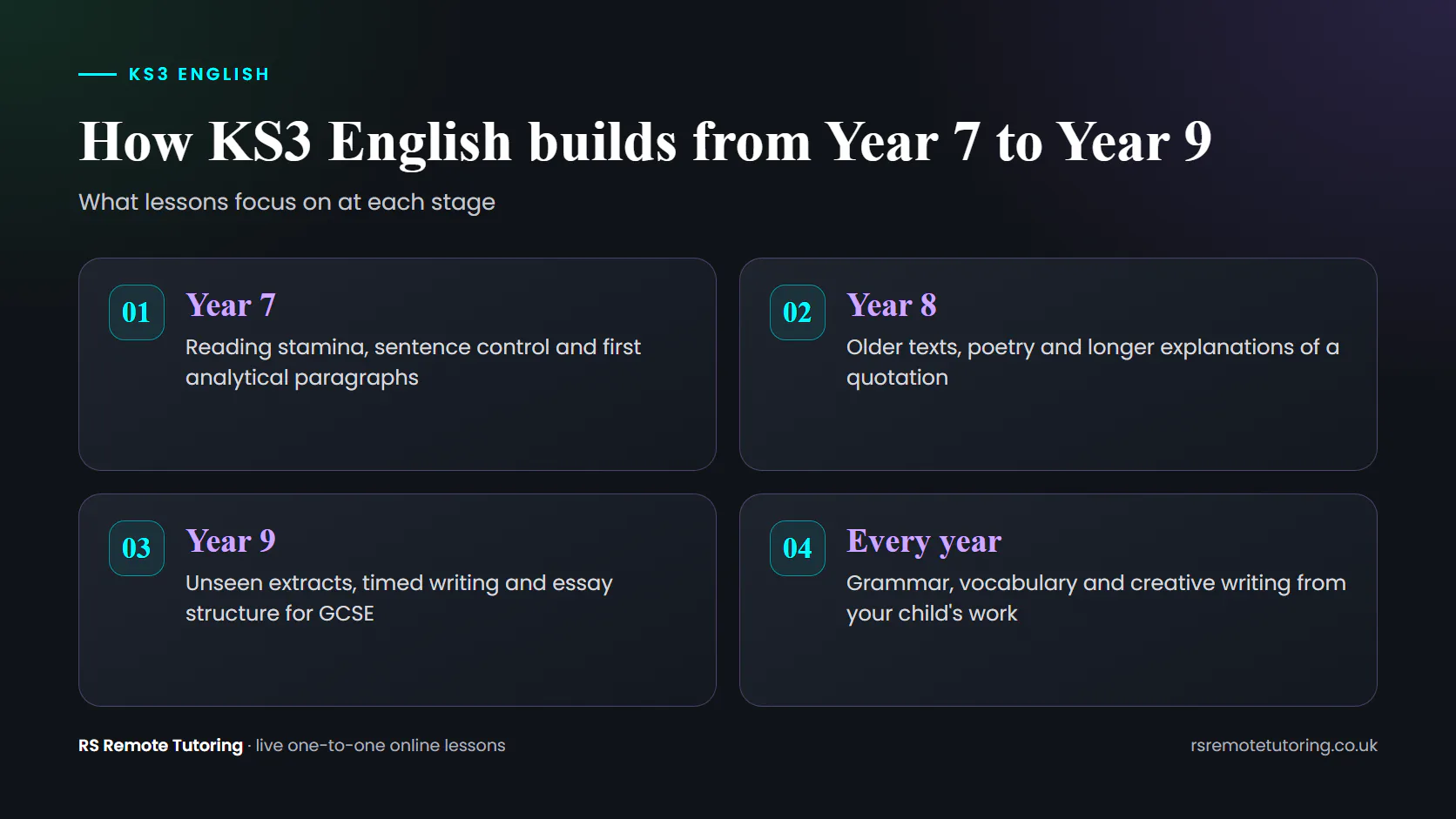
Year 7 is about settling into secondary reading and writing, Year 8 adds longer analysis and harder texts, and Year 9 prepares the skills GCSE English will test. The tutor starts from your child’s year, this term’s topic and how secure the basics are.

Year 7: settling the basics

The move from primary often exposes gaps in reading stamina, spelling or sentence control. Early lessons find which basics are missing and fix them while the school work is still manageable.

A typical Year 7 lesson might read a chapter of the class novel, answer inference questions on it, then write a short paragraph about a character.

Year 8: longer writing and harder texts

Year 8 often brings older texts, poetry and longer written answers. Students who coped in Year 7 can start to slip here, often without saying so.

A typical Year 8 lesson might compare two short poems, plan an analytical paragraph and write it with live feedback on the explanation.

Year 9: ready for GCSE

Many schools begin GCSE-style tasks in Year 9, and some start GCSE content. Lessons introduce unseen extracts, timed writing and essay structure so Year 10 does not arrive as a shock.

A typical Year 9 lesson might take a Shakespeare scene, track how a character changes, then write a two-paragraph response.

Diagram of KS3 English across Year 7, Year 8 and Year 9, with grammar, vocabulary and creative writing in every year.
Lessons start from your child’s year group and how secure the basics are.

Your school and curriculum

How do lessons match what your child studies at school?

Lessons follow your child’s school topics and the key stage 3 English programme of study in the National Curriculum: reading, writing, grammar and vocabulary, and spoken English. We ask what the class is reading this term so tutoring and school work point the same way.

Schools choose their own texts and teaching order at KS3, so there is no single syllabus to follow. The tutor works from your child’s books and the skill areas below.

Curriculum areaWhat lessons practise
ReadingWhole books, short stories, poems and plays, including Shakespeare, with inference backed by evidence
WritingEssays, stories, descriptions and letters, planned, drafted, edited and proofread
Grammar and vocabularySentence control, punctuation, Standard English and new words used deliberately
Spoken EnglishExplaining ideas aloud and discussing texts, which suits one-to-one lessons on Zoom
School tasksHomework, class assessments and the text your child is studying now
Not sure of the topicSend a homework sheet or the class reading list and we will plan from it

KS3 English is not examined nationally, which is why gaps often go unnoticed until Year 10. Lessons are judged on what your child can now do, such as writing a clearer paragraph or reading a harder text with confidence.

Is it right for your child

Who is one-to-one KS3 English tuition for?

One-to-one KS3 English tuition suits students who find secondary reading hard, write in long unpunctuated sentences, struggle to explain a quotation, or have stopped enjoying English. It also helps confident readers who want stretch before GCSE options and Year 10.

Your child may benefit from a KS3 English tutor if they:

  • avoid reading the class novel or lose track of what is happening;
  • write answers that retell the story instead of explaining it;
  • run sentences together or use commas where full stops belong;
  • get comments like “explain further” without knowing what that means;
  • arrived in Year 7 working below the expected level in English;
  • read widely already and need harder texts and writing challenges.

The free trial works as a gap check. The tutor asks your child to read and write something short, then explains what needs work first and roughly what the next few weeks would cover.

Inside a lesson

What does a KS3 English lesson look like?

KS3 English lessons last 60 minutes on Zoom, with reading and writing in a shared document. In this Year 8 example, your child writes an analytical paragraph about a character: a reading check, a modelled paragraph, their own paragraph written live, then feedback.

  1. CheckAbout 10 minutesYour child reads a short passage from the class novel aloud and answers three questions, one of them asking what a character is really feeling.
  2. TeachAbout 15 minutesThe tutor models one paragraph: a clear point, a short quotation and two sentences explaining the writer’s word choice. Your child labels each part.
  3. PractiseAbout 25 minutesYour child writes their own paragraph about a different moment. The tutor questions the explanation until it says why the words matter, not only what they mean.
  4. FeedbackAbout 10 minutesSpelling and punctuation slips are fixed together, and one target is set for next week. Parents receive the same summary.

Creative writing lessons use the same shape. Your child studies a short model opening, writes their own, and redrafts one paragraph after feedback before the lesson ends.

Diagram of a KS3 English analytical paragraph: make a point, add evidence, explain it and link back.
The explanation step is where most of the lesson time goes.

Who teaches KS3 English

Who will teach my child KS3 English?

We match one KS3 English tutor to your child’s year group, the skill that feels hardest, their confidence and your free times. The team includes PGDE-trained Mei Tang, fifteen years in English education, and transition specialist Tamanna Hussain.

Mei Tang

English, KS3 and GCSE

  • BA Linguistics
  • PGDE English
  • 15 years in English education

Mei trained as a teacher after a linguistics degree and once led an English department. With KS3 students she starts with comprehension, grammar and vocabulary, since fixing those early lifts every other piece of English work.

Tamanna Hussain

KS3 Maths and English foundations

  • 10+ years teaching
  • Primary and transition specialist

Tamanna taught reading and English to Years 4 to 6 for over ten years. We usually suggest her for Year 7 and Year 8 students who started secondary school working below the level expected for their age.

Michael Prentice

English, KS3 and GCSE

  • A-Levels
  • Classroom and private tuition

Michael uses discussion and creative tasks to draw out students who have gone quiet in English. Alongside private one-to-one teaching, he has done cover work in schools.

Because every KS3 student is under 18, the tutor will hold a current enhanced DBS check. Plenty of Year 7 parents stay within earshot for the first lesson or two, and that is completely fine.

Four steps to start

How does a KS3 English trial lesson work?

It is built around a piece of homework. Tell us the year group and what is hard in English, and a coordinator names one tutor and why. Your child works through that homework in a free 30-minute trial, then weekly lessons are your call.

  1. Tell us about your childPut the year group on the trial form, along with the book the class is reading, any comments from school and whether your child has lost confidence in English. Then pick one recent homework task to bring along.
  2. One tutor, explainedA coordinator reads your notes and suggests a single KS3 English tutor, along with why that person suits your child’s age and difficulty.
  3. A trial around homeworkOn Zoom, your child and the tutor work through part of that homework together, reading a little and writing a little. No card details are taken, and nothing needs cancelling afterwards.
  4. Book weekly lessonsIf your child gets on with the tutor, lessons run weekly at a regular time. If not, tell us and we match someone new without charge.

No homework this week? A school report or your child’s English exercise book does the same job and shows the tutor where to begin.

Clear lesson pricing

How much does KS3 English tutoring cost?

KS3 English costs £30 per 60-minute lesson, and our GCSE and A-Level hours are charged at that same rate. Weekly bookings of three or more lessons cut that to £27.50, the upfront annual plan to £25, and the trial is free.

Meet your tutor first

Free

30-minute one-to-one trial on Zoom

No card details. No obligation to continue.

Standard lesson

£30

60-minute one-to-one online lesson

The same rate for every tutor and every level.

Three or more a week

£27.50

Per 60-minute lesson

For families booking three or more lessons each week.

Annual plan

£25

Per 60-minute lesson, paid upfront

48 weekly lessons for £1,200.

A weekly KS3 lesson adds up to £120 across a four-week month. There is no fee to join or be matched, and tutors’ planning time is never billed. A short block of lessons aimed at one skill, such as punctuation, is fine too.

Why families choose RS

What do Year 7 to 9 families get from RS Remote Tutoring?

Your child gets one English tutor who sticks with them, lessons built on the class reader rather than extra worksheets, and a plain note after each session. Lessons have run online since 2020, and our English tutors also teach GCSE from Year 10.

Built on school work

Lessons use the novel, play or poems your child is studying, so tutoring makes the next English lesson easier instead of adding a second course to keep up with.

One tutor into GCSE

Your child keeps the same tutor each week, and our English tutors also teach GCSE. Nobody has to change person at the point Year 10 begins.

Progress you can see

With no national KS3 exam to measure against, the update after each lesson is your guide: the skill covered, what got better and the practice set. Faster homework and longer, clearer answers usually show first.

English is one strand of our wider KS3 tutoring. If Maths is also a worry, KS3 Maths tuition runs on the same terms and at the same £30 an hour.

London and UK families

Can my child join KS3 English lessons from outside London?

Yes. KS3 English lessons take place over Zoom from your own home, so a Year 7 in Norwich or Bristol gets the same teaching as one in London. Home for us is Feltham, Greater London, and lessons are fitted around the school day.

Any laptop, desktop or tablet with a built-in or plug-in webcam is fine, on a normal home connection. Pick a corner quiet enough for reading aloud. Zoom is free. Recording is possible on request, once safeguarding, privacy and consent are settled.

When Year 10 arrives, the same tutor can carry on with GCSE English Language tutoring and GCSE English Literature tutoring, so the reading and writing habits built at KS3 keep going.

Common questions

Frequently Asked Questions

Parents of Year 7, 8 and 9 students often ask about these: school topics, reading, grammar, homework, tutors, cost and the trial.

How much does a KS3 English tutor cost?

£30 an hour, the same as our GCSE and A-Level lessons. Book three lessons or more in a week and each costs £27.50, or pay a year ahead and the rate becomes £25. The half-hour trial costs nothing and needs no card.

Do lessons follow what my child is studying at school?

Yes. Tell us the class text and current topic, and the tutor plans around them. Lessons also cover the reading, writing and grammar skills the KS3 National Curriculum expects across Years 7 to 9.

Which year groups do you teach for KS3 English?

We teach Year 7, Year 8 and Year 9. The plan changes by year, from settling basics in Year 7 to GCSE-style reading and writing in Year 9.

Can you help with spelling, punctuation and grammar?

Yes. Most lessons include them, using your child’s own writing. The tutor corrects slips as your child writes, explains the rule and sets one habit to practise before the next lesson.

My child does not like reading. Can a tutor help?

Often, yes. Reading short passages aloud with a tutor and talking about them builds confidence without pressure. Lessons start with texts your child can manage, then move towards the class reading.

Is KS3 English tutoring just homework help?

No, although homework often features because it is what your child is facing that week. The tutor uses it to teach the skill underneath, for example how to read a passage closely or build a clear paragraph.

Will the same English tutor teach my child each week?

Yes. Your child is taught by one tutor in a regular weekly slot, which matters for a younger child building trust. Ask for a change whenever you like and we will rematch at no cost.

How do we book a KS3 English trial?

Request the trial with English as the subject and your child’s year group, plus the class reader and the main difficulty if you can. We then suggest a tutor and agree a time with you.

Free 30-minute trial

Fix the reading and writing gaps before Year 10

Start with whatever is hardest for your child in English right now. During a free 30-minute trial, a KS3 English tutor spots which gap to close first and outlines the following few weeks.