Your child’s RE homework asks whether we should always forgive someone, and the answer comes back as two short lines. The ideas are there, but the explaining is not. A KS3 Religious Studies tutor from RS Remote Tutoring helps your child understand what different religions teach, give reasons for a view and write answers that show their thinking.
Your child talks ideas through with one tutor on a live Zoom call, which suits Year 7 to 9 students who stay quiet in a busy RE classroom. Each week picks up the school’s current RE unit. Our tutors cover religions and beliefs, ethics and big questions, and they check written answers during the lesson, so good habits build week by week.
No card details for the trial. No obligation to continue.
Live one-to-one lessonsPersonal tutor matchingFree 30-minute trialEnhanced DBS checked tutorsTeaching since 2020
What lessons cover
What does KS3 Religious Studies tutoring cover?
Our KS3 Religious Studies tutoring covers the beliefs and practices of the religions your child studies, ethical questions, reasoned discussion and clear written answers. Lessons follow the school’s current RE topic, so tutoring supports classwork and homework instead of running a separate course.
Religions and beliefs
KS3 RE usually introduces several traditions, such as Christianity, Islam, Judaism, Hinduism, Buddhism and Sikhism, and often non-religious worldviews too. Lessons cover key beliefs, festivals, places of worship, sacred texts and how believers live them out.
The tutor makes sure your child can describe each religion accurately and respectfully, using the right terms.
Ethics and big questions
Many schools set units on questions such as why people suffer, what makes an action right or wrong, or how we should treat the planet. Your child learns how different religions and worldviews answer them.
Lessons also show why believers within the same religion can disagree, which is a point school assessments often reward.
Reasoned discussion
RE asks students to give a view and back it up, which quieter students can find hard in a busy classroom. One-to-one, your child can try out an argument, hear a different view and sharpen their thinking without an audience.
Clear, explained written answers
Many KS3 answers lose credit because they state a fact without explaining it. Lessons practise a simple pattern: make a point, explain it, support it with a teaching or example, then consider another view.
The same pattern carries straight into GCSE writing later on.
Religions, beliefs and ethics for Years 7 to 9, taught one-to-one around your child’s school topics.
Your school’s syllabus
How do lessons follow your child’s school RE syllabus?
RE is compulsory in schools but is not part of the National Curriculum, so topics differ from school to school. Local councils set the syllabus for many schools, while academies and faith schools can set their own. Our tutors follow your child’s school topics.
Two Year 8 students at neighbouring schools can be studying completely different RE units. That is normal, and it is why we ask what your child is studying before the first lesson.
What shapes KS3 RE
What it means for lessons
Compulsory, but not National Curriculum
RE has to be taught, yet there is no single national programme of study, so the content varies between schools
Locally agreed syllabus
Local councils are responsible for the RE syllabus in many schools, so topics often follow the area’s agreed syllabus
Academies and faith schools
These schools can set their own RE syllabus, which may give more time to one tradition or to philosophy and ethics
What the subject is called
Schools may call it RE, RS, Religion and Worldviews, or Philosophy and Ethics, and lessons work the same way
What to send us
The current topic, a recent homework or the school’s RE overview for the year, so the tutor starts on the right material
If you are not sure what your child is studying, the exercise book is usually the quickest guide. A photo of the last few pages is plenty for the tutor to plan from.
Years 7, 8 and 9
How does KS3 RE change from Year 7 to Year 9?
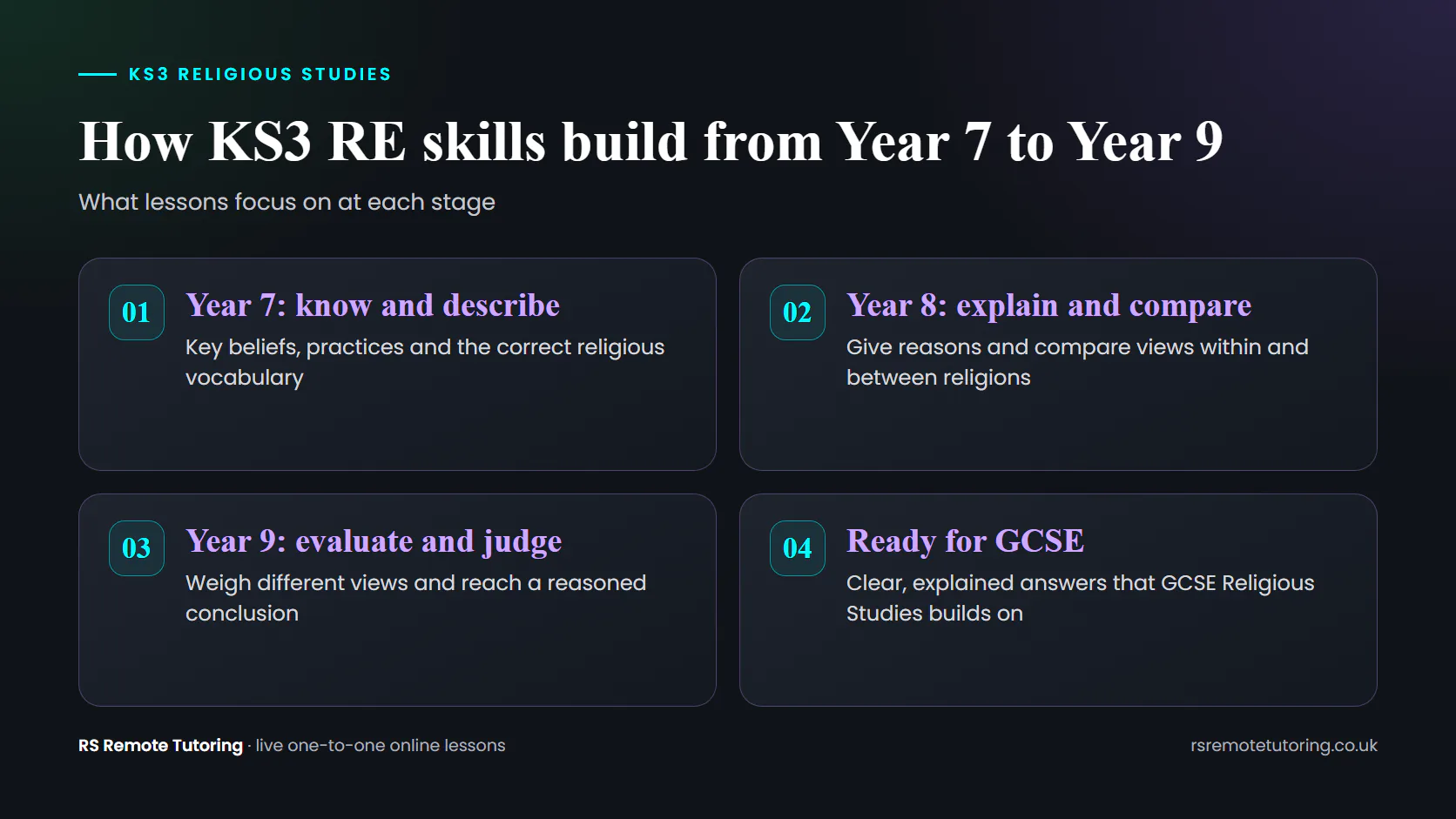
Year 7 builds accurate knowledge of beliefs and practices, Year 8 asks students to explain and compare, and Year 9 brings longer answers that weigh different views. We plan lessons around your child’s year group, the school’s topics and any assessments coming up.
Year 7: knowing the basics well
Secondary RE often moves faster than primary. Year 7 students meet new vocabulary, several religions at once and longer written tasks.
Lessons focus on secure knowledge: what a belief is, what it means to a believer and the right word for it, so later work has something solid to stand on.
Year 8: explaining and comparing
Year 8 work tends to ask why. Why do some Christians fast during Lent? How do Sikh and Muslim teachings about equality compare?
Lessons build the habit of giving a reason instead of only stating a fact, and of comparing views within and between religions.
Year 9: weighing views and looking ahead
Year 9 brings longer answers and often a first taste of evaluation: is a statement true, and why might others disagree? Some schools begin GCSE content during Year 9.
Lessons help your child reach a reasoned conclusion, which is the skill GCSE Religious Studies questions build on.
Lessons meet your child at their stage and build towards the skills GCSE asks for.
Is it right for your child
Who is one-to-one KS3 RE tutoring for?
KS3 Religious Studies tutoring suits students who find the new vocabulary confusing, write very short answers or mix up beliefs between religions. It also helps confident students who want more challenge, and Year 9 students thinking about taking GCSE Religious Studies.
Your child may benefit from a KS3 Religious Studies tutor if they:
write one-line answers that state a fact without explaining it;
muddle the beliefs, festivals or holy books of different religions;
have strong opinions but struggle to support them with reasons;
go quiet in class discussions and have lost confidence in the subject;
are considering GCSE Religious Studies as an option in Year 9;
enjoy big questions and want more challenge than class time allows.
Most KS3 RE difficulties come down to one or two habits, not a lack of ability. Once your child can explain one point properly, longer answers feel far less daunting.
Inside a lesson
What does a KS3 Religious Studies lesson look like?
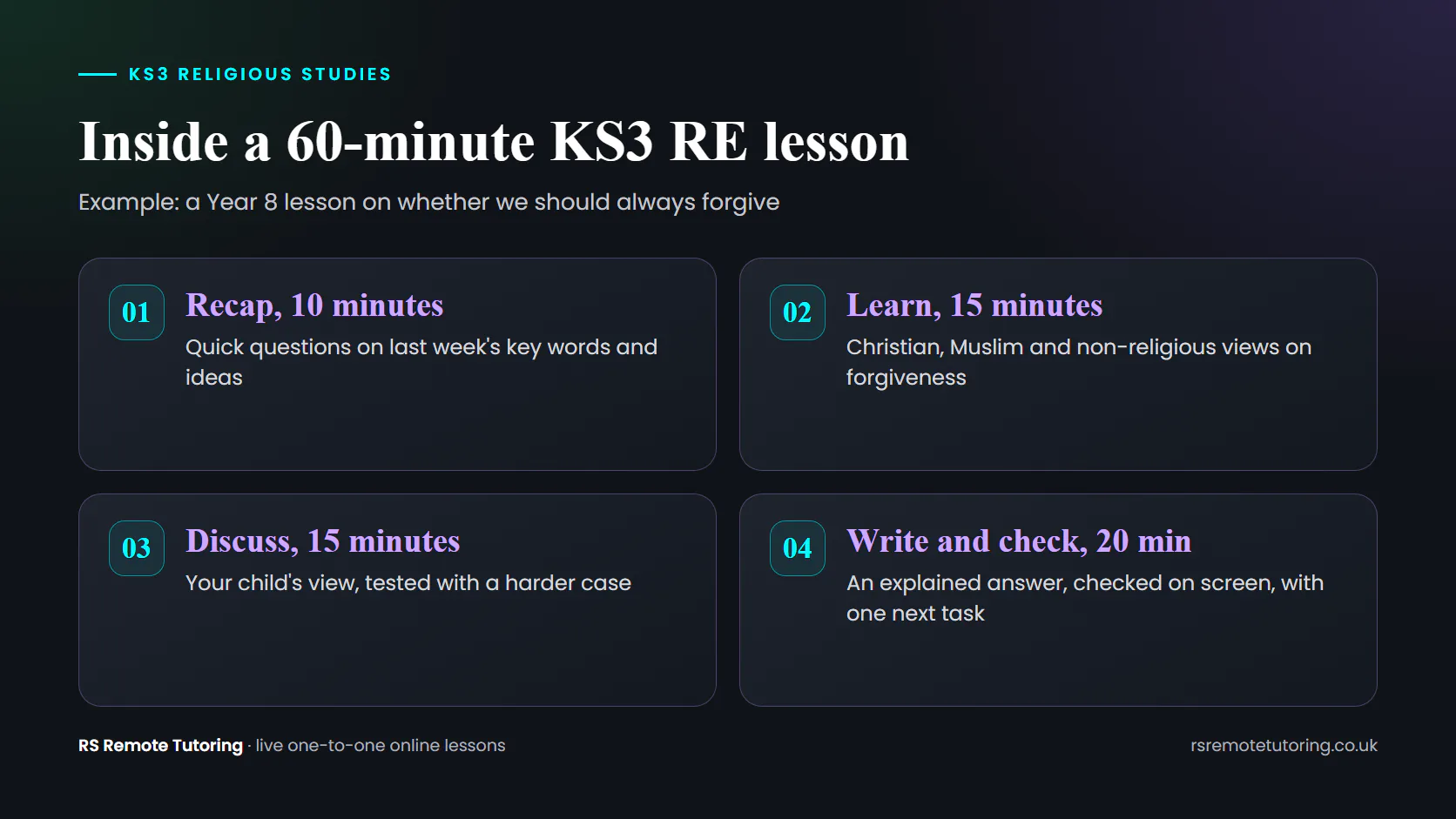
Here is a typical 60-minute Year 8 lesson on the question ‘Should we always forgive?’. Your child recaps last week’s topic, learns what different religions teach about forgiveness, discusses the question with the tutor, then writes an explained answer that is checked before the end.
RecapAbout 10 minutesA few quick questions on last week’s topic, such as the meaning of key words. Anything that has slipped is fixed before new work begins.
LearnAbout 15 minutesThe tutor explains Christian teaching on forgiveness, including Jesus telling Peter there is no fixed limit to it, and the Muslim belief that Allah is merciful and forgiving. A non-religious view is included too.
DiscussAbout 15 minutesYour child gives their own view, and the tutor tests it with a harder case, such as a crime that caused serious harm. Your child practises giving a reason and answering a different view.
Write and checkAbout 20 minutesYour child writes an explained answer using point, explanation, teaching and other view. The tutor checks it on screen, shows one thing to improve and sets a short task. Parents get the same summary.
The first lessons also show the tutor where your child is starting from, whether the gap is knowledge, explanation or confidence. The following weeks are planned around that, alongside the school’s topics.
Each lesson ends with a written answer, so you can see the explaining improve week by week.
Who teaches KS3 RE
Who will teach my child KS3 Religious Studies?
Your child is taught by one of eight tutors who teach KS3 Religious Studies, matched on the school’s topics, your child’s confidence and the times you need. They include a PGCE teacher with QTS, an MA in Theology and specialists in ethics and comparative religion.
Faijah Hussain
Religious Studies and Philosophy, Year 7 to A-Level
PGCE with QTS
BA Religion, Philosophy and Ethics
7 years teaching
Faijah has taught Humanities in secondary schools and online, so KS3 RE lessons are familiar ground. Her own model answers give younger students a clear picture of what a well-explained answer looks like.
Sarah Ahmed
Religious Studies and Philosophy
Islamic Studies
Ethics and Philosophy
With a background in Islamic Studies, Sarah brings Christianity and Islam to life beyond the textbook summary, which helps students who find it hard to keep two religions apart. At KS3 she also leads ethical debates, where students learn to argue a view with care.
Hannah Williams
Religious Studies, ethics and comparative religion
Philosophy and Ethics
Comparative religion
Hannah’s strength is comparing religions and building critical thinking. She helps students move from listing facts to explaining similarities and differences, which Year 8 and Year 9 tasks ask for more and more.
Ben Ashcroft
Religious Studies and English
Classroom teaching experience
Private tuition
Ben brings classroom experience as well as private tuition, and he treats RE as a subject of argument rather than memory. He also teaches English, which helps students whose RE answers are held back by their writing.
Jonathan Reed, Harleen, Grace Adeyemi and Hamza Latif also teach KS3 Religious Studies. Each of the eight holds a current enhanced DBS check for teaching children, and we confirmed their identity, certificates and references before they took on a pupil.
Four steps to start
How does my child start KS3 RE tutoring?
Share the year group, this term’s RE unit and where answers fall short. A coordinator names one tutor and says why, then your child spends a free 30-minute trial discussing a question like ‘Is it ever right to break a promise?’ before you decide.
Share this term’s RE unitWrite down the year group, the RE unit the class is on, any homework that went badly and the evenings or weekends that suit your family.
Meet one suggested tutorOur coordinator looks at the unit and your child’s confidence, then recommends a single RE tutor and explains the choice.
Talk through a big questionIn a free 30-minute Zoom trial, your child discusses whether it is ever right to break a promise, then turns one idea into a written sentence or two. There is no card to enter and no commitment afterwards.
Settle on a weekly timeHappy with the trial? From then on, that tutor keeps a regular weekly slot with your child. Not quite right? We match a different tutor free of charge.
A recent RE homework or a photo of the exercise book is the most useful thing to have ready. It shows the tutor exactly what the school expects at your child’s stage.
How much does KS3 Religious Studies tutoring cost?
An hour of KS3 RE costs £30, just as an hour of GCSE or A-Level does. Three or more RE lessons in a week cost £27.50 apiece. An annual plan settled upfront makes it £25 a lesson, and the opening 30-minute trial is free.
Meet your tutor first
Free
30-minute one-to-one trial on Zoom
No card details. No obligation to continue.
Standard lesson
£30
60-minute one-to-one online lesson
The same rate for every tutor and every level.
Three or more a week
£27.50
Per 60-minute lesson
For families booking three or more lessons each week.
Annual plan
£25
Per 60-minute lesson, paid upfront
48 weekly lessons for £1,200.
A weekly RE lesson adds up to £120 every four weeks at the standard rate. There are no sign-up or matching fees, and no extra charge for planning lessons around your child’s school topics.
Families choose us for one patient tutor who stays with their child each week, lessons built around the school’s RE topics, and plain-English updates after every session. Our founder, head tutor Rumaan Aslam, has overseen lessons for UK pupils since 2020.
One tutor who knows your child
Your child keeps the same tutor at the same weekly time. That steadiness matters at KS3, when confidence in a subject can rise or fall quickly.
Honest updates after each lesson
After each session you learn which RE topic was covered, how your child’s explaining is coming on, what still needs work and the short task for next time. There is no invented score, just a clear picture of where your child is.
Checked tutors and free rematching
Every KS3 RE tutor holds an enhanced DBS and had their certificates checked before teaching. If your child and the tutor do not get on, we find another one at no cost, whenever you ask.
KS3 Religious Studies is part of our wider KS3 tutoring, and students whose written answers need work across subjects can combine it with KS3 English tuition.
London and UK families
Do KS3 RE lessons work for families outside London?
Yes. KS3 RE runs entirely on Zoom, so a Year 7 in Leicester joins from the kitchen table as easily as a pupil in Hounslow. Our team is based in Feltham, Greater London, and lessons fit after school or at weekends.
Set your child up with a webcam on a laptop, tablet or desktop, the free Zoom app, ordinary home broadband and somewhere quiet to talk. Phones can be used, though written answers are far easier on a larger screen. You are welcome nearby, but nobody needs to sit in.
If your child goes on to take the subject in Year 10, our GCSE Religious Studies tutoring carries on with the same approach. Every one of our KS3 RE tutors also teaches GCSE Religious Studies, so the same tutor can usually continue.
Common questions
Frequently Asked Questions
Quick answers for parents of Year 7 to 9 students on RE fees, school syllabuses, religions covered, beliefs and booking a free trial.
What do KS3 RE lessons cost?
Each 60-minute lesson is £30, the same at every level we teach. Three or more a week brings each lesson down to £27.50, and paying for the annual plan upfront makes it £25. Nobody pays for the 30-minute trial, and we never ask for a card.
Is RE part of the National Curriculum?
No. RE is compulsory in schools, but it is not part of the National Curriculum. Local councils set the syllabus for many schools, while academies and faith schools can set their own, so our tutors follow the topics your child’s school is teaching.
Which religions can the tutor cover?
Our tutors cover the religions most often taught at KS3, including Christianity, Islam, Judaism, Hinduism, Buddhism and Sikhism, along with ethics and philosophy. Mention the unit your child is on, and the coordinator will choose a tutor at home with that religion.
How do lessons handle different beliefs?
Lessons focus on understanding what each religion and worldview teaches and on explaining reasons clearly, which is what school RE assesses. Your child is encouraged to form and explain their own view. If you have particular wishes, mention them when you enquire.
Can the tutor help with RE homework and school assessments?
Yes. Send the homework, the topic or the assessment date, and the tutor will use it in the lesson. Your child still does the thinking and the writing, with guidance and corrections as they go.
Will KS3 tutoring help with GCSE Religious Studies?
It gives your child a strong start. GCSE questions build on the KS3 skills of explaining a teaching and weighing different views, so practising them early makes the step up in Year 10 much smoother.
Does my child see the same RE tutor each week?
Yes, at the same time every week, which helps quieter pupils settle and speak up. If the pairing is not working, let us know and we will swap tutors without charge.
How do we book a KS3 Religious Studies trial?
Use the trial form and choose KS3 as the level and Religious Studies as the subject. Add the year group, the current RE topic and times that suit. We then suggest a tutor and agree the trial time with you.
Free 30-minute trial
Help your child explain what they think, and why
Start with this term’s RE topic or the homework that caused the most trouble. In a free 30-minute trial, a KS3 RE tutor talks a big question through with your child and shows you whether knowledge, explaining or confidence needs work first.