GCSE Chemistry felt manageable. Then Year 12 arrived with moles calculations that run to four steps and mechanisms where one curly arrow in the wrong place loses the mark. An A-Level Chemistry tutor from RS Remote Tutoring works out which step is failing and fixes it on real exam questions.
Every lesson is a live Zoom hour for your child alone, pitched at the AQA, Pearson Edexcel or OCR papers they will actually sit. Our tutors cover physical, organic and inorganic chemistry, plus the practical theory the written papers test, and they correct working while your child is still writing it.
No card details for the trial. No obligation to continue.
Live one-to-one lessonsPersonal tutor matchingFree 30-minute trialEnhanced DBS checked tutorsTeaching since 2020
What lessons cover
What does A-Level Chemistry tutoring cover?
Our A-Level Chemistry tutoring covers the whole course: physical, organic and inorganic chemistry, plus the practical skills the written papers test. Lessons spend most time on calculations, mechanisms and the topics your child keeps dropping marks on, using questions written in your board’s style.
Physical chemistry and calculations
This is where most marks are decided. We work on amount of substance, energetics, kinetics, equilibria, acids and bases, and later on thermodynamics and electrode potentials.
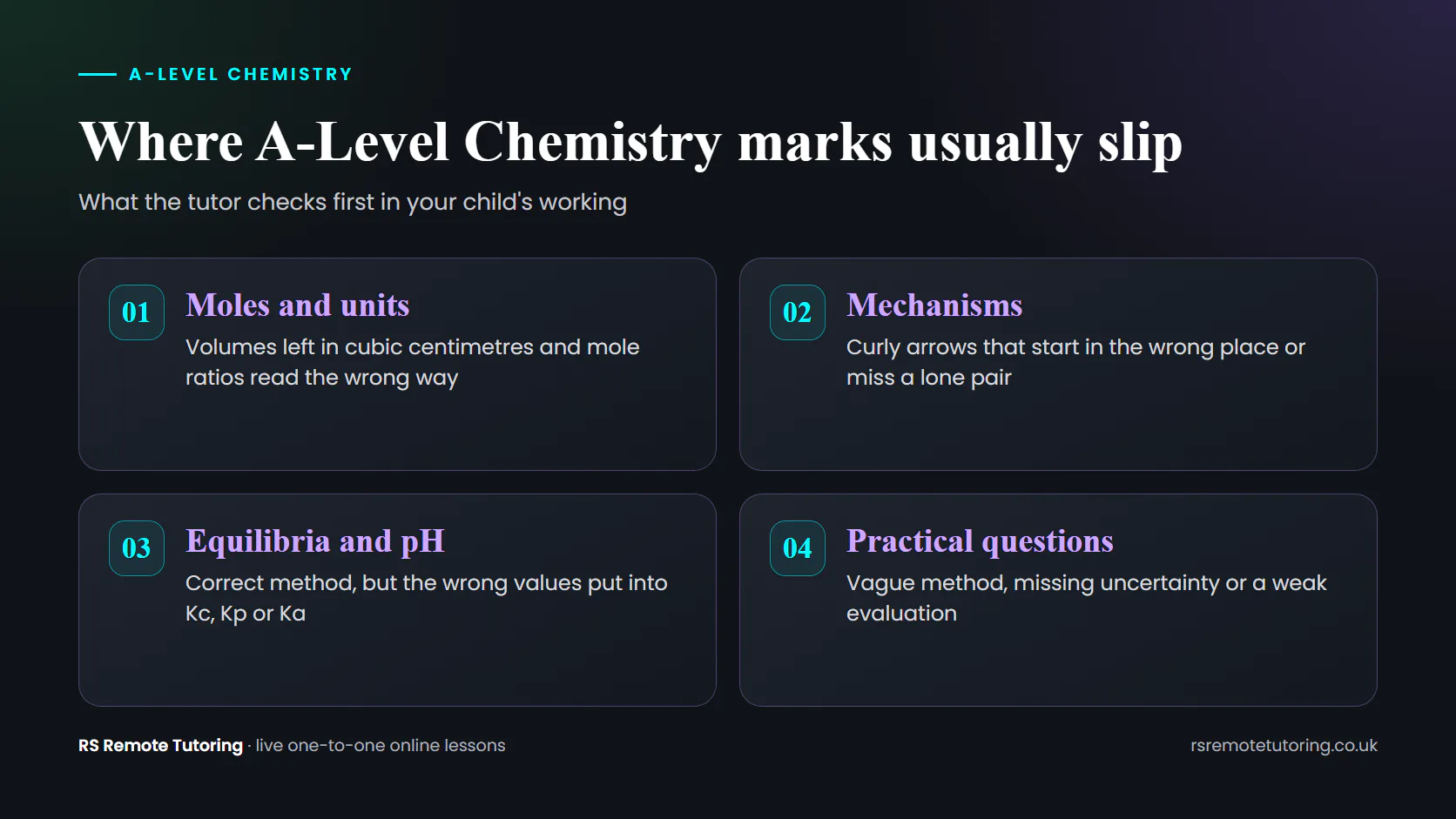
A wrong answer here usually comes from an earlier slip: a volume left in cubic centimetres, a mole ratio read the wrong way round or a rounded figure carried forward. The tutor watches each line and stops at the one that breaks.
Organic chemistry and mechanisms
Organic chemistry rewards precision. Lessons cover the main functional groups, reaction conditions, isomerism, synthesis routes and analysis by spectroscopy and chromatography.
For mechanisms, your child draws every curly arrow on the shared whiteboard. Each arrow has to start at a lone pair or a bond, and a tutor who sees the drawing live can correct it before the habit sets.
Inorganic chemistry and trends
Periodicity, the Group 2 elements, the halogens and transition metals are often treated as topics to memorise. Students lose marks when they can state a trend but cannot explain it.
We link each trend back to atomic structure and bonding, so your child can write the explanation the mark scheme asks for rather than a list of facts.
Practical theory and exam technique
Every board tests practical knowledge in the written papers: apparatus, method, uncertainty, titration results and how to evaluate an experiment. We practise those questions directly, because they reward a specific way of writing.
Before mocks, the tutor sets timed questions in your board’s format, including the practical-based questions that students tend to rush.
Physical, organic and inorganic chemistry, taught one-to-one and matched to your child’s exam board.
Your board and papers
Which A-Level Chemistry specification is your child studying?
AQA, Pearson Edexcel and OCR each group physical, organic and inorganic chemistry into papers in their own way, and OCR runs two separate courses. Knowing the specification code before the trial lets the tutor choose practice questions in exactly that board’s style.
All the main A-Level Chemistry courses are linear, with three written papers sat at the end of Year 13. What differs is how content is grouped, how long each paper runs and how practical questions are set.
Board and specification
How the written papers are set
AQA A-Level Chemistry (7405)
Paper 1 physical and inorganic; Paper 2 physical and organic; Paper 3 any content and practical skills, with 30 multiple choice marks. Each paper is two hours
Pearson Edexcel A-Level Chemistry (9CH0)
Papers 1 and 2 (Advanced Inorganic and Physical; Advanced Organic and Physical) run for 1 hour 45 minutes; the third, General and Practical Principles in Chemistry, runs for 2 hours 30 minutes
OCR A-Level Chemistry A (H432)
Periodic table, elements and physical chemistry; Synthesis and analytical techniques; Unified chemistry, which draws on every module
OCR A-Level Chemistry B, Salters (H433)
A context-led course with its own paper structure. Mention Salters on the form, since its context-led storylines need a tutor who has worked with them
Practical endorsement
Your child’s teachers judge it through lab work; it is reported as pass or not classified, outside the A-Level grade itself
Not sure of the board
A chemistry mock or the data booklet your child uses normally names the board; send a photo and the coordinator will pin down the code
Your child’s teachers sign off the endorsement in the school or college lab, which is why it cannot be done over Zoom. What we teach is the theory behind it: techniques, apparatus and the analysis questions that appear on the written papers, which is where many students lose marks they could have kept.
Year 12 and Year 13
How does A-Level Chemistry step up from Year 12 to Year 13?
Year 12 builds the foundations every later topic relies on, especially moles and bonding, while Year 13 adds harder physical and organic chemistry and puts everything under exam conditions. Lessons track the school’s order, so new class topics can be practised that week.
Year 12: getting the foundations secure
Atomic structure, amount of substance, bonding, energetics, kinetics and equilibria usually arrive in the first year, alongside early organic chemistry. Any weakness in moles here follows your child through the rest of the course.
A typical Year 12 lesson might cover a titration calculation, then a mechanism for electrophilic addition to an alkene, drawn step by step.
Year 13: harder content and full papers
Year 13 often brings Born-Haber cycles, entropy, rate equations, equilibrium constants for gases, buffers, electrode potentials, transition metals, aromatic chemistry and NMR. The papers also test Year 12 content, so revision keeps it moving.
A typical Year 13 lesson might work through a buffer pH calculation, then a synthesis question that links three reactions.
Retakes and late starts
Some students start support late in Year 13 or are retaking the qualification. The tutor then sorts topics by how many marks your child is losing on each, often starting with moles or equilibria, and moves to full timed papers once the weakest areas hold.
The first lessons show which of these is costing your child the most marks.
Is it right for your child
Who is one-to-one A-Level Chemistry tuition for?
One-to-one A-Level Chemistry tuition helps students who can follow a worked titration in class but stall on their own, who misplace curly arrows, or whose mock grade sits below an offer. Students chasing an A or A* get harder synoptic questions too.
A private A-Level Chemistry tutor may help if your child:
gets lost partway through multi-step moles or equilibrium calculations;
can name a reaction but cannot draw its mechanism accurately;
learns inorganic trends by heart but struggles to explain them;
loses marks on practical questions about method, uncertainty or results;
holds a medicine, pharmacy or chemistry offer that depends on a grade the mocks have not reached yet;
is predicted a high grade but runs out of time on Paper 3.
Lessons start with whatever is not working. A student who panics at calculations needs a different plan from one who knows the content but writes vague answers, so the first lessons focus on finding out which it is.
Every lesson follows the same rhythm, so progress is easy to follow from week to week.
Inside a lesson
What does a typical A-Level Chemistry lesson look like?
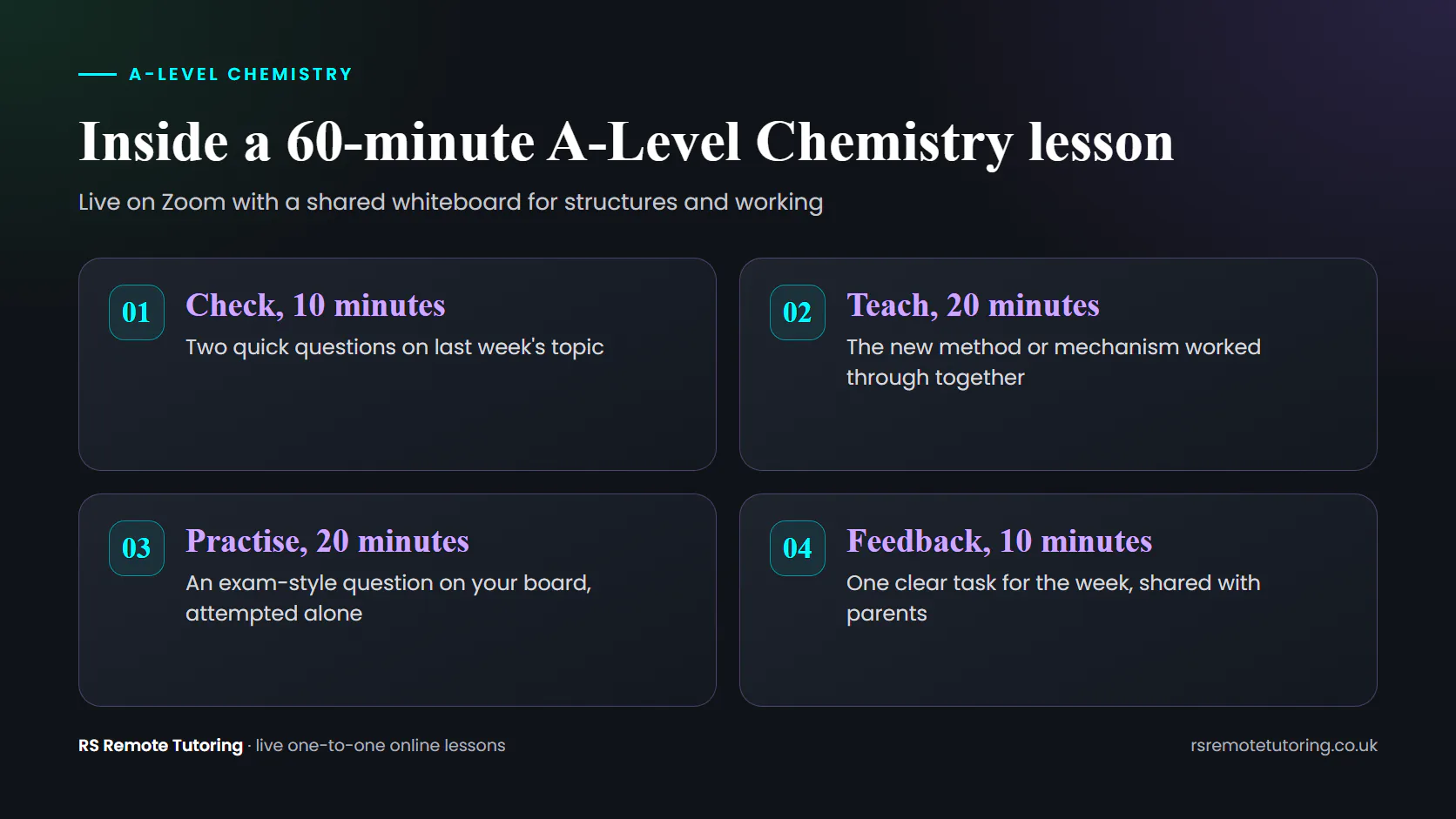
Take a 60-minute Year 13 buffers lesson on Zoom: a pH warm-up, the buffer calculation built step by step on the whiteboard, one exam question your child tackles without help, then feedback that you and your child both receive.
CheckAbout 10 minutesTwo short questions: the pH of a strong acid, then of a weak acid using Ka. If either goes wrong, the tutor fixes it now, because buffers build on both.
TeachAbout 20 minutesHow a buffer resists change, then the calculation itself. Your child writes each step on the whiteboard, working out moles of acid and salt before using them.
PractiseAbout 20 minutesAn exam-style buffer question on your child’s board, attempted alone. The tutor stops a line that is heading the wrong way and asks what should come next.
FeedbackAbout 10 minutesWhich buffer steps your child can now do unaided, which still need prompting, and one or two pH questions to try before next week. You get the same note.
Early lessons are partly detective work. Is your child losing chemistry marks on numbers, arrows, written explanations or practical method? Once the tutor knows, the next few weeks are built around that answer.
Who teaches A-Level Chemistry
Who will teach my child A-Level Chemistry?
Two tutors teach A-Level Chemistry with us, Mahnoor Sohail and Nadia Rahman, and both hold Master’s degrees with chemistry at their core. We choose between them on board, target grade and timing, and your child has a free trial with that tutor first.
Mahnoor Sohail
Chemistry, GCSE and A-Level
MSc Inorganic Chemistry
Research background
Research-lab experience and an MSc in Inorganic Chemistry sit behind Mahnoor’s teaching. She is strongest on the topics that are hard rather than fiddly, such as moles, bonding, energetics and equilibrium, and she teaches the practical endorsement theory that A-Level papers test.
Nadia Rahman
Science and Maths, GCSE and A-Level
MSc Biochemistry and Chemistry
B.Ed
8+ years teaching
Nadia combines a B.Ed with an MSc in Biochemistry and Chemistry, and has more than eight years of teaching behind her. She teaches both A-Level Chemistry and A-Level Biology, which helps students who take the two together and notice the overlap in biochemistry.
Both passed our checks before teaching: identity confirmed, degree certificates checked and references taken up. As tutors of students under 18, they each hold a current enhanced DBS check.
Four steps to start
What happens after you contact us about A-Level Chemistry?
Tell us which chemistry is causing trouble, whether that is moles, mechanisms or a whole paper. Mahnoor or Nadia is proposed with a reason, your child spends a free half hour solving chemistry with them, and the weekly booking only starts if it suits.
Point to the chemistry that failsThe trial form has space for Year 12 or 13, the board, the grade now and the grade needed, plus the sticking point. Be specific: equilibrium constants, nucleophilic substitution, transition metal colours or titration uncertainty.
Hear which chemist we suggestOur coordinator reads the form and suggests either Mahnoor or Nadia, explaining why that tutor suits your child, so there is no list of profiles to sift.
Try a free 30-minute lessonOn Zoom, your child tackles a real A-Level question, perhaps drawing a mechanism or setting out a moles calculation, while the tutor watches. No payment details are taken at this stage.
Keep a weekly chemistry slotIf the trial goes well, that tutor teaches your child at the same time every week. If it does not, the coordinator arranges a different match at no cost.
Have a recent mock, a marked test or a homework sheet ready for the trial. A real piece of work shows the tutor where to begin far more quickly than a description can.
A 60-minute A-Level Chemistry lesson costs £30, whichever of our chemists teaches it. A student booked for three or more hours a week pays £27.50 an hour, the annual plan brings an hour to £25, and the half-hour trial costs nothing.
Meet your tutor first
Free
30-minute one-to-one trial on Zoom
No card details. No obligation to continue.
Standard lesson
£30
60-minute one-to-one online lesson
The same rate for every tutor and every level.
Three or more a week
£27.50
Per 60-minute lesson
For families booking three or more lessons each week.
Annual plan
£25
Per 60-minute lesson, paid upfront
48 weekly lessons for £1,200.
Chemistry at A-Level costs no more per hour than KS3 science with us, and nothing is added for signing up, matching or the tutor’s preparation. A weekly lesson comes to £120 over four weeks; Year 13 students who move to two lessons a week before the final papers still pay £30 an hour unless they reach three.
What makes our A-Level Chemistry tutoring worth booking?
Chemistry marks are lost in small, repeatable places, so one tutor who sees your child’s calculations and arrows every week catches them early. You get a plain account after each lesson; we started teaching UK students online in 2020, and our founder still teaches.
One tutor who knows the gaps
Your child keeps the same tutor every week at a fixed time. After a few weeks, that tutor knows which calculations hold and which still wobble, so no lesson is spent starting over.
Updates you can act on
After each lesson you receive a short note listing the reactions or calculations covered, which ones now come easily, which still trip your child up, and the questions set for the week. It is written so you can follow progress without joining the Zoom call.
Checked tutors and free rematches
Every tutor has ID, certificates and references checked before teaching, and anyone with under-18 students holds an enhanced DBS check. Should the pairing stop working at any point, we rematch free of charge and your child does not lose a lesson.
Can my child take A-Level Chemistry lessons from outside London?
Yes. The lessons run on Zoom, so a student in Manchester, Bristol or Kent works with the same chemistry tutors as one in west London. We run the service from Feltham, Greater London, and agree lesson times around sixth form and the tutor’s diary.
Skeletal formulae and titration working are far easier to draw on a laptop, desktop or tablet with a camera than on a phone, although a phone will connect. Beyond that, a normal home broadband connection, the free Zoom app and a quiet desk are enough.
Questions about chemistry lessons can come in at any hour, any day of the week, and WhatsApp is normally the quickest route to a reply. If your child is in Year 11 and still unsure about moles or bonding, our GCSE Chemistry tutoring uses the same approach and gives a firmer start to Year 12.
Common questions
Frequently Asked Questions
What parents ask us about A-Level Chemistry support, from the practical endorsement and exam boards to price, tutors and the free trial.
How much does an A-Level Chemistry tutor cost?
£30 for a 60-minute lesson. A Year 13 student doing three or more lessons a week before exams pays £27.50 per lesson, and the annual plan, paid in advance, brings each lesson to £25. The 30-minute trial is free, and no card is needed to book it.
Which exam boards do your A-Level Chemistry tutors cover?
AQA, Pearson Edexcel and OCR. If your child is on OCR’s Salters course, say so, and we will check that the tutor knows it. Unsure of the board? Send a picture of any chemistry mock and we will work it out.
Can a tutor help with the chemistry practical endorsement?
We teach the theory the written papers assess, including the techniques, apparatus and analysis questions built on the practical work. Signing off the endorsement happens in your child’s school or college lab, so it is not something an online tutor can do.
Can a tutor help with organic mechanisms?
Yes. Your child draws each mechanism on the shared whiteboard while the tutor watches, so a misplaced curly arrow or missing lone pair is corrected straight away. We then practise the same mechanism inside exam questions.
Is Year 12 too early for a chemistry tutor?
No, it is often the most useful time. Year 13 topics build directly on Year 12 moles, bonding and equilibria, so securing them early gives your child a steadier final year and more time for past papers later.
Can a chemistry tutor help in the weeks before mocks?
Yes. When booking the trial, give us the mock or exam dates, the board and the chemistry topics your child is most worried about. Lessons can then focus on the highest-value topics and timed practice on your child’s papers.
Will the same chemistry tutor teach my child every week?
Yes. One tutor takes every lesson at the weekly time you agree. If the pairing does not suit your child, let us know and we will arrange a different tutor at no cost.
How do we book an A-Level Chemistry trial?
Open the trial form, select Chemistry as the subject and A-Levels as the level, and tell us the board, the area your child finds hardest and when they are free. The coordinator then proposes a tutor and confirms a time.
Free 30-minute trial
Find out where the Chemistry marks are going
Bring the calculation, mechanism or paper that worries your child most. In a free 30-minute trial, one of our A-Level Chemistry tutors works on it with your child and shows you where the marks are going and what to fix first.