Your child can explain how a processor fetches an instruction, then faces a programming question and cannot write the first line. Or the code works and the theory answers keep missing the key term. An A-Level Computer Science tutor from RS Remote Tutoring works on whichever half is costing marks.
Each session is a live, one-to-one Zoom call. Your child shares the screen while writing and testing programs, so a wrong assumption shows up the moment it is typed. A-Level teaching is led by Sidra Paracha, a working software engineer, and follows your child’s exam board, programming language and project timeline.
No card details for the trial. No obligation to continue.
Live one-to-one lessonsPersonal tutor matchingFree 30-minute trialEnhanced DBS checked tutorsTeaching since 2020
What lessons cover
What does A-Level Computer Science tutoring cover?
Our A-Level Computer Science tutoring covers both exam papers and the skills the programming project relies on: programming, data structures, algorithms, computer systems, networks, databases and theory of computation. Lesson time goes to whichever area is losing your child the most marks.
Programming and problem solving
A-Level programming goes well past GCSE loops. Students work with subroutines and parameters, recursion, file handling, exception handling and object-oriented programming, including classes, inheritance and polymorphism.
Your child stays at the keyboard. The tutor sets a short problem, watches the code take shape on screen and asks why a line was written before suggesting anything.
Data structures and algorithms
Stacks, queues, linked lists, trees, graphs and hash tables appear on both main boards, along with searching, sorting and path-finding methods such as Dijkstra’s algorithm. Students must trace them by hand, not only use them.
We work through trace tables and Big O comparisons until your child can explain why merge sort beats bubble sort on a long list, in the words a mark scheme rewards.
Computer systems, networks and databases
The theory side covers processor architecture and the fetch-execute cycle, binary and hexadecimal, Boolean algebra, networking and protocols, databases and SQL, and the legal and ethical questions computing raises.
These questions reward exact terminology. Lessons use past-paper questions and mark schemes, so your child learns which phrase earns the mark and which only sounds close.
Theory of computation and exam technique
Finite state machines, regular expressions and Turing machines carry weight on AQA, while OCR tests computational thinking across its papers. We teach whatever your child’s board sets, in the order the school teaches it.
Before mocks, lessons switch to timed questions and extended answers. AQA students also practise the on-screen style of the programming paper, where they adapt and extend code under time pressure.
Programming, algorithms and computer systems, taught one-to-one and matched to your child’s exam board.
Your board and papers
Which A-Level Computer Science papers will lessons prepare for?
AQA and OCR examine A-Level Computer Science in different ways, so we plan around your child’s specification. Each board sets two exams worth 40% apiece and a programming project worth 20%, yet the programming exam looks very different. We confirm the board before the trial.
Most schools in England teach AQA or OCR. The content overlaps a great deal, but the way it is examined changes the practice your child needs, especially for programming.
Board and component
How it is assessed
AQA A-Level Computer Science (7517), Paper 1
On-screen exam, 2 hours 30 minutes, 40%. Programming and theory questions, built around preliminary material and a skeleton program released before the exam
AQA Paper 2
Written exam, 2 hours 30 minutes, 40%. Data representation, computer systems and architecture, networking, databases and related theory
AQA non-exam assessment
A practical computing project, 75 marks and 20% of the A-Level, with 42 of those marks for the technical solution
Algorithms and programming: written exam, 2 hours 30 minutes, 140 marks, 40%
OCR programming project
Non-exam assessment, 70 marks, 20%. The student analyses a problem, then designs, develops, tests and evaluates a solution
Not sure of the board
Share the course title, or photograph the front of a mock paper, and we will work out the specification before the first lesson
Tell us the programming language your school uses as well, since it shapes the exam practice and the project. Studying WJEC, Eduqas or Cambridge International instead? Mention it in the enquiry and we will say plainly whether we can match that course before any lesson is booked.
The project, within the rules
Can a tutor help with the A-Level Computer Science NEA?
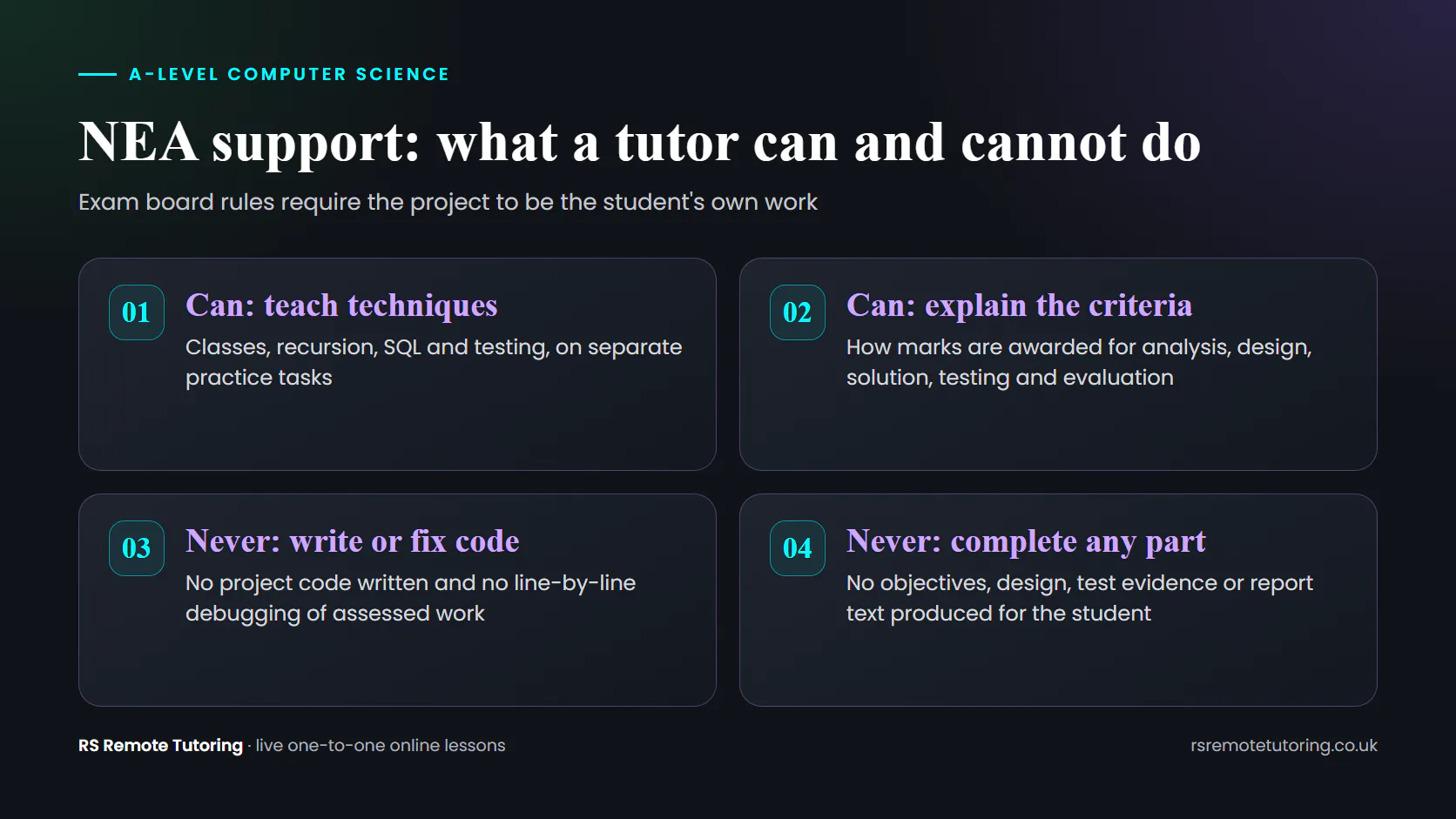
Yes, within the exam board rules. A tutor can teach the programming, design and testing skills the project needs and explain how the marking criteria work. Our tutor will never write, debug line by line or complete any part of assessed NEA work.
What lessons can include
Teaching the techniques a strong project tends to use, such as classes, recursion, file handling, SQL queries or a clear test plan, through separate practice problems that are not part of the project.
Explaining what the marking criteria ask for in analysis, design, the technical solution, testing and evaluation, so your child understands how marks are awarded and can judge their own work against them.
Helping your child plan time across the project stages and practise explaining code out loud, since teachers can ask students to talk through how their program works.
What we will never do
We will not write project code, debug it line by line, choose or word the objectives, draw the design, produce test evidence or edit the report. That holds for every section, however close the deadline.
Exam board rules say submitted work must be the student’s own, and AQA’s project form asks students whether they have had help from anyone other than their subject teachers. Copying or other cheating can lead to disqualification, a far bigger risk than a lower mark.
Lessons build the skills the project needs; the project itself stays entirely your child’s work.
We suggest telling your child’s teacher that they have a tutor. Being open about the support keeps any declaration simple, and the school can say if there is anything it would rather the tutor avoided.
Is it right for your child
Who is one-to-one A-Level Computer Science tuition for?
One-to-one A-Level Computer Science tuition suits students who follow the theory in class but stall when writing code, code confidently but lose marks on definitions, or need a steady plan for Year 13 exams that sits alongside the project deadline.
A private A-Level Computer Science tutor tends to help most when students:
can follow a worked program but cannot start one from a blank screen;
lose theory marks because their wording is close but not exact;
find recursion, object-oriented programming or linked structures hard to picture;
struggle to trace an algorithm by hand or compare efficiency with Big O notation;
are behind on project skills such as SQL, file handling or testing;
arrived from GCSE with little real programming practice and feel the gap widening.
Students whose GCSE course was light on coding often need the most help early in Year 12. We start there, rather than with whatever the class happens to cover this week.
Inside a lesson
What does a typical A-Level Computer Science lesson look like?
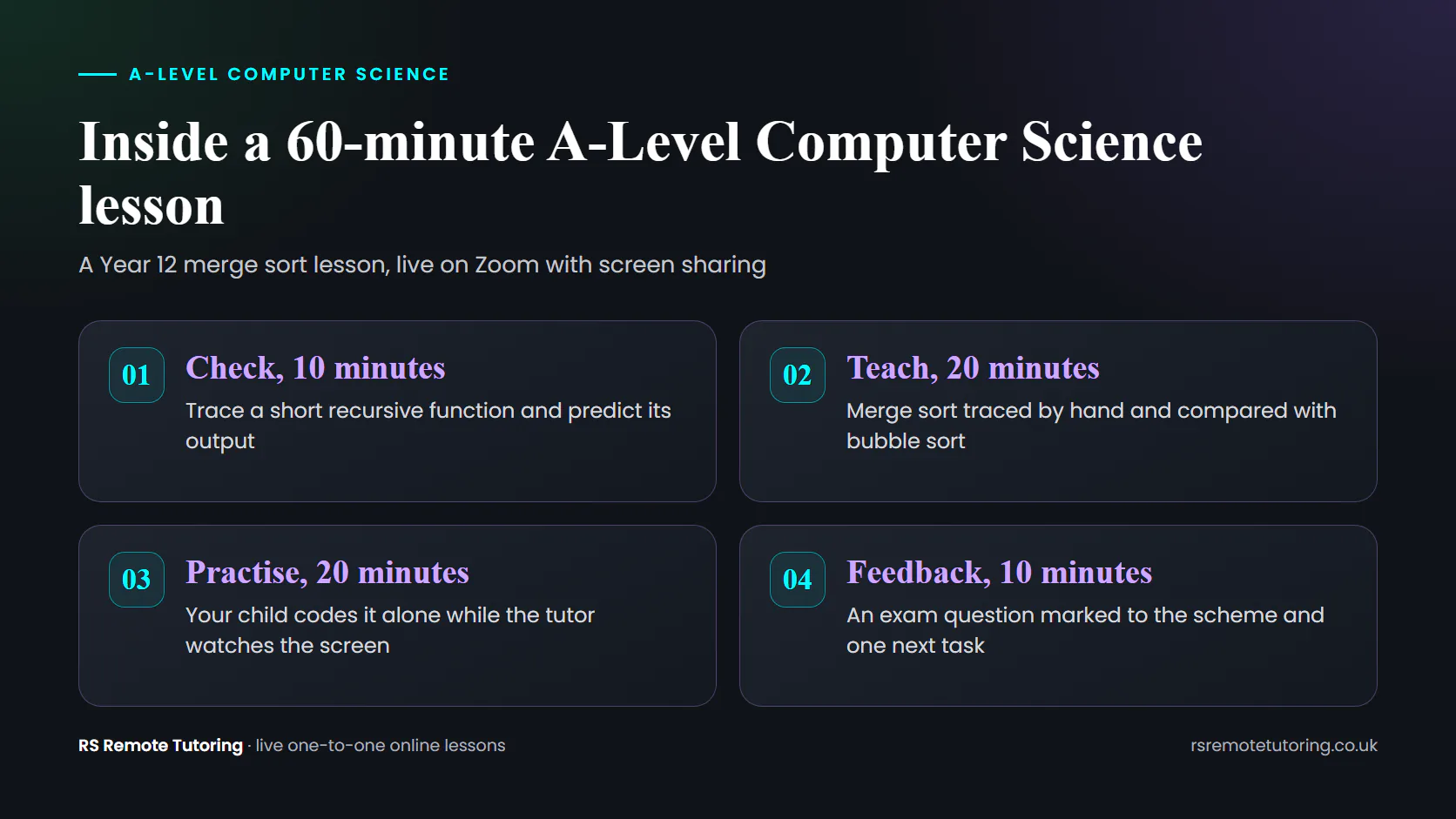
Each lesson lasts 60 minutes on Zoom, using screen sharing and a shared whiteboard. In this Year 12 example on merge sort, your child recaps recursion, traces the algorithm by hand, codes it alone, then gets feedback and one clear next task.
CheckAbout 10 minutesYour child traces a short recursive function on the whiteboard and predicts its output. If recursion is still shaky, the tutor settles that first, because merge sort depends on it.
TeachAbout 20 minutesThe tutor splits an eight-item list and your child does the merging, one comparison at a time. Then you compare its time complexity with bubble sort and set out how to explain the difference in an exam answer.
PractiseAbout 20 minutesYour child writes merge sort in their own editor while sharing the screen. When the merge loop stops one item early, the tutor asks them to trace it with a three-item list rather than pointing at the bug.
FeedbackAbout 10 minutesYour child answers a past-paper style sorting question, marked against the scheme. The tutor then names what went better, what is still weak and one coding task for the week ahead. Parents get the same note.
Early lessons double as a diagnosis. The tutor notes whether marks slip in programming, theory wording or exam timing, then plans the coming weeks around it. Practice tasks like this one are always separate from the assessed project.
A steady weekly pattern makes it easy to see which skills are getting stronger.
Who teaches A-Level CS
Who will teach my child A-Level Computer Science?
A-Level Computer Science is taught by Sidra Paracha, a working software engineer who teaches the subject from KS3 to A-Level. She is our one A-Level specialist in this subject, so you meet Sidra in the free trial and decide from there.
Sidra Paracha
Computer Science, KS3 to A-Level
Software engineer
Programming and system design
Sidra works as a software engineer alongside her teaching, so debugging, testing and system design are part of her normal working week. She suits students who can answer theory questions well but lock up when a blank editor asks them to build something.
Because one tutor teaches A-Level Computer Science, lesson times depend on Sidra’s timetable. She is usually free on weekday evenings and at weekends, and we confirm a slot before anything is booked.
Like every tutor we place with a student under 18, Sidra holds a current enhanced DBS check, and our checks before placement covered her identity, certificates and references.
Four steps to start
How does my child start A-Level Computer Science lessons with Sidra?
Tell us which paper or programming topic is failing, plus the board and school language. Our coordinator checks Sidra’s diary, your child codes or answers a real question in a free 30-minute trial, and weekly lessons follow only if it fits.
Name the weak paper or topicSay whether the programming exam, the theory exam or one topic such as recursion is dragging marks down, and add the board, year group, school language and current and target grades.
We check Sidra’s diaryOur coordinator compares your preferred times with Sidra’s weekday evening and weekend slots, checks the board and language, and explains why she suits your child.
Code in a free 30-minute trialWith the screen shared, your child builds a short program or tackles a past exam question. The trial is free, needs no payment card and leaves nothing to cancel afterwards.
Settle a weekly coding slotIf the trial clicks, Sidra teaches your child at one fixed time each week. If it does not, say so and we will set out honestly what else is possible.
Have a recent mock paper, some practice code or teacher feedback ready for the trial. Please do not send project files: lessons build skills and never work on the assessed project itself.
How much does A-Level Computer Science tutoring cost?
Each 60-minute A-Level Computer Science session with Sidra is £30, what we charge at KS3 or GCSE too. Booking three or more sessions a week drops the price to £27.50, an annual plan paid upfront brings it to £25, and the 30-minute trial costs nothing.
Meet your tutor first
Free
30-minute one-to-one trial on Zoom
No card details. No obligation to continue.
Standard lesson
£30
60-minute one-to-one online lesson
The same rate for every tutor and every level.
Three or more a week
£27.50
Per 60-minute lesson
For families booking three or more lessons each week.
Annual plan
£25
Per 60-minute lesson, paid upfront
48 weekly lessons for £1,200.
Four weekly lessons at the standard rate come to £120 a month. Sidra’s professional software background adds nothing to the fee, and we charge nothing for sign-up, matching or lesson planning.
What makes our A-Level Computer Science tutoring different?
Families choose us for a tutor who codes professionally, lessons where your child does the typing, clear rules on project support and plain updates after every lesson. Founder Rumaan Aslam, who still teaches, has run RS Remote Tutoring online for UK students since 2020.
Your child writes the code
Screen sharing lets the tutor watch each line appear and step in the moment something goes wrong. Your child builds the habit of finding their own bugs, which both the exam and the project expect.
Updates after every lesson
After each session you get a short note: which topic or program was tackled, what is getting stronger, what is still slipping and the practice set for the week. You do not need to sit in, and nothing is dressed up as a score.
Honest about rules and limits
We tell you plainly what a tutor may do for the NEA and what we never do. We also tell you that one tutor covers this subject at A-Level, so you know what availability looks like before you commit.
In a student’s words
A review from a GCSE Computer Science student on Sidra’s profile reads: “Very thorough with coding topics, made me understand key concepts well.” Across Google and Bark, our reviews average 4.9.
Plenty of Computer Science students also take Maths. Our A-Level tutoring lets them add A-Level Maths tuition alongside Sidra’s lessons, with one coordinator handling both timetables.
London and UK families
Can my child learn A-Level Computer Science online from anywhere in the UK?
Yes. Sidra teaches A-Level Computer Science entirely online, so a student in Cumbria joins exactly as one in London does. Our base is Feltham in Greater London, and session times fit around school, the project deadline and Sidra’s diary.
For programming lessons, use a laptop or desktop with a webcam, plus ordinary home broadband, the free Zoom app and whichever code editor school already uses. A tablet copes with theory questions, but writing programs needs a real keyboard.
If your child is still in Year 11, our GCSE Computer Science tutoring uses the same screen-sharing approach and builds the programming habits that A-Level assumes from the first week of Year 12.
Common questions
Frequently Asked Questions
Quick answers on A-Level Computer Science fees, AQA and OCR, the NEA rules, programming languages and how the free trial with Sidra works.
What will A-Level Computer Science lessons with Sidra cost?
Sessions with Sidra are £30 for an hour. That falls to £27.50 per session at three or more a week, or £25 on an annual plan paid upfront. A first 30-minute session with her costs nothing, and we never ask for card details.
Does Sidra teach the AQA and OCR A-Level Computer Science courses?
Yes. Lessons follow AQA (7517) or OCR (H446), the specifications most schools in England use. For a different course, such as WJEC, Eduqas or Cambridge International, name it on the form and we will check the fit before booking.
Will the tutor do my child’s NEA project?
No. The tutor teaches the skills the project needs and explains the marking criteria, but never writes, debugs line by line or completes any part of the assessed work. Exam board rules require the project to be your child’s own.
Which programming language will lessons use?
Lessons use the language your child’s school teaches for the course. Tell us which one when you enquire, so we can confirm it with the tutor before the trial rather than assume.
Do you have more than one A-Level Computer Science tutor?
Not at present. A-Level Computer Science is taught by Sidra Paracha, so our coordinator checks her availability against the times you need before anything is booked.
Can lessons help before mocks and final exams?
Yes. Send the exam dates, board and weakest topics when you book the trial. Lessons then move to timed questions, trace tables, extended theory answers and, for AQA students, on-screen programming practice.
Will my child work with Sidra every week?
Yes. Lessons run with Sidra at a fixed weekly slot, so she builds a clear picture of where your child’s code and theory answers go wrong and plans around it.
How do we book an A-Level Computer Science trial?
Use the trial form and choose A-Level and Computer Science. Add the board, the school’s programming language and times that suit. We then check Sidra’s free slots and confirm a trial time with you.
Free 30-minute trial
See whether the code or the theory is costing marks
Book a free 30-minute lesson and your child will write some code or answer a real exam question while the tutor watches. You will know what to work on first and whether weekly lessons make sense.