One-to-one online A-Level Physics tuition, on request
A-Level Physics Tutor Online
Your child can rearrange an equation without thinking, yet a fields question or a capacitor graph still leaves them unsure where to begin. An A-Level Physics tutor helps them picture what is happening first, so the maths has something to attach to.
We arrange A-Level Physics lessons on request, and they depend on tutor availability. Lessons are taught by Dr Anna Müller, who holds a PhD in Physics. Send us the board and the times you need, and we will confirm whether a regular slot is free before booking the trial.
No card details for the trial. No obligation to continue.
Live one-to-one lessonsPersonal tutor matchingFree 30-minute trialEnhanced DBS checked tutorsTeaching since 2020
What lessons cover
What does A-Level Physics tutoring cover?
A-Level Physics tutoring with us covers mechanics, materials, electricity, waves and fields, with the further topics your board adds in Year 13. Lessons concentrate on applying the maths, explaining the physics in words and answering the practical questions the written papers set.
Mechanics and materials
Vectors, motion, forces, momentum, work and energy are the base of the course, followed by circular motion and simple harmonic motion. Materials adds density, stress, strain and the Young modulus.
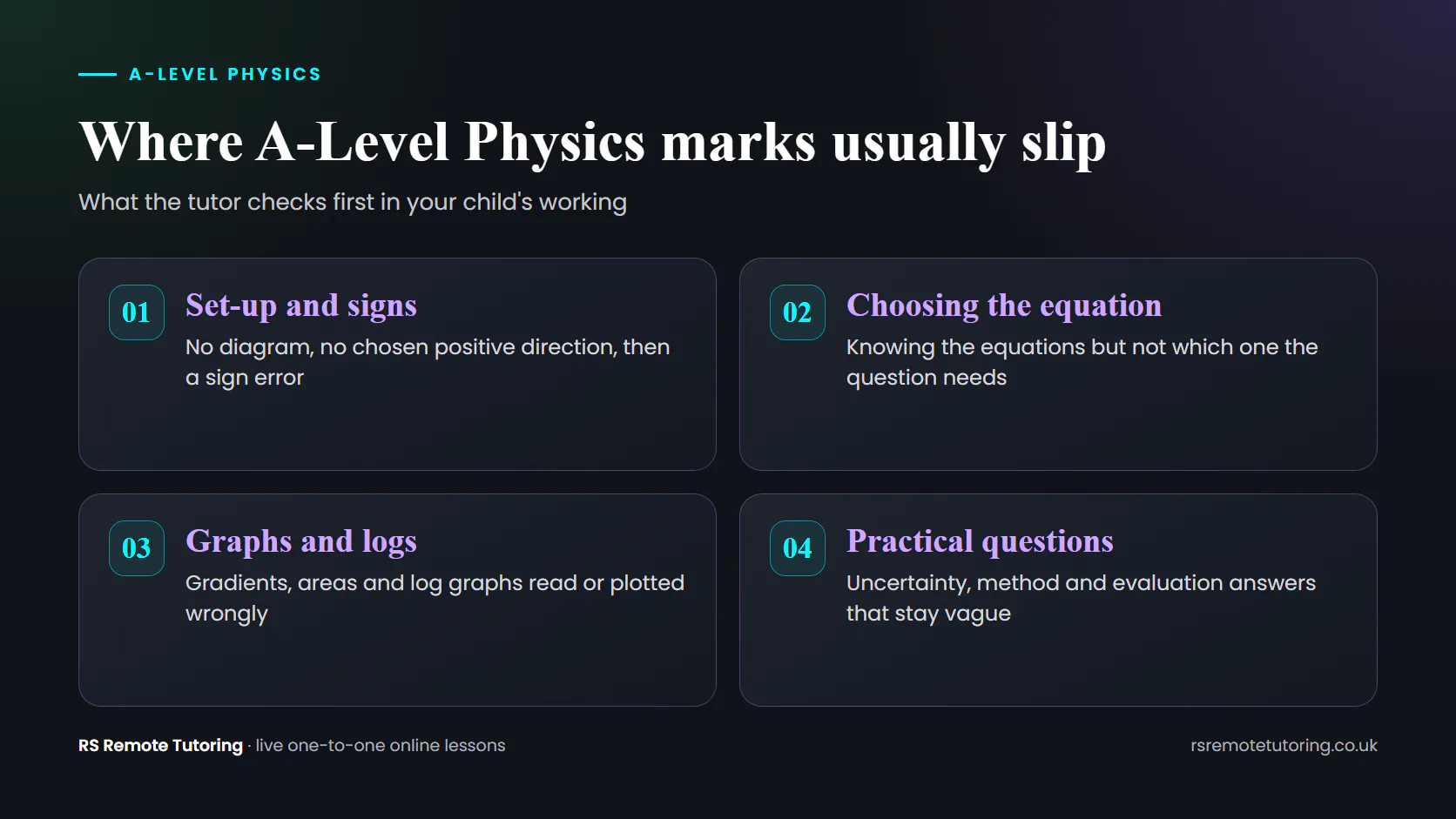
Most errors start with the set-up. Lessons begin each problem with a labelled diagram and the direction chosen as positive, because a sign error at the start cannot be fixed later.
Electricity and circuits
Current, potential difference, resistance, resistivity, internal resistance and potential dividers all come up, along with capacitors on most courses.
Students often know the equations but cannot say what happens to each reading when one component changes. We practise that reasoning step by step, because exam questions rarely give a straight calculation.
Waves, fields and further topics
Waves covers superposition, interference, diffraction and refraction. Year 13 brings gravitational, electric and magnetic fields, thermal physics and nuclear physics, plus particles and quantum ideas depending on the board.
Field topics are where picturing the physics matters most, and it is where Dr Müller’s teaching concentrates.
Maths, graphs and practical theory
The maths runs through every paper. AQA, for example, states that at least 40% of its A-Level Physics marks test mathematical skills. Lessons cover rearranging, logarithmic graphs, gradients, areas and uncertainties.
Practical questions on method, uncertainty and data analysis are practised directly, using the format of your child’s papers.
Mechanics, electricity, waves and fields, taught one-to-one and matched to your child’s exam board.
Your board and papers
Which A-Level Physics papers and options will your child sit?
AQA, Pearson Edexcel and OCR group physics topics into papers differently, and AQA students also study one optional topic for Paper 3. When you enquire we check the specification code and option alongside Dr Müller’s availability, so practice uses your child’s paper format.
Each main Physics course ends with three written papers in the summer of Year 13, and the practical endorsement is reported on its own. The written papers are set out below.
Board and specification
How the written papers are set
AQA A-Level Physics (7408)
Paper 1 covers sections 1 to 5 and periodic motion; Paper 2 thermal physics, fields and nuclear physics; Paper 3 practical skills and data analysis plus one optional topic. Each paper is two hours
AQA Paper 3 options
Astrophysics, medical physics, engineering physics, turning points in physics or electronics. Tell us which one your child’s school teaches
Pearson Edexcel A-Level Physics (9PH0)
Advanced Physics I and Advanced Physics II last 1 hour 45 minutes apiece; the third paper, General and Practical Principles in Physics, lasts 2 hours 30 minutes
OCR A-Level Physics A (H556)
Modelling physics and Exploring physics run for 2 hours 15 minutes; Unified physics runs for 1 hour 30 minutes and draws on every module
OCR Physics B, Advancing Physics (H557)
Advancing Physics follows its own context-led layout; mention it when you get in touch and we will check whether Dr Müller can teach it before any trial
Practical endorsement
Judged by your child’s physics teachers through lab work and reported as pass or not classified, separate from the A-Level grade
Because the endorsement is earned in the school or college lab, it sits outside what an online lesson can deliver. Lessons instead cover the practical physics examined on paper: choosing apparatus, planning methods, combining uncertainties and analysing results.
Year 12 and Year 13
How does A-Level Physics get harder in Year 13?
Year 12 builds the core: measurement, mechanics, materials, electricity, waves and particles. Year 13 adds fields, thermal physics, nuclear physics and the further mechanics that depend on it, then tests both years together. Dr Müller follows the sequence your child’s school uses.
Year 12: making the core reliable
The jump from GCSE is mostly in the maths and the reasoning. Your child now needs to resolve vectors, combine equations of motion and explain circuit behaviour in a sentence, not just calculate it.
Projectile motion is a good example: your child splits the velocity into components, solves each direction separately and checks the answer makes physical sense.
Year 13: fields and harder graphs
Year 13 brings gravitational and electric fields, capacitors, magnetic flux, thermal physics and radioactive decay. Exponential changes and logarithmic graphs become routine.
Capacitor discharge is typical: the lesson builds the exponential model, then uses a log graph of real readings to find the time constant.
Retakes and late starts
Students who start late in Year 13 or are retaking need a tighter plan. Dr Müller puts the highest-mark topics for your child first and timed papers after. Give us the exam dates in your first message, because they decide which of her slots are realistic.
The first lessons show which of these is costing your child the most marks.
Is it right for your child
Who is one-to-one A-Level Physics tuition for?
One-to-one A-Level Physics tuition helps students who handle the algebra but cannot picture fields or circuits, who lose the thread in multi-step problems, or whose mock grade sits under an engineering or science offer. Strong students can push into harder problems.
A private A-Level Physics tutor may help if your child:
knows the equations but cannot tell which one a question needs;
loses track of directions and signs in mechanics problems;
struggles to explain what happens in a circuit when something changes;
finds fields, capacitors or exponential decay hard to picture;
drops marks on uncertainty, graph and practical method questions;
needs Physics for an engineering or science offer and the mock grade is below it.
Because lessons are arranged on request, the first conversation also covers timing. We check that a regular weekly slot exists before suggesting a trial, so your child does not start with a tutor who cannot continue.
Each lesson follows the same rhythm, so progress is easy to follow.
Inside a lesson
What does a typical A-Level Physics lesson look like?
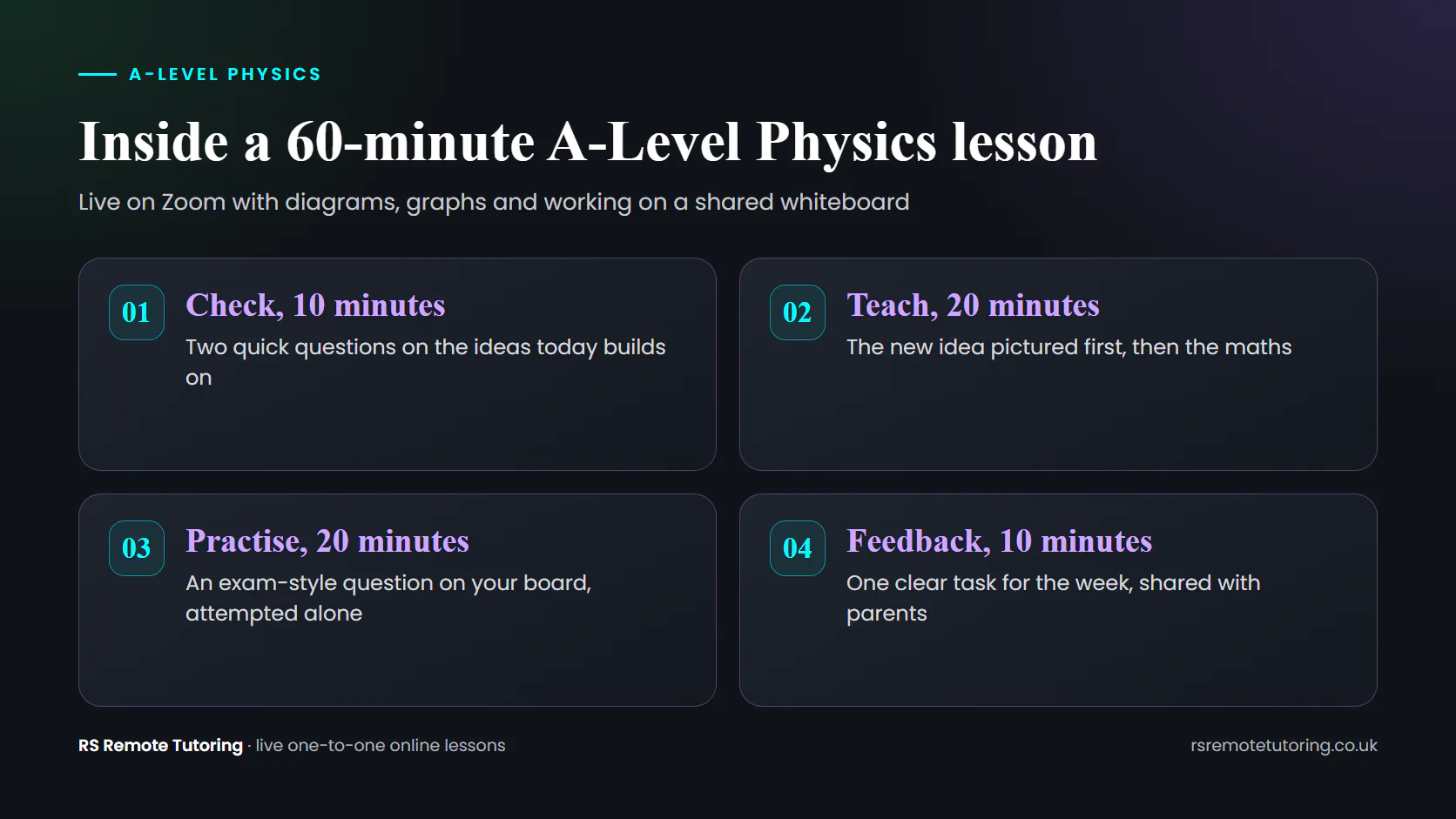
Here is a 60-minute Year 13 capacitor discharge lesson on Zoom: a recap of charge and current, the exponential model built together on the whiteboard, a data question your child plots and solves alone, then feedback shared with you.
CheckAbout 10 minutesTwo short questions using Q = It and the energy stored in a capacitor. If either slips, the tutor fixes it first, because the discharge equation builds on both.
TeachAbout 20 minutesWhy the current falls as the capacitor discharges, then the exponential equation and the time constant. Your child sketches the graph and explains its shape in words.
PractiseAbout 20 minutesAn exam-style question with a table of readings, attempted alone: plot a log graph, find the gradient and work out the time constant, with units.
FeedbackAbout 10 minutesWhether the time constant came out right with units, which step needed help, and one discharge or charging question for the week. You get the same summary.
Over the first few lessons Dr Müller works out whether your child’s physics marks go on the maths, the reasoning or exam technique, and sets the following weeks around that.
Who teaches A-Level Physics
Who will teach my child A-Level Physics?
A-Level Physics is taught by Dr Anna Müller, who holds a PhD in Physics. She takes A-Level students on request, so places depend on her availability that term. We confirm a suitable weekly slot with you before arranging the free 30-minute trial.
Dr Anna Müller
Physics and Combined Science, A-Level on request
PhD Physics
Waves, forces and electricity
Real situations come first in Anna’s lessons and the formula sheet second. She focuses on waves, forces and electricity, the areas where students who can do the maths still struggle to picture the physics. She teaches GCSE Physics and Combined Science as well, and takes A-Level Physics students on request.
Because there is one A-Level Physics tutor, we are open about availability from the first message. If no regular slot suits, we will tell you before any trial is booked. We checked Dr Müller’s ID, her PhD certificate and her references before she taught a single lesson, and her enhanced DBS check is current.
Four steps to start
What happens when you ask for A-Level Physics lessons?
Because A-Level Physics is on request, availability comes first. You send the board, the problem topics and your child’s free times; we check Dr Müller’s diary; if a weekly slot exists, the free 30-minute trial comes next, with no commitment before it.
Tell us what you needMessage us on WhatsApp or use the trial form with the year group, specification code (and AQA option if relevant), current and target grades, the physics that keeps going wrong and every time your child could do.
We check availabilityA coordinator checks whether Dr Müller has a regular weekly slot that fits, and tells you plainly either way before anything is booked.
Try a free 30-minute lessonWith a slot confirmed, your child joins Dr Müller on Zoom for half an hour and works a real A-Level question, perhaps a circuit or a fields problem. You give no card details for this.
Book weekly lessonsIf it goes well, the slot becomes your child’s regular weekly lesson with Dr Müller, and you hear how it went after each one.
Have a marked physics mock or a homework your child could not finish ready for the trial. It lets Dr Müller see the lost marks from the first minute.
Each 60-minute A-Level Physics lesson is £30, the same as a lesson in any other subject or level with us. Three or more a week bring it to £27.50 per lesson, the annual plan paid upfront to £25, and the half-hour trial is free.
Meet your tutor first
Free
30-minute one-to-one trial on Zoom
No card details. No obligation to continue.
Standard lesson
£30
60-minute one-to-one online lesson
The same rate for every tutor and every level.
Three or more a week
£27.50
Per 60-minute lesson
For families booking three or more lessons each week.
Annual plan
£25
Per 60-minute lesson, paid upfront
48 weekly lessons for £1,200.
Arranging a lesson on request costs nothing extra, and an hour with a PhD physicist is charged at the standard rate. No sign-up, matching or planning fees apply, and booking and rescheduling are explained before you pay.
You get a PhD physicist who teaches your child every week, corrections made while the working is on the whiteboard, and a plain update after each lesson. We have taught UK students online since 2020, and we say upfront whether a Physics slot exists.
A consistent weekly tutor
Once lessons start, your child has the same tutor at a fixed time each week. Over a term, that tutor learns exactly where your child’s reasoning slips and plans around it.
Updates you can use
A short note follows every lesson: the physics covered, the steps your child now does reliably, the ones still slipping and the practice for the week. There’s no need for a parent to join.
Straight answers on availability
A slot is confirmed before the trial, not after it, so your child never starts with a tutor who then has no time. Dr Müller is vetted and holds an enhanced DBS check.
A-Level Physics sits within our wider A-Level tutoring. Students who find the maths in Physics is holding them back can also take A-Level Maths tutoring, which covers the algebra, calculus and mechanics the two subjects share.
London and UK families
Can my child have A-Level Physics lessons from outside London?
Yes, subject to Dr Müller’s availability. Every lesson is on Zoom, which means a student in York or Southampton is taught the same way as one in Twickenham. We work from Feltham in Greater London and fit lesson times around school and her free slots.
Sketching field lines, circuit diagrams and log graphs needs a proper screen, so a laptop, tablet or desktop with a camera is the right kit; a phone connects but is cramped. Zoom is free and ordinary home broadband copes fine.
Physics enquiries are answered at any hour, seven days a week, and WhatsApp tends to be the quickest channel. Year 11 students can lay the groundwork first with our GCSE Physics tutoring, which several of our tutors teach.
Common questions
Frequently Asked Questions
What parents ask before requesting A-Level Physics lessons: availability, Dr Müller, boards and AQA options, price and the trial.
Do you offer A-Level Physics tutoring?
Yes, on request. A-Level Physics lessons depend on tutor availability that term, so we confirm a suitable weekly slot with you before booking the free trial. If nothing fits, we tell you straight away.
Who teaches A-Level Physics?
Dr Anna Müller, who holds a PhD in Physics and also teaches GCSE Physics and Combined Science. She takes A-Level students on request, depending on her timetable.
How much does an A-Level Physics tutor cost?
£30 for each 60-minute lesson. Book three or more lessons a week and each is £27.50; on the annual plan, paid upfront, each is £25. No card details are taken for the free 30-minute trial.
Which exam boards do you cover for A-Level Physics?
AQA, Pearson Edexcel and OCR. Give us the specification code from a mock paper and, for AQA, the Paper 3 option the school teaches, so we can check the fit before arranging a trial.
Can lessons help with the maths in Physics?
Yes. Rearranging equations, logarithmic graphs, gradients, areas under graphs and uncertainties are practised inside physics questions, so your child learns when to use each technique and not only how.
Does Dr Müller teach the physics practical endorsement?
She teaches the practical physics the written papers examine: apparatus, methods, uncertainties and data analysis. The endorsement is assessed through lab work at your child’s school or college, so it cannot be completed online.
Is there time for Physics tuition before mocks or the summer exams?
Sometimes, but slots are tighter close to exams. Send the dates, the board and the weakest topics in your enquiry, and we will say honestly whether regular lessons can fit in before them.
How do we request an A-Level Physics trial?
WhatsApp us, or fill in the trial form choosing A-Levels and then Physics. Include the board, the main difficulty and your child’s free times, and we will confirm Dr Müller’s availability before any trial is booked.
Free 30-minute trial, subject to availability
Ask us about an A-Level Physics slot
Tell us the board, the topic causing most trouble and the times your child is free. We will check availability first, then arrange a free 30-minute lesson with Dr Anna Müller if a regular slot fits.