Your child reads the extract, says something sensible about it out loud, then writes half a page that lands in a low mark band. A GCSE English Language tutor from RS Remote Tutoring works on that gap: turning what your child notices in a text into answers and writing that earn marks.
Every lesson is live on Zoom with one tutor and one student, planned around the two Language papers set by your child’s board. Our GCSE English Language tuition covers unseen extracts, inference, comparison, and creative and transactional writing, and the tutor marks answers while your child is still writing them.
No card details for the trial. No obligation to continue.
Live one-to-one lessonsPersonal tutor matchingFree 30-minute trialEnhanced DBS checked tutorsTeaching since 2020
What lessons cover
What does GCSE English Language tutoring cover?
GCSE English Language tutoring covers the reading and writing skills both exam papers test: finding and inferring meaning, analysing language and structure, comparing and evaluating texts, and writing creatively or to argue. Lessons spend most time on whichever question type is costing your child marks.
Reading and inference
Every Language paper uses texts your child has never seen before, so there is nothing to memorise. Lessons build a reliable way to read an unseen extract: what is happening, what is implied, and which details carry that meaning.
Inference is often where marks start to slip. A student who writes “the character is sad” needs to learn to say how they know, using the writer’s exact words.
Language and structure analysis
Analysis questions reward a few precise comments far more than a long list of techniques. We practise picking a short quotation, naming what the writer does, and explaining the effect on the reader in plain words.
Structure questions trouble many students because they ask about the whole text. The tutor shows your child how to track shifts in focus, from the opening to the ending.
Comparison and evaluation
The longer reading questions ask your child to compare two writers’ viewpoints or to judge how far they agree with a statement about a text. Both need a clear opinion held across the whole answer.
We plan these answers before writing them, so the response argues one line instead of describing the extract paragraph by paragraph.
Creative and transactional writing
Writing is worth half the marks on every major board. Lessons cover descriptive and narrative writing, and writing to argue, persuade or advise in forms such as articles, letters and speeches.
Technical accuracy carries real marks too. The tutor corrects sentence control, punctuation and spelling as your child writes, then sets the one habit to fix next.
Unseen reading and writing practice, taught one-to-one and matched to your child’s exam board.
Your board and papers
Which English Language papers will the lessons prepare for?
Lessons follow the board, specification and paper layout your child will sit, because each board orders its reading and writing tasks differently and draws extracts from different centuries. The board is confirmed before the trial, so every practice extract matches the real Language paper.
Every board sets two written papers, each with a reading section and a writing section. What changes is the type of text, the length of each paper and how the marks are weighted.
Board and specification
How the papers are set out
AQA GCSE English Language (8700)
Paper 1 Explorations in creative reading and writing; Paper 2 Writers’ viewpoints and perspectives; each 1 hour 45 minutes and 50% of the grade
Pearson Edexcel GCSE English Language (1EN0)
Paper 1 Fiction and Imaginative Writing on a 19th-century extract (40%); Paper 2 Non-fiction and Transactional Writing (60%)
Pearson Edexcel English Language 2.0 (1EN2)
Paper 1 Non-Fiction Texts and Paper 2 Contemporary Texts, each 1 hour 55 minutes and 50% of the grade
OCR GCSE English Language (J351)
Communicating information and ideas; Exploring effects and impact; each 2 hours and 50% of the grade
Eduqas GCSE English Language
Component 1 on 20th-century fiction and creative prose writing; Component 2 on 19th and 21st-century non-fiction and transactional writing
Spoken language endorsement
A presentation assessed in school and reported separately as Pass, Merit or Distinction, not part of the 9 to 1 grade
AQA made small changes to some question wording for exams from summer 2026, such as Paper 1 question 4 inviting students to agree, disagree or both. The structure and marks stayed the same, and our tutors practise with the current wording.
Unsure of the board? A photo of the front cover of a Language mock shows the specification code, and we will work out the board from it before the trial is booked.
Is it right for your child
Who is one-to-one GCSE English Language tuition for?
One-to-one GCSE English Language tuition suits students who understand texts but cannot turn that into marks, who freeze on the writing question, or who need a Grade 4 or 5 for college. It also helps confident students chasing a 7 or above.
Your child may benefit from GCSE English Language tutoring if they:
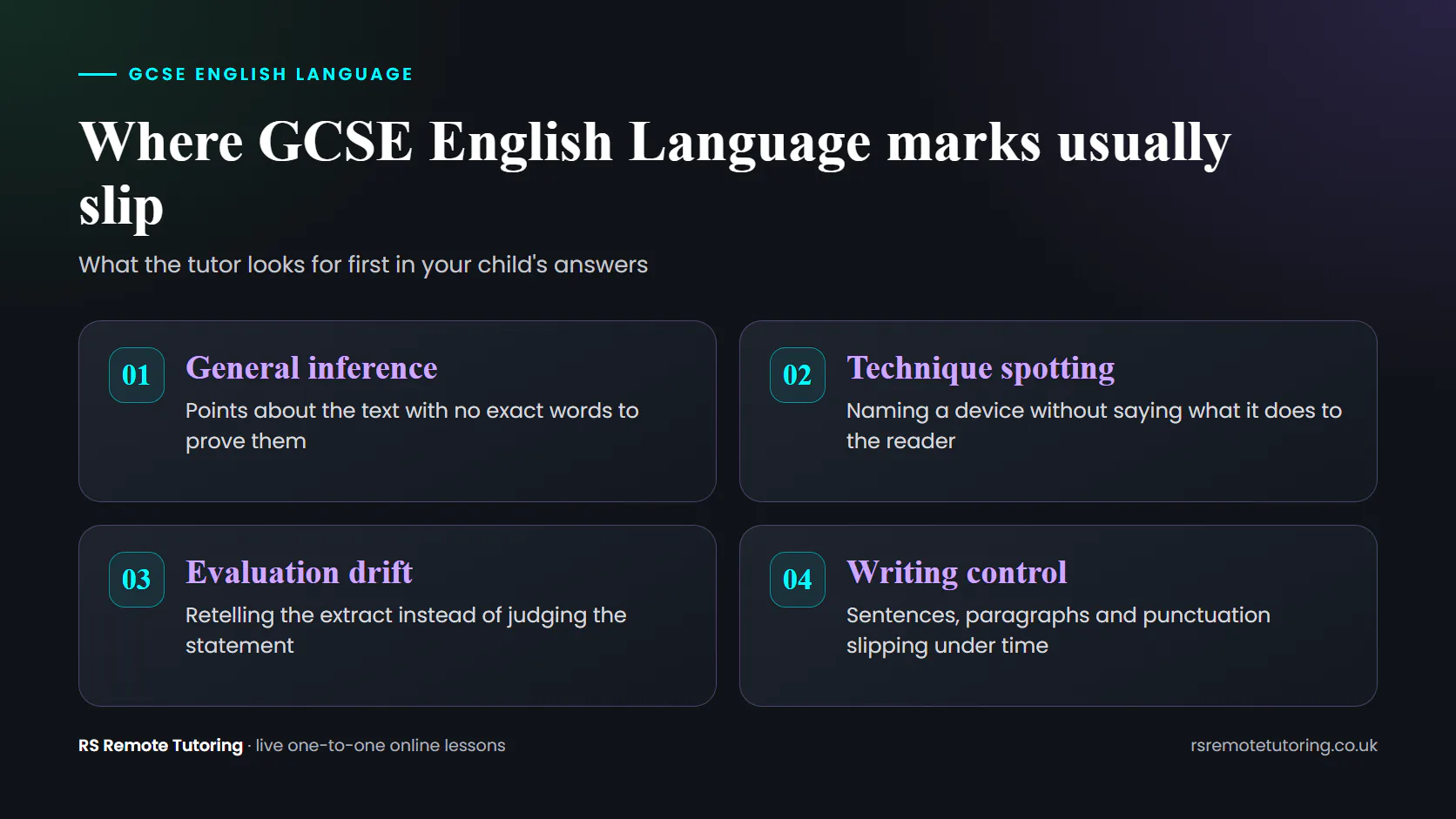
write a lot in reading answers but score low because the points stay general;
list techniques without explaining what they do to the reader;
run out of time before the writing section, which carries half the marks;
write stories that start well and then lose control of sentences and paragraphs;
need a Grade 4 or 5 for a sixth form, college or apprenticeship place;
are resitting after missing a Grade 4 the first time.
The first lessons show which of these matters most. A confident storyteller who skims the extracts needs different lessons from a careful analyst whose own writing comes out rushed and flat.
The first lessons show which of these costs your child the most marks.
Inside a lesson
What does a GCSE English Language lesson look like?
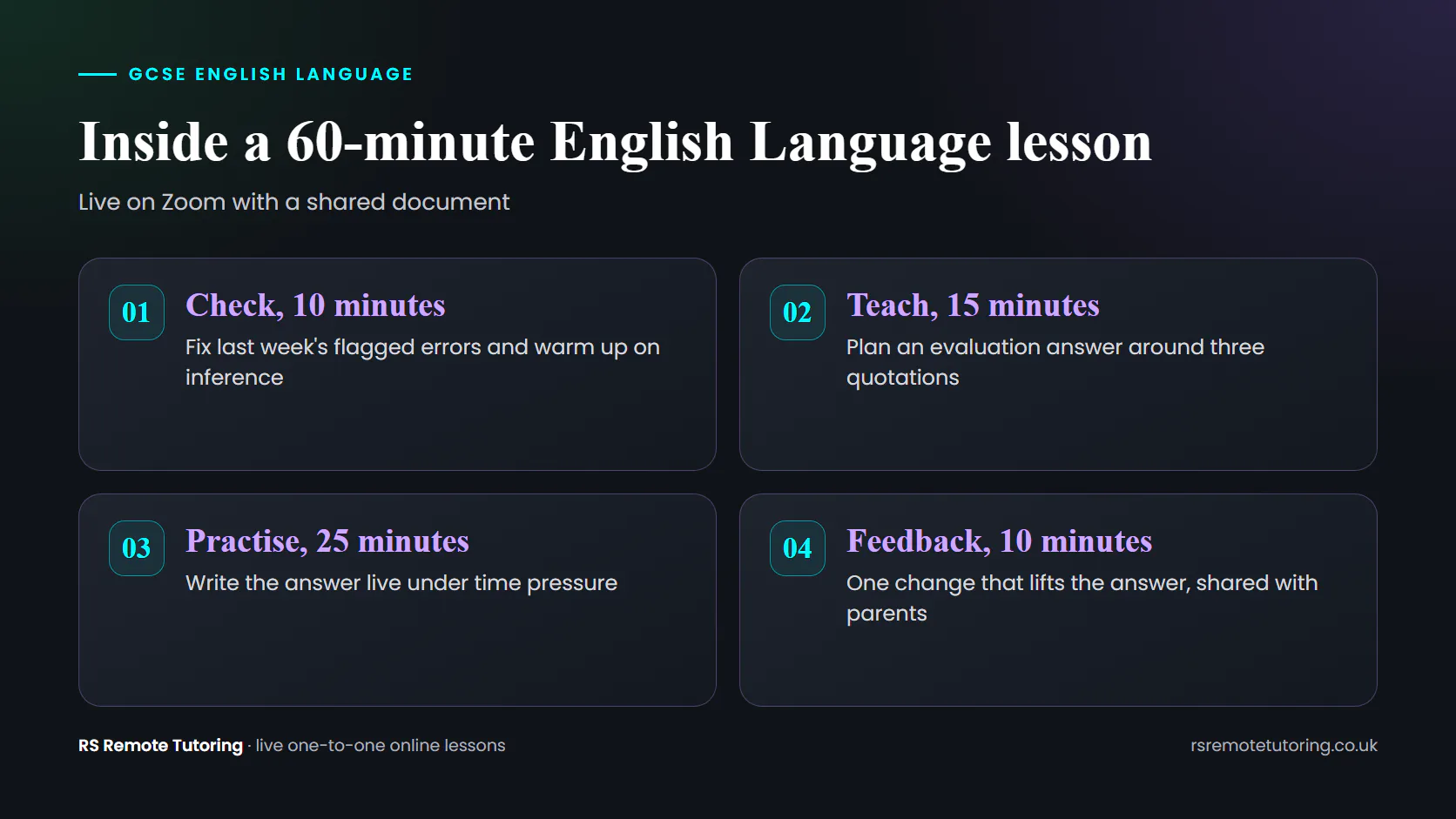
Language lessons last 60 minutes, with your child typing into a shared document the tutor can see. This example targets AQA Paper 1 question 4, the 20-mark evaluation question: a quick check, a model plan, a timed answer written live, then marked feedback.
CheckAbout 10 minutesYour child rereads last week’s paragraph and fixes the two errors the tutor flagged. Then a short inference question on a new extract, to warm up close reading.
TeachAbout 15 minutesThe tutor and your child read the statement together and decide how far they agree. They plan three points, each tied to a quotation and to the writer’s choices.
PractiseAbout 25 minutesYour child writes the answer under time pressure in the shared document. The tutor watches it appear and stops a paragraph that drifts into retelling the story.
FeedbackAbout 10 minutesThe tutor places the answer in a mark scheme level and names the single change that would move it up. Parents get the same summary and next week’s practice task.
The same rhythm works for writing lessons. Your child drafts an opening paragraph live, the tutor marks it line by line for vocabulary, sentence variety and accuracy, and the rewrite happens before the lesson ends.
Each lesson follows the same rhythm, so progress is easy to follow week to week.
Who teaches English Language
Who will teach my child GCSE English Language?
We choose one GCSE English Language tutor for your child, based on board, target grade, weakest paper skill and free times. The team includes a former AQA examiner and a linguistics graduate with a PGDE and fifteen years in English.
Sarah Collins
English Language and Literature, KS3 and GCSE
Former AQA examiner
Exam preparation
Sarah has marked GCSE English papers, so she teaches the difference between an answer that sounds good and one that meets the level descriptors. That matters most in the final months before the exam.
Mei Tang
English, KS3 and GCSE
BA Linguistics
PGDE English
15 years in English education
Mei has led an English department and trained as a teacher on top of a linguistics degree. She is strongest on comprehension, vocabulary and writing accuracy, the habits that quietly cap a Language grade.
Emily Johnson
English Language and Literature
Creative writing
Analytical essays
Emily covers both English papers and focuses on creative writing, the section many students treat as luck. She shows exactly what a stronger description or story opening does differently, then has your child practise it.
Callum Doyle
English, KS3 and GCSE
A*A*B at A-Level
300+ hours taught
Callum works mainly through past paper questions, which suits students who know the theory but lose marks on the paper itself. His lessons keep returning to the real question until the method holds under time.
No Language tutor teaches for us until identity, certificates and references have been checked. Any tutor placed with an under-18, including your child’s, carries a current enhanced DBS check.
Year 10, Year 11 and resits
Does the plan change in Year 10, Year 11 or a resit?
Yes. Year 10 is the time to build reading and writing habits slowly, Year 11 moves to timed questions and full papers, and a resit plan starts from the paper your child sat. We shape lessons around the time left and the grade needed.
Year 10: building the method
Most schools introduce the question types in Year 10, often one at a time. Lessons use that slower pace to make each method automatic, so your child can read an extract and know what each question wants.
Writing gets regular short practice here, because sentence control improves through many small corrections rather than one long essay.
Year 11: timing and full papers
By Year 11 the problem is usually time. Lessons move to timed single questions, then whole sections, so your child learns how long each answer deserves and stops overwriting the short ones.
Before mocks, the tutor uses your child’s own mock paper to set priorities for the remaining months.
Resits: starting from the result
Students who missed a Grade 4 often need fewer skills fixed than they fear. The tutor finds where the marks went and works on those first. Our GCSE resit tutoring covers the November and summer exam series.
Four steps to start
What happens after I ask for a GCSE English Language trial?
It takes four steps. Send the board and a recent Paper 1 or Paper 2 answer, hear which single tutor we suggest and why, test the match in a free 30-minute lesson on that answer, then continue weekly only if your child is happy.
Send an answer and the boardFill in the year group on the trial form, name the board if you can, and add the grade your child is on and aiming for. Mention whether the reading questions or the writing task worries them more.
One tutor, with a reasonA coordinator reads it and suggests a single English Language tutor, saying why that tutor suits this board and this weakness, so there is no shortlist to compare.
A free 30-minute lessonOn Zoom, the tutor usually takes one paragraph your child has written and improves it with them. You never give card details, and there is nothing to cancel if you stop there.
Weekly lessons, or a rematchIf the trial suits, the same tutor keeps a fixed weekly slot. If it does not, we find another English Language tutor and charge nothing for it.
Bring a recent Paper 1 or Paper 2 answer to the trial if you have one, even a weak one. A school report or marked homework works too, and either one shows the tutor where to begin.
How much does GCSE English Language tutoring cost?
A 60-minute GCSE English Language lesson costs £30 with any of our tutors. With a booking of three or more a week, each lesson is £27.50, pay for the year upfront and it is £25, and nothing is charged for the 30-minute trial.
Meet your tutor first
Free
30-minute one-to-one trial on Zoom
No card details. No obligation to continue.
Standard lesson
£30
60-minute one-to-one online lesson
The same rate for every tutor and every level.
Three or more a week
£27.50
Per 60-minute lesson
For families booking three or more lessons each week.
Annual plan
£25
Per 60-minute lesson, paid upfront
48 weekly lessons for £1,200.
Four weekly Language lessons in a month come to £120. You pay nothing to sign up, nothing for the match and nothing for the tutor’s planning, and an hour with the former AQA examiner is priced the same as an hour with anyone else.
What makes our GCSE English Language tutoring different?
Parents pick us because one English Language tutor stays with their child, answers are marked while the sentence is being written, and a report follows every lesson. Founder Rumaan Aslam has run our online teaching for UK families since 2020.
Writing marked as it happens
Your child writes in a shared document and the tutor comments while the sentence is still fresh. Fixing a habit in the moment sticks far better than red ink on an essay handed back next week.
One tutor who knows the writing
Your child sees the same tutor in the same weekly slot. A few weeks in, that tutor knows which writing habits cost marks, something a rotating tutor would never pick up.
Updates in plain English
After every Language lesson you get a short note: the question type covered, what is getting better, what is still slipping and the practice for next week. You do not need to watch the lesson to follow progress.
One parent whose daughter had GCSE Maths and English lessons with us wrote: “The tutors are reliable and professional. They also were very relatable to my 15 year old.” (Diana H, verified review). Language is one half of our GCSE English tutoring, and students taking set texts as well can add GCSE English Literature tuition with the same tutor.
London and UK families
Can my child take GCSE English Language lessons from anywhere in the UK?
Yes. Every GCSE English Language lesson happens on Zoom, so a student in Leeds, Cardiff or central London joins the same way. We run lessons from Feltham in Greater London and set times around school hours and the tutor’s diary.
For the writing tasks, a laptop or desktop with a keyboard is easiest, though a tablet with a webcam also works. Ordinary home broadband is enough and Zoom costs nothing. A phone will do at a pinch, but typing a full story on one is hard work.
Questions parents ask before booking English Language lessons: cost, boards, resits, mock papers, tutors and the free trial.
How much does a GCSE English Language tutor cost?
£30 for each 60-minute lesson. Taking three or more lessons weekly drops it to £27.50, and a year’s lessons bought upfront cost £25 each. The first 30 minutes are a free trial, and we take no card details.
Which exam boards do your English Language tutors cover?
Between them, our Language tutors teach AQA, Pearson Edexcel, OCR, WJEC and Eduqas. If you are unsure, the specification code on a mock paper tells us the board, and the tutor we suggest will know that paper’s question order.
Can you help a student resitting GCSE English Language?
Yes. The tutor starts from where the marks were lost in the first attempt and works on those skills first. Tell us which exam series your child is entered for when you book the trial.
Is Year 10 too early to start English Language tuition?
No, Year 10 is often the most useful time. Reading and writing improve through steady practice, and starting early leaves room to fix habits before timed papers and mocks take over in Year 11.
Can the tutor work on my child’s mock papers?
Yes. Send or bring a recent mock paper and the tutor will use it to see which questions lose marks. Your child then reworks answers in the lesson with corrections as they write.
Does my child keep one English Language tutor all year?
Yes. One tutor teaches your child at one fixed weekly time and gets to know their writing closely. If the pairing stops working at any point, say so and we will rematch at no cost.
Do you also teach GCSE English Literature?
Yes. Most of our English tutors teach both subjects, so one tutor can split time between Language skills and set texts. The price is the same £30 a lesson whichever subject the lesson covers.
How do we book a GCSE English Language trial?
Open the trial form, choose English Language as the subject, then add your child’s year group and, if known, the exam board. A tutor and a time are usually confirmed within a day or two.
Free 30-minute trial
Turn what your child notices into marks
Start with the question or writing task that worries your child most. In a free 30-minute trial, the tutor finds where the reading and writing marks are leaking and sketches the next few weeks of work.