Your child knows what happens in Macbeth and can name the themes, yet the essay comes back marked as description. A GCSE English Literature tutor from RS Remote Tutoring teaches the step that is missing: an argument about the writer’s choices, held together by well-chosen quotations.
Each Zoom lesson is one-to-one and works from the play, novel and poems your child’s school has chosen for the exam. Our GCSE English Literature tutoring covers Shakespeare, the 19th-century novel, the modern text, the poetry anthology and unseen poetry, with essays planned and marked in the lesson.
No card details for the trial. No obligation to continue.
Live one-to-one lessonsPersonal tutor matchingFree 30-minute trialEnhanced DBS checked tutorsTeaching since 2020
What lessons cover
What does GCSE English Literature tutoring cover?
GCSE English Literature tutoring covers every part of the course your child is examined on: the Shakespeare play, the 19th-century novel, the modern text, the poetry anthology and unseen poetry. Lessons work from the texts your child’s school is studying, not a generic list.
Shakespeare
Most boards start the Shakespeare question with an extract, then ask about the whole play. We practise reading the extract closely for language and staging, and linking it to two or three other moments your child can quote.
Shakespeare’s language puts many students off. The tutor works through key speeches line by line until your child can explain them in their own words.
The novel and the modern text
The 19th-century novel and the modern play or novel both need an argument about character, theme and the writer’s purpose. Lessons turn plot knowledge into a clear view your child can defend.
Context is used where it supports a point, such as Victorian attitudes in a Dickens novel, rather than as a paragraph of history bolted on.
Poetry comparison
The anthology question asks your child to compare poems from the cluster the school has studied. We build comparison into every paragraph, so both poems are discussed together instead of one after the other.
Students often know the poems they like and avoid the rest. The tutor makes sure every poem in the cluster has a few secure quotations ready.
Unseen poetry
Unseen poems cannot be revised, so lessons build a repeatable way to read one cold: what the speaker feels, how it shifts, and which images carry that change.
Your child practises on short, unfamiliar poems under time, then compares two, which is what several boards ask for.
Set texts, Shakespeare and poetry, taught one-to-one and matched to your child’s exam board.
Your board and papers
How do lessons fit your child’s board and set texts?
Lessons follow your child’s board, papers and set texts, because each board groups the texts differently and asks different question types. We check the board and the texts before the trial, so the tutor arrives prepared for the books your child is actually studying.
Every board examines a Shakespeare play, a 19th-century novel, a modern text and poetry, but they split them across two papers in different ways.
Board and specification
How the papers are set out
AQA GCSE English Literature (8702)
Paper 1 Shakespeare and the 19th-century novel (1 hour 45 minutes, 40%); Paper 2 Modern texts and poetry, including the anthology and unseen poetry (2 hours 15 minutes, 60%)
Pearson Edexcel GCSE English Literature (1ET0)
Paper 1 Shakespeare and Post-1914 Literature; Paper 2 19th-century Novel and Poetry since 1789, including two unseen poems to compare; each 50%
OCR GCSE English Literature (J352)
Exploring modern and literary heritage texts; Exploring poetry and Shakespeare; each 2 hours and 50%
Eduqas GCSE English Literature
Component 1 Shakespeare and poetry (40%); Component 2 post-1914 prose or drama, 19th-century prose and unseen poetry (60%)
Closed book
AQA and Pearson Edexcel exams are closed book, so quotations have to be learned rather than looked up
Set texts
Schools choose from each board’s list. Send us the titles and we will match a tutor who teaches them
Board lists do change. Eduqas has a new poetry anthology for first exams in summer 2027, so tell us which anthology your child’s class is using.
Is it right for your child
Who is one-to-one GCSE English Literature tuition for?
One-to-one GCSE English Literature tuition suits students who know the texts but write plot summaries, who cannot remember quotations in a closed-book exam, or who dread the poetry questions. It also stretches strong students aiming for a 7, 8 or 9.
Your child may benefit from a GCSE English Literature tutor if they:
retell the story when the question asks about the writer’s methods;
remember plenty of quotations but struggle to choose the right one;
write about one poem, then the other, instead of comparing them;
freeze when an unseen poem appears with no notes to lean on;
find Shakespeare’s language hard to follow, so avoid the extract;
get essays back with comments about structure they do not know how to fix.
A short essay in the trial usually shows which of these matters most. The plan for the following weeks starts there, not with the text your child happens to like least.
Inside a lesson
What does a GCSE English Literature lesson look like?
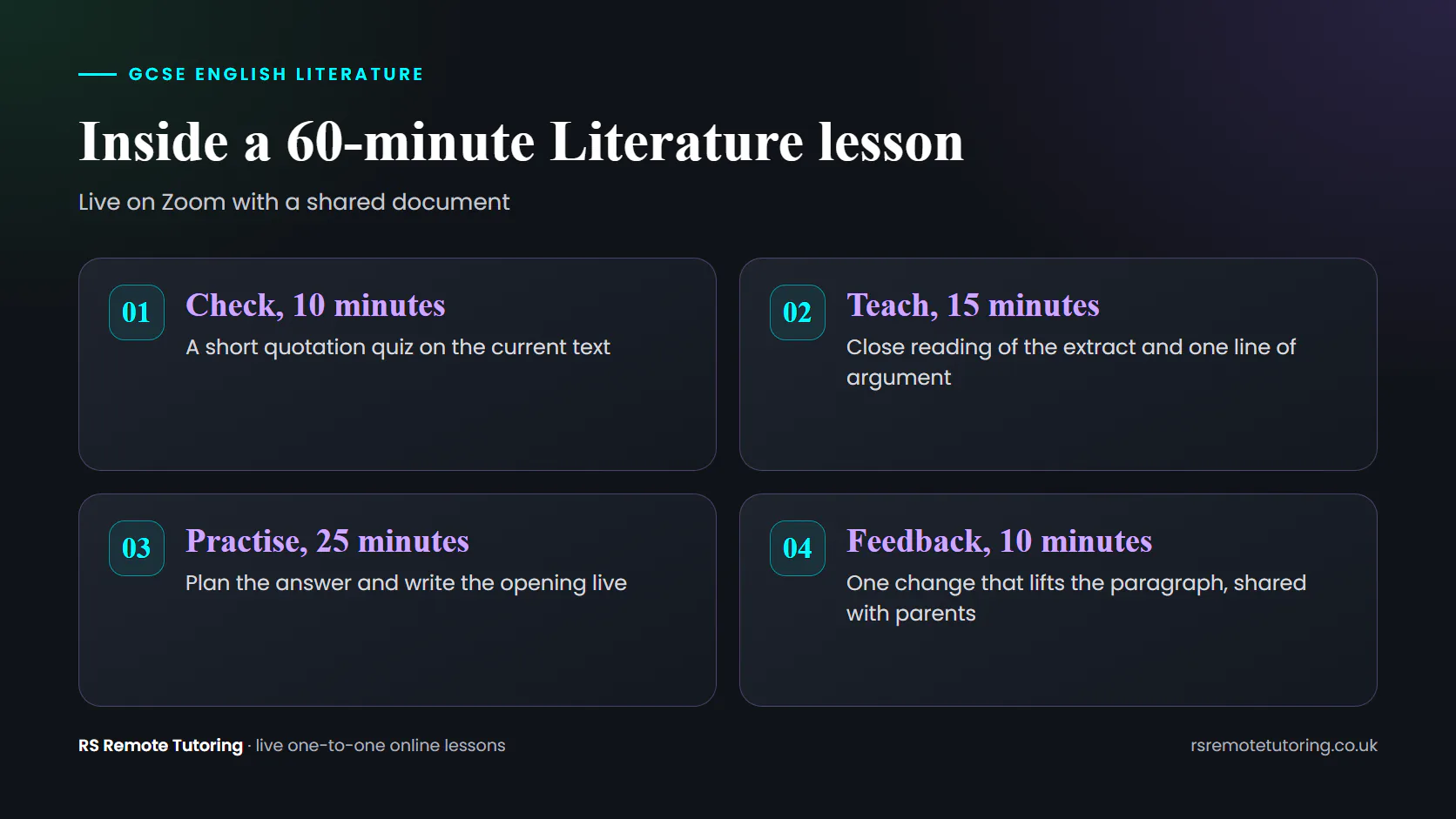
Each Literature lesson lasts an hour, with plans and paragraphs written in a shared document. This one prepares a Macbeth answer on an extract and the whole play: a quotation check, close reading, a timed plan and opening, then marked feedback.
CheckAbout 10 minutesA quick quotation quiz on Macbeth’s ambition and guilt. Your child explains what each quotation shows, not only who says it.
TeachAbout 15 minutesTutor and student read the extract together, annotate two or three key images and agree one line of argument about how Shakespeare presents Macbeth.
PractiseAbout 25 minutesYour child plans the answer, linking the extract to two other scenes, then writes the opening and first paragraph while the tutor watches and questions each claim.
FeedbackAbout 10 minutesThe tutor reads the paragraph against the top mark scheme levels and points to the one sentence that would push it higher. Parents receive the summary and the paragraph to finish before next week.
Poetry lessons follow the same pattern. Two poems go side by side, your child builds a comparison table of ideas and methods, and then writes one paragraph that discusses both poems at once.
Each lesson follows the same rhythm, whichever text is being studied.
Quotations and essays
How do lessons improve quotations and essays?
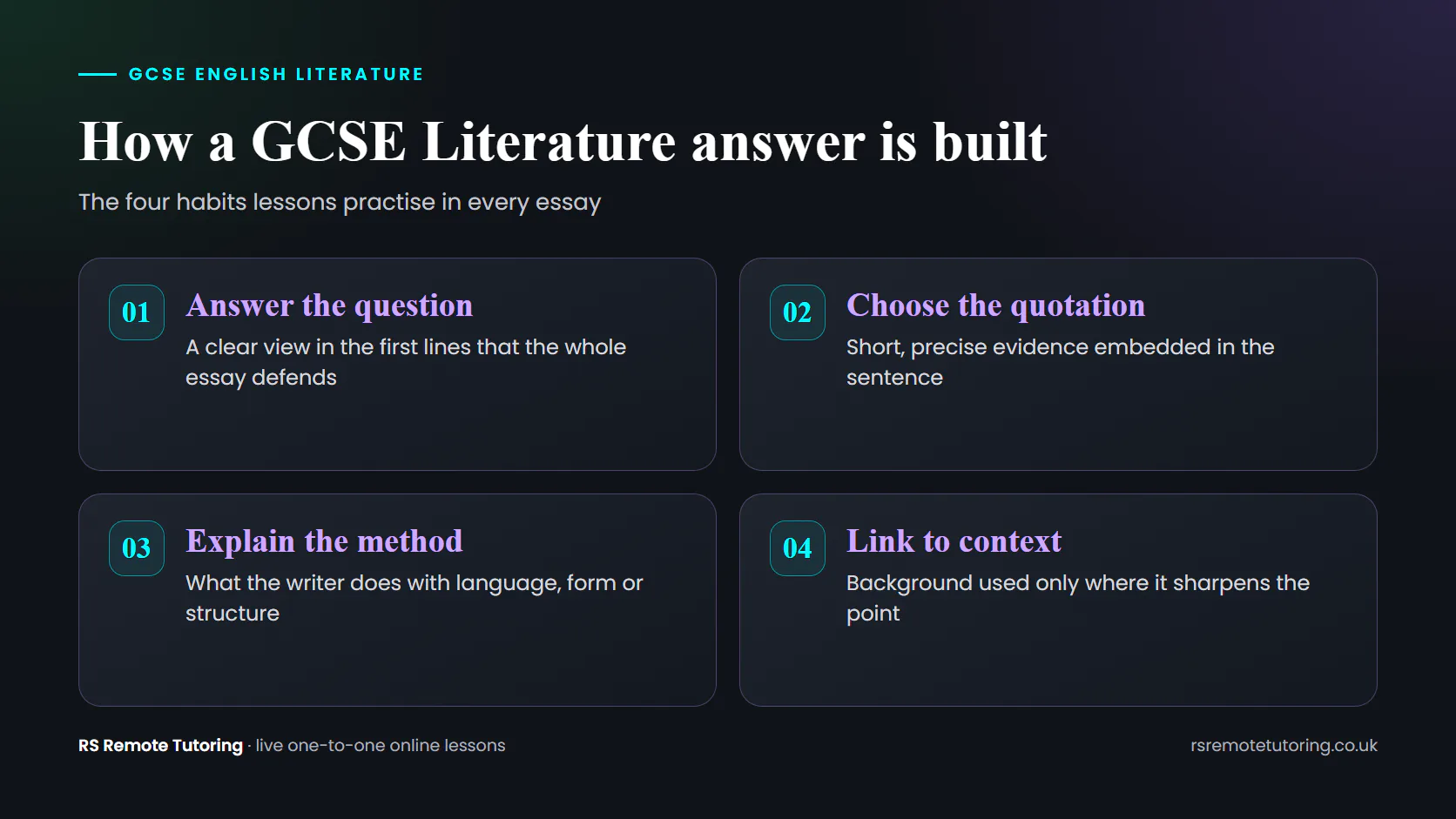
Lessons improve quotations by having your child build and test a short bank for each text, then practise using them inside sentences. Essays improve through planning an argument first and getting live feedback on each paragraph against the levels examiners use.
Quotations your child can use
Learning fifty quotations rarely helps. Your child builds a bank of short, flexible ones for each text, grouped by character and theme, and tests them at the start of lessons.
We also practise embedding a few words of quotation inside a sentence, which reads more fluently and is easier to remember under exam pressure.
Essays with a clear argument
Strong Literature essays answer the question in the first lines and keep returning to it. The tutor shows your child how to plan three or four points that build an argument rather than a list.
Each paragraph is read in the lesson and your child rewrites the weakest sentence before moving on.
Feedback you can see
Parents hear after every lesson which text was covered, what improved in the writing and what to practise next. Marked school essays are useful too, so send them and the tutor will build on the teacher’s comments.
Lessons practise these habits on the texts your child is studying.
Who teaches Literature
Who will teach my child GCSE English Literature?
Your child’s GCSE English Literature tutor is chosen for the set texts first, then the board, target grade and the part of the course that feels hardest. The team includes a poetry and Shakespeare specialist and a former AQA examiner.
Sophie Green
English Language and Literature
Poetry and Shakespeare
Essay structure
Sophie concentrates on the parts of Literature where structure decides the mark: poetry comparison, the Shakespeare extract question and building an argument across a full essay. She suits students whose ideas are good but whose essays wander.
Sarah Collins
English Language and Literature, KS3 and GCSE
Former AQA examiner
Exam preparation
Having marked the papers, Sarah teaches what the top levels actually reward in a Literature answer. Her lessons are especially useful in the final term, when every essay should be aimed at the mark scheme.
Amara Bello
English, KS3 and GCSE
Bachelor’s degree
4+ years tutoring
Amara works with students who do not enjoy English and simply need to get through it with a solid grade. Her focus is essay writing that is clear, organised and unafraid of the question.
Ben Ashcroft
Religious Studies and English
Classroom teaching experience
Private tuition
With classroom experience behind his private teaching, Ben treats a Literature essay as a reasoned argument. He helps students put their own reading of a text on paper with confidence.
All tutors are vetted before their first lesson: identity confirmed, certificates checked and references taken up. As your child is under 18, their Literature tutor will also hold a current enhanced DBS check.
Four steps to start
What should I send to start GCSE English Literature lessons?
Start by telling us which set texts the school is studying and the board, if known. We put forward one tutor who teaches those texts, a free 30-minute trial follows, and weekly lessons begin only if it works.
Send the texts and the problemList the Shakespeare play, the novel, the modern text and the anthology cluster on the trial form, with the year group and the board if you know it. Then say which of them your child dreads most.
One tutor who knows the booksA coordinator checks which of our Literature tutors teaches those titles and puts one forward, explaining why that tutor fits.
Try a free 30-minute lessonThe trial is usually a conversation on Zoom about a short extract or poem from one of the set texts. We take no card details, so you have nothing to cancel.
Book weekly lessonsWhen the trial goes well, the same tutor takes every lesson at a set weekly time. When it does not, we suggest someone else at no cost.
A recent marked essay or mock answer is the single most useful thing to have ready for the trial. It shows the tutor the writing habits behind the grade.
How much does GCSE English Literature tutoring cost?
Every 60-minute GCSE English Literature lesson is £30, whichever tutor or set text your child has. The rate is £27.50 with three or more weekly lessons, £25 a lesson on a year paid upfront, and the 30-minute trial is free.
Meet your tutor first
Free
30-minute one-to-one trial on Zoom
No card details. No obligation to continue.
Standard lesson
£30
60-minute one-to-one online lesson
The same rate for every tutor and every level.
Three or more a week
£27.50
Per 60-minute lesson
For families booking three or more lessons each week.
Annual plan
£25
Per 60-minute lesson, paid upfront
48 weekly lessons for £1,200.
Over a four-week month, one Literature lesson a week comes to £120. Joining is free, matching is free, and the time a tutor spends preparing your child’s set texts is never billed.
Why do families trust us with GCSE English Literature?
Parents value a Literature tutor matched to the set texts, essays that are planned and corrected in the lesson itself, and an honest note after each session. Founded by head tutor Rumaan Aslam, we have taught online since 2020.
Matched to your set texts
We ask for the titles before matching, so your child is not paired with someone reading A Christmas Carol for the first time alongside them.
The same tutor each week
Lessons stay with one tutor in one regular weekly slot, so that tutor learns which quotations stick, which texts are weak and how your child’s essays tend to go wrong.
Checked tutors, free rematch
Every Literature tutor passes identity, certificate and reference checks, and any placed with a student under 18 has a current enhanced DBS check. Say the word at any stage and a different Literature tutor takes over, at no charge.
Where in the UK can my child take GCSE English Literature lessons?
Anywhere in the UK. Our GCSE English Literature lessons happen entirely online, so your postcode makes no difference to the teaching. RS Remote Tutoring works from Feltham, Greater London, and fits lessons around your child’s school week and the tutor’s free slots.
Keep the set texts within reach, ideally the editions used in class. Any laptop, tablet or desktop with a camera will run Zoom, which is free, over ordinary broadband. Essays can be planned on a phone, but a bigger screen makes it far easier.
Younger students meeting Shakespeare and poetry for the first time can start with KS3 English tutoring. Year 11 students short on time before the exams may prefer focused GCSE revision tutoring across several subjects.
Common questions
Frequently Asked Questions
What parents ask us about Literature tuition: set texts, unseen poetry, essay feedback, boards, cost and the trial.
How much does a GCSE English Literature tutor cost?
Each 60-minute Literature lesson is £30. Lessons drop to £27.50 each once your child is booked for three or more a week, and to £25 on the annual plan paid upfront. Nobody asks for card details for the free 30-minute trial.
Do your tutors teach my child’s set texts?
We match a tutor to the texts your child’s school is studying. Send the titles and the anthology cluster when you enquire, and we will check before suggesting a tutor rather than promising every text in advance.
Which exam boards do your Literature tutors cover?
Our Literature tutors work with AQA, Pearson Edexcel, OCR, WJEC and Eduqas. Unsure which board? The titles of the set texts will usually tell us.
Can a tutor help with unseen poetry?
Yes. Lessons practise a step-by-step way to read an unfamiliar poem and compare two, using short poems your child has not seen. Regular practice is what makes the unseen questions feel manageable.
Will the tutor give feedback on my child’s essays?
Yes. Your child plans and writes in the lesson and the tutor gives feedback on each paragraph as it is written. Send any marked school essays too, so the tutor can build on the teacher’s comments.
Is it too late to start Literature tutoring before mocks or the real exams?
No. Tell us the exam dates and the texts that feel weakest when you book, and the early lessons go on quotations, timed plans and practice answers for those texts.
Does my child keep the same Literature tutor?
Yes. One tutor teaches every lesson in the same weekly slot and gets to know how your child writes about each text. Ask for a different tutor at any stage and we will rematch free of charge.
How do we book a GCSE English Literature trial?
On the trial form, select English Literature and give your child’s year group. Listing the set texts and board helps us choose the right tutor, and we then come back to you with a time.
Free 30-minute trial
Help your child write about texts, not just know them
Start with the text or question your child finds hardest. In a free 30-minute trial, a GCSE English Literature tutor matched to that text shows how your child’s essays can move from retelling the plot to arguing a point.