Your child comes home with a Science test marked “explain more” on every answer. They know the words, like particles, energy and cells, but cannot link them into a reason. A KS3 Science tutor from RS Remote Tutoring teaches them to turn what they know into a clear scientific explanation.
Each Zoom lesson pairs your child, in Year 7, 8 or 9, with one tutor and nobody else. Our KS3 Science tuition moves through biology, chemistry and physics in the sequence their school uses, and weaves data, graphs and practical skills into each unit.
No card details for the trial. No obligation to continue.
Live one-to-one lessonsPersonal tutor matchingFree 30-minute trialEnhanced DBS checked tutorsTeaching since 2020
What lessons cover
What does KS3 Science tutoring cover?
KS3 Science tutoring covers the biology, chemistry and physics your child studies in Years 7 to 9, plus the working scientifically skills that run through all three. Lessons focus on the topics your child finds hardest and the explanations tests reward.
Biology: cells, body systems and ecosystems
Lessons cover cells and how they are organised, digestion, breathing, the skeleton and muscles, reproduction, photosynthesis, respiration, food chains, inheritance and variation.
Biology rewards precise words. The tutor helps your child say “diffuses from a high to a low concentration” rather than “moves across”, which is often the difference between one mark and two.
Chemistry: particles, reactions and the periodic table
We work on the particle model, atoms, elements and compounds, mixtures and separation, acids and alkalis, chemical reactions, the periodic table and the Earth’s atmosphere.
Many students learn word equations by heart without seeing what is happening. Lessons use simple particle drawings so your child can picture the reaction first.
Physics: forces, energy, circuits and waves
Physics lessons cover speed, forces and pressure, energy stores and transfers, current and voltage in circuits, magnetism, sound and light waves, and space.
This is where Maths meets Science. The tutor makes sure your child can rearrange a simple formula and use units properly, because that is where marks often go.
Working scientifically
Every topic includes the skills scientists use: planning a fair test, naming variables, taking measurements, drawing graphs and judging whether a conclusion is backed by the results.
These skills appear in school tests across all three sciences and carry straight into GCSE practical questions.
Biology, chemistry and physics foundations, taught one-to-one for Years 7 to 9.
Years 7 to 9
How do lessons change from Year 7 to Year 9?
Lessons follow your child’s school scheme of work, which teaches the KS3 National Curriculum in its own order. Year 7 builds the basics, Year 8 asks for longer explanations, and Year 9 prepares for GCSE Combined or Triple Science. We plan around each stage.
KS3 Science has no exam board. Schools choose their own order of topics, and some start GCSE content during Year 9. The table shows the typical focus at each stage, which the tutor then matches to your child’s actual topics.
Stage
What lessons usually focus on
Year 7
Lab basics, cells, particles and states of matter, simple forces, and writing a method a classmate could follow
Year 8
Body systems, chemical reactions, energy, circuits and waves, with longer answers that link cause and effect
Year 9
Harder ideas such as atomic structure, inheritance and pressure, plus the data and graph skills GCSE expects
Working scientifically
Fair tests, variables, accurate measurement, graphs and evaluating results, practised in every year
Toward GCSE
Secure foundations before your child starts GCSE Combined Science or the three separate sciences
Not sure of the topic
Send a test, homework sheet or the school’s topic list and we will plan from it
When Year 10 begins, our GCSE Science tutoring carries on from the same foundations. Many families keep the same tutor, so nobody has to learn your child’s habits from scratch.
Explanations, data, practicals
How does a tutor help with explanations, data and practical skills?
A tutor helps by practising the three skills school reports most often flag: writing a scientific explanation, reading and drawing graphs, and describing an experiment properly. Each one is taught with a clear structure your child can reuse in any topic.
Scientific explanations
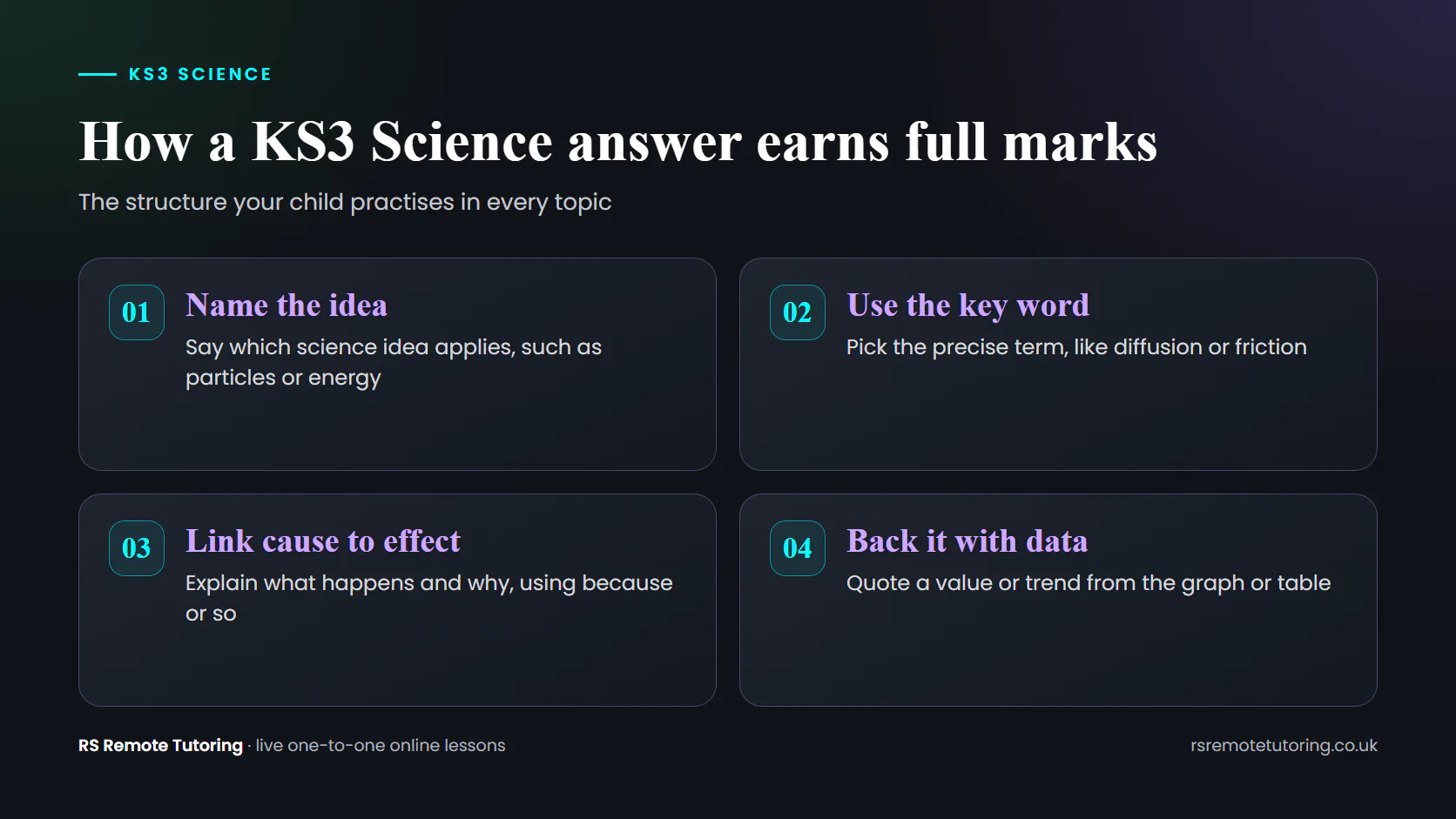
A good answer names the science idea, uses the right key word and links a cause to its effect. The tutor models one answer, then your child writes the next and improves it with feedback.
Over a few weeks, “it gets hot” becomes “the particles gain energy and move faster”.
Data and graphs
Your child practises choosing a bar chart or line graph, labelling axes with units, plotting points accurately and describing a pattern in words.
We also work on reading values from a graph and spotting a result that does not fit, which tests often ask about.
Practical skills at home
Lessons cannot run a school experiment, but they can prepare your child to do one well. We work through methods, independent and dependent variables, control variables, safety and how to make a test fair.
Your child then explains what the results show and how the method could be improved.
Practising one structure helps your child write fuller answers in biology, chemistry and physics.
Is it right for your child
Who is KS3 Science tuition right for?
KS3 Science tuition helps the Year 7 to 9 student whose answers come back marked “explain more”, who gets lost in the maths inside physics and chemistry, or who says Science is not for them. It also gives a firmer start before GCSE options.
An online KS3 Science tutor can help if your child:
knows the key words but writes short, vague answers;
mixes up ideas from biology, chemistry and physics;
struggles to draw or read a graph from results;
panics when a question describes an experiment;
finds formulas, units and calculations confusing;
is choosing options in Year 9 and wants Science to feel secure.
Science at KS3 is often taught as one subject by several teachers, so a gap in one area can go unnoticed for a long time. One-to-one lessons find it early.
Inside a lesson
What does a Year 9 particle model lesson look like?
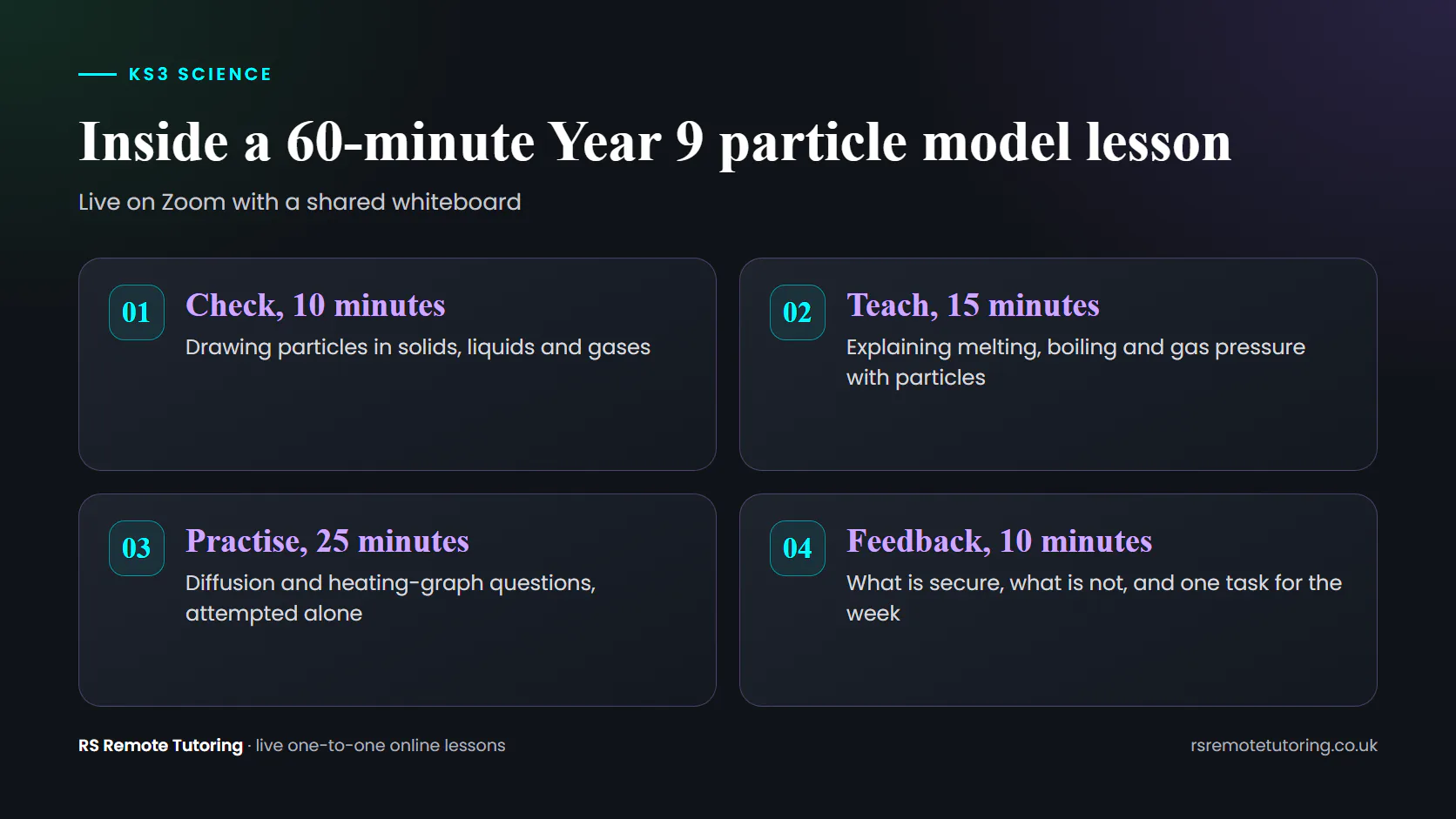
In this hour-long Zoom session, a Year 9 student sketches particles to show what they remember, learns to explain a change of state using particle behaviour, tackles test-style questions alone and leaves with one clear task for the coming week.
CheckAbout 10 minutesYour child draws particles in a solid, a liquid and a gas on the whiteboard. The drawings show at once whether spacing and movement are secure.
TeachAbout 15 minutesThe tutor explains why a balloon shrinks in a cold room and how particles explain melting and boiling, then models a full written answer.
PractiseAbout 25 minutesQuestions on diffusion, gas pressure and a heating graph with a flat section, attempted alone. The tutor stops a vague sentence and asks what the particles are doing.
FeedbackAbout 10 minutesWhat your child can now explain, what still needs work and one short task. Parents receive the same summary after the lesson.
Early lessons double as a diagnosis: is your child losing marks on recall, on written explanations, on graphs or on the calculations? The answer decides what the next few weeks of Science cover.
Each lesson follows the same rhythm, so you can see what has improved from week to week.
Who teaches KS3 Science
Who will teach my child KS3 Science?
Fourteen of our tutors teach KS3 Science, with backgrounds in biochemistry, pharmacy, physics and medicine. We pair your child by year, the science they find toughest, confidence and your free hours, and they try a free lesson with that tutor before you book.
Nadia Rahman
Science and Maths
MSc Biochemistry and Chemistry
B.Ed
8+ years teaching
Nadia covers biology, chemistry and physics, which suits KS3, where all three are often taught together. Her teaching degree means subject knowledge and classroom training arrive together.
Rumaan Aslam
Founder and Head Tutor
MPharm
7 years teaching
Rumaan set up RS Remote Tutoring in 2020 and has kept teaching ever since. Students who have already written science off often end up with him; at KS3 the real issue is usually confidence.
Dr Anna Müller
Physics and Science
PhD Physics
Anna explains physics through things your child has seen in real life, not a sheet of formulas. She is a good match for students who manage the calculations but can’t yet picture what a force, a wave or a circuit is actually doing.
Olivia Brown
Physics and Science
UK based
Required practicals
Olivia concentrates on experiment questions. She is a good fit for students who understand the theory but freeze when a question is written up as an investigation.
Any Science tutor teaching a student below 18 holds a current enhanced DBS check. Before anyone’s first lesson, we confirm who they are, check their qualification certificates and follow up their references.
Four steps to start
What are the first steps with a KS3 Science tutor?
Send us the year group and the Science topic or test that went badly. We put forward one tutor and explain the choice, your child has a free 30-minute trial on that topic, and weekly lessons begin only once your child is happy.
Share the last end-of-topic testOn the trial form, note the year group, the unit your child is on, the mark from their last end-of-topic test or a practical write-up that came back covered in red, and the times you can do.
Meet your suggested tutorA coordinator reads it and proposes one Science tutor, chosen for the area your child finds hardest, with the reason spelt out. You get one name, not a catalogue.
Free 30-minute trial on ZoomTogether they work through a real question from the current unit, perhaps a graph from a recent practical. Nobody asks for card details, and you have nothing to cancel.
Carry on weeklyHappy with it? Your child keeps that Science tutor on the same day and time every week. Not quite right? We rematch with another Science tutor at no cost.
Have a marked end-of-topic test or a practical write-up open on the table for the trial. The teacher’s comments show the tutor exactly where answers dropped marks.
One-to-one KS3 Science tuition is £30 per 60-minute lesson, a rate we keep identical from Year 7 to A-Level. Book three or more sessions in one week and each falls to £27.50, while the annual plan comes to £25. The trial is free.
Meet your tutor first
Free
30-minute one-to-one trial on Zoom
No card details. No obligation to continue.
Standard lesson
£30
60-minute one-to-one online lesson
The same rate for every tutor and every level.
Three or more a week
£27.50
Per 60-minute lesson
For families booking three or more lessons each week.
Annual plan
£25
Per 60-minute lesson, paid upfront
48 weekly lessons for £1,200.
Science once a week at £30 adds up to £120 across a typical four-week month. You pay no registration charge, no matching charge and nothing for lesson preparation. If two or three lessons are all it takes to get through photosynthesis or circuits before an end-of-topic test, that’s fine with us.
Why do families trust RS Remote Tutoring with KS3 Science?
Families get a Science tutor who sticks with their child every week, explanations taught as reasoning rather than facts to memorise, and an honest note after every lesson. RS Remote Tutoring began teaching UK students online in 2020 and is led by founder Rumaan Aslam.
The same tutor each week
One tutor, one regular time slot. Within a few weeks that person can tell whether the trouble is biology vocabulary, chemistry particles or physics calculations, and plans lessons to match.
Updates you can act on
After every session a short note tells you the Science covered, what has improved, what hasn’t yet and what to revise before next time. It’s written in plain English, with no made-up score.
Vetted tutors and a free rematch
No tutor teaches until we have checked them, and those with under-18 students hold an enhanced DBS check. If your child and their tutor don’t gel, we arrange a new one at no cost, at any point.
KS3 Science sits within our wider KS3 tutoring. Students who find the calculations in physics and chemistry hard often add KS3 Maths tuition alongside, and it costs the same £30 a lesson.
London and UK families
Do online KS3 Science lessons work for families outside London?
Yes. KS3 Science is taught entirely on Zoom, so a Year 8 student in Devon logs in the same way as one near our base in Feltham, Greater London. Lesson times are fixed around your child’s school day, after-school clubs and the tutor’s availability.
All your child needs is a webcam on a laptop, desktop or tablet, a standard home internet connection and Zoom, which costs nothing. Labelled diagrams and line graphs are much easier to draw on a bigger screen than on a phone.
Keep the Science exercise book or latest test within reach, so the tutor can tie each lesson to classwork. If you would like a lesson recorded, ask us; we can arrange it subject to safeguarding, privacy and consent.
Common questions
Frequently Asked Questions
What parents ask before booking KS3 Science: the three sciences, school topics, practicals, GCSE preparation, tutors, fees and the free trial.
How much does a KS3 Science tutor cost?
£30 per 60-minute one-to-one lesson. Book three or more a week and each costs £27.50; the annual plan, paid in advance, comes to £25 a lesson. The 30-minute trial costs nothing, and we never ask for a card.
Do lessons cover biology, chemistry and physics?
Yes, together with working scientifically. Most students are weaker in one of the three, so lesson time goes to whichever science is costing your child marks.
Will the tutor follow my child’s school topics?
Yes. With no exam board at KS3, the tutor plans from your school’s own Science scheme of work. A test, homework sheet or topic list is enough for lessons to mirror classwork.
Can a tutor help with practical and experiment questions online?
Yes. Lessons cannot replace a school lab, but they cover methods, variables, fair tests, results tables, graphs and evaluation, which is what most experiment questions test.
Will KS3 Science tutoring help with GCSE?
It builds the foundations GCSE Combined Science and the separate sciences rely on, such as particles, cells, forces and graph skills. We cannot promise a grade, but secure KS3 ideas make Year 10 far less of a jump.
Does my child keep the same Science tutor?
Yes. The same Science tutor teaches your child on the same weekday at the same hour. If the match doesn’t feel right, let us know and we’ll switch tutors free of charge, without losing a lesson.
What should we have ready for the first lesson?
A marked test, recent homework or the school’s topic list is ideal. It shows the tutor which answers lost marks, so the trial works on a real problem.
How can I arrange a free KS3 Science trial?
Open the trial form, pick KS3 and Science, then tell us the year group, the current unit and when your child is free. We’ll reply with a matched tutor and a lesson time.
Free 30-minute trial
Turn short Science answers into full explanations
Start with the topic or test that worried your child most. In a free 30-minute trial, a matched KS3 Science tutor finds where the marks slipped away and what to tackle first.