The mock timetable has arrived, and your child has three weeks to get ready for papers that will shape their predicted grades. Our mock exam tutoring gives them a tutor who knows their exam board, works through real exam-style questions with them and fixes the errors that cost marks, one subject at a time.
Every lesson is a live Zoom hour with only your child and the tutor. After the mocks, the same tutor goes through the marked paper question by question and turns the results into a plan for the summer 2027 exams, which start on 10 May 2027.
No card details for the trial. No obligation to continue.
Live one-to-one lessonsPersonal tutor matchingFree 30-minute trialEnhanced DBS checked tutorsTeaching since 2020
What lessons cover
What does mock exam tutoring include?
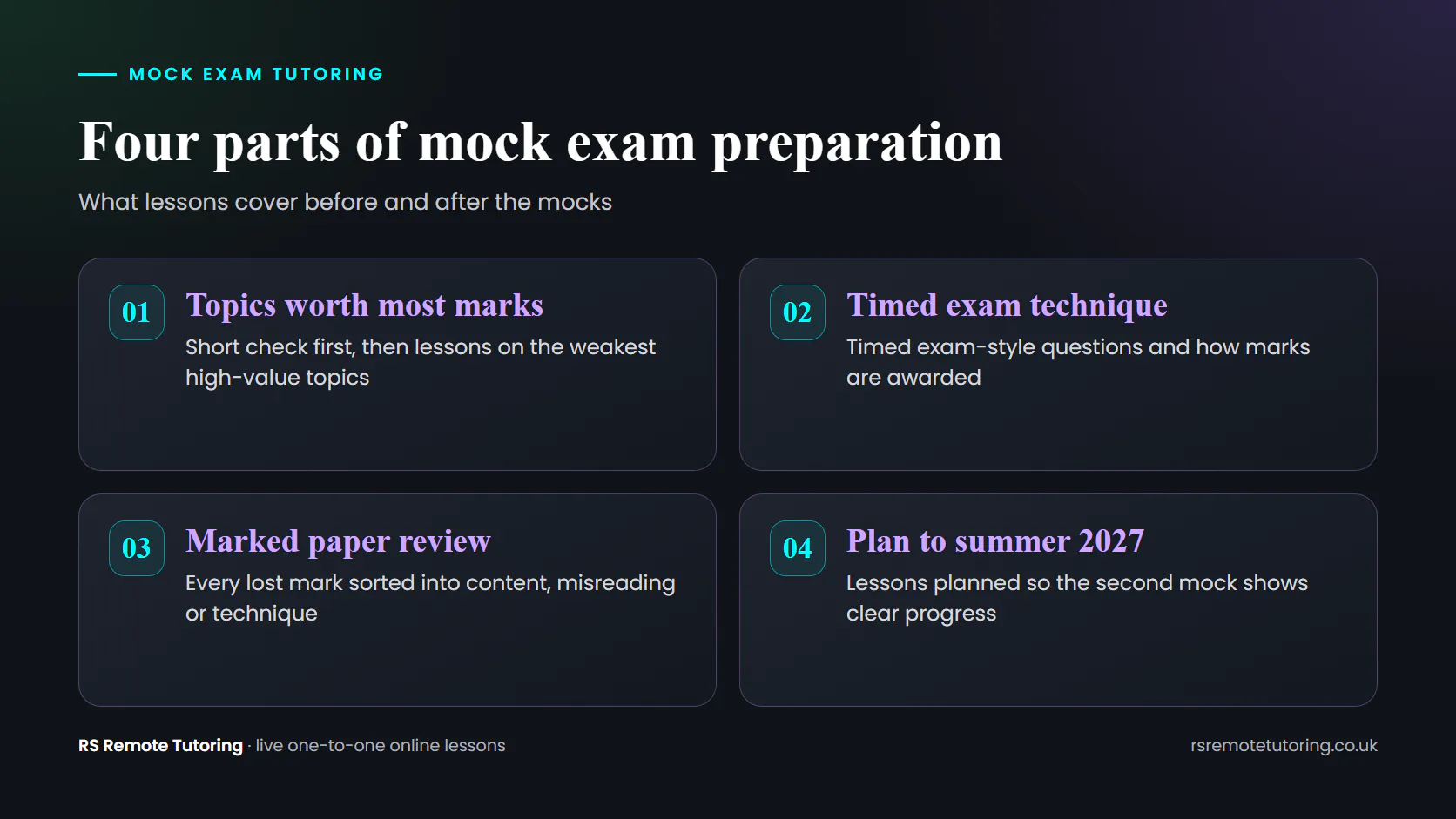
Mock exam tutoring covers three jobs: closing the topic gaps that would cost the most marks, practising timed exam-style questions for your child’s board, and reviewing the marked mock afterwards so the next round of revision starts from real evidence.
Before the mocks: the topics worth most marks
There is rarely time to revise everything before a mock. The tutor starts with a short check of the subject, then spends lessons on the topics that appear most often on your child’s papers and that your child is weakest at.
That keeps the weeks before the mocks focused. Your child goes in having secured the questions they were most likely to drop, rather than having skimmed every chapter once.
Exam technique under time pressure
Plenty of students know the content and still lose marks to timing, command words or answers that never reach the mark scheme. Tutors set timed sections inside the lesson and show your child how marks are awarded on each question type.
Practising this before the mock means the result shows what your child knows, not how badly they paced the paper.
After the mocks: reading the marked paper
A mock grade on its own says little. Send the marked paper and the tutor reviews it before the lesson or works through it with your child in the lesson, depending on the tutor’s plan and how well your child understands their mistakes.
Each lost mark is sorted into a content gap, a misread question or a technique slip. Those three causes need different fixes, so the review decides what the lessons focus on between the mocks and the summer exams.
A plan from mocks to the 2027 exams
Many schools run a second round of mocks in late February or March. The tutor plans the weeks in between so that second mock shows clear progress on the gaps found in the first.
Parents hear after every lesson what was covered, what is improving and what to practise next.
Lessons before the mocks secure marks; lessons after them use the marked paper to plan the summer.
The 2026/27 mock calendar
When are mock exams in 2026/27?
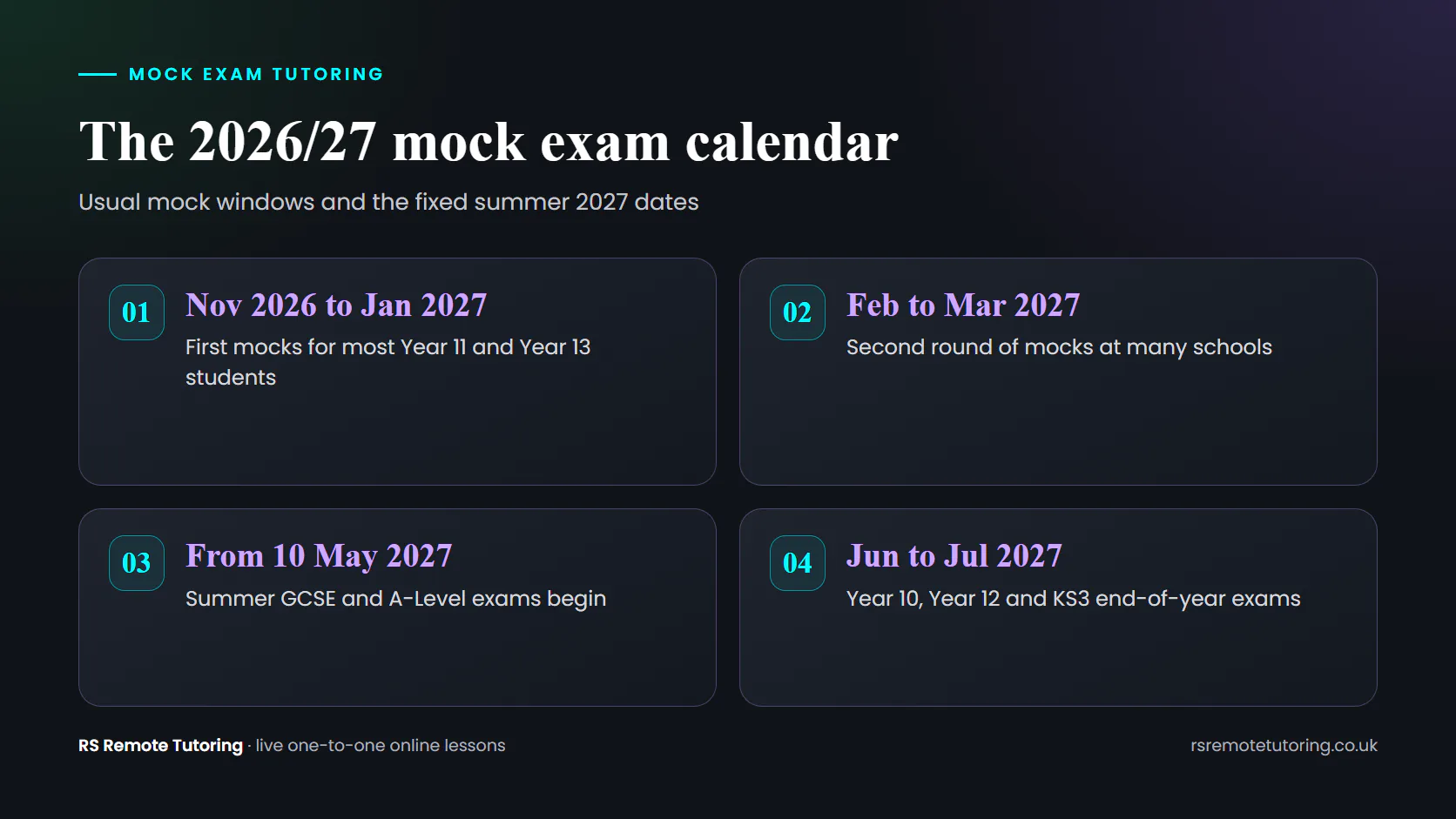
Each school sets its own dates. Most Year 11 and Year 13 students sit their first mocks between November and January, many schools add a second round in February or March, and Year 10, Year 12 and KS3 exams usually fall in June and July.
Your child’s school will publish the exact timetable, usually a few weeks before the mocks begin. The table shows the usual pattern for the 2026/27 school year and the fixed national dates the mocks lead up to.
Year group
When mocks usually happen in 2026/27
Year 11 (GCSE)
First mocks from November 2026 to January 2027; a second round in late February or March 2027 at many schools
Year 13 (A-Level)
From November or December 2026 through to March 2027, with some schools holding mocks around Easter
Year 10 and Year 12
End-of-year mocks, most often in June or July 2027, with some schools using March
Year 7 to Year 9 (KS3)
End-of-year exams, usually from early June to early July 2027
Summer 2027 exams
GCSE and A-Level exams run from 10 May 2027; the last GCSE paper is on 18 June and the last A-Level paper on 22 June
Results days
A-Level results on 12 August 2027 and GCSE results on 19 August 2027
Year 13 students applying to university by the 13 January 2027 UCAS deadline should check whether their school uses mock results when it sets predicted grades. Schools are also asked to keep mock papers and results as evidence in case summer exams cannot go ahead, so the mocks are worth sitting properly.
Each school sets its own dates; this is the usual pattern for the 2026/27 year.
Who it suits
Who is mock exam tutoring for?
Mock exam tutoring suits students in Year 9 to Year 13 who have mocks or end-of-year exams coming up, or who have just had a disappointing mock result and want a clear plan before the second mock or the summer 2027 exams.
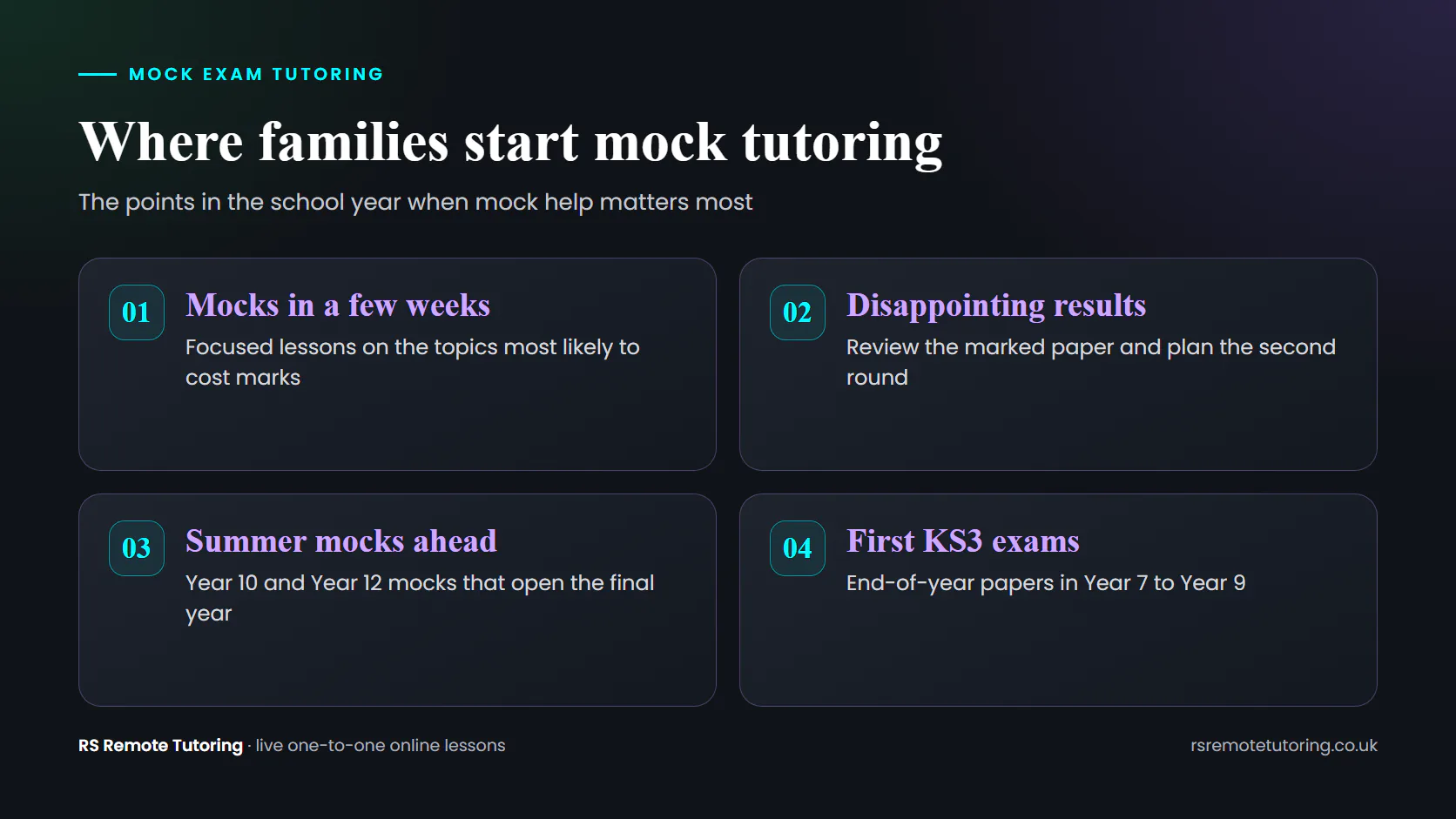
Families usually come to us at one of a few points in the school year:
Year 11 students with GCSE mocks in the next few weeks and one or two subjects that feel shaky
Year 13 students who need A-Level mock grades that support their predicted grades and university offers
Students whose first mocks went badly and who want a structured plan before the second round
Year 10 and Year 12 students preparing for summer mocks that start the final year of the course
KS3 students in Year 7 to Year 9 facing end-of-year exams with exam-style papers for the first time
Students retaking GCSE Maths or English who want a mock-style run-through before the real paper
If the mocks are close, it is still worth starting. A few focused lessons on the highest-value topics can change how a paper goes. For the longer run-up after mocks, our GCSE revision tutoring carries the same plan through to May.
Most families start a few weeks before the mocks or straight after the results.
Inside a lesson
What happens in a mock preparation lesson?
A mock preparation lesson is a live 60-minute Zoom session with one tutor. It usually moves from a quick check of last week’s topic, to teaching one high-value area, to a timed exam-style question, then feedback your child can act on before the mock.
Check, 10 minutesA few short questions on last week’s topic show whether it held. Anything that slipped is fixed straight away.
Teach, 20 minutesOne topic that carries real marks on your child’s papers, explained with worked examples on the shared whiteboard.
Timed practice, 20 minutesAn exam-style question from your child’s board, answered against the clock while the tutor watches the working.
Feedback, 10 minutesThe answer is checked against how marks are awarded, and your child leaves with the two or three things to practise before the next lesson.
After the mocks, the marked paper is reviewed in the lesson or before it, depending on the tutor and how much your child already understands. The tutor sorts each lost mark by cause and sets the order of topics for the next few weeks.
Who teaches
Who will help my child prepare for their mocks?
Your child is matched with one tutor who teaches their subject at their level and knows their exam board. Our team of 40 tutors includes qualified teachers and tutors with examining experience, so mock preparation is built around how marks are actually awarded.
Sarah Collins
GCSE English Language and Literature
Former AQA examiner
Exam preparation
Sarah has marked the papers, which shapes what she teaches. For English mocks she works on where examiners award marks and where answers quietly lose them.
Imran Sadiq
Maths, KS3 to A-Level
PGCE Secondary Maths
Qualified teacher
Imran is one of our qualified maths teachers. He covers KS3 and A-Level Maths, including calculus, pure and applied content, so a mock review can trace a lost mark back to the earlier skill behind it.
Priya Nair
Biology and Science, to A-Level
MTech Biotechnology
MA Education, University of Bath
Examining experience
Priya brings examining experience at a higher level to A-Level Biology mocks, where precise wording and data questions decide a lot of marks.
Dr Anna Müller
Physics and Science
PhD Physics
Anna teaches Science from KS3 upwards and A-Level Physics on request, subject to availability. Calculation questions and required practicals are a common mock focus in her lessons.
We match a tutor by subject, level, exam board and the timing of your child’s mocks. If the fit is not right after the trial or at any later stage, we rematch at no cost.
How to start
How do I book mock exam tutoring?
Booking takes four steps. Tell us the subjects, year group and mock dates, we put forward one matched tutor, your child has a free 30-minute trial on Zoom, and weekly lessons start at a fixed time that fits around school.
Send the detailsBook the free trial and tell us the subjects, year group, exam board if you know it, and when the mocks start.
Meet one matched tutorOur coordinator reads the enquiry and puts forward one tutor, with the reason they suit your child.
Free 30-minute trialYour child meets the tutor on Zoom. No card details, and no obligation to continue.
Lessons before and after the mocksWeekly lessons start at a fixed slot, with more lessons a week available when the mocks are close.
If the mocks are only a few weeks away, say so on the enquiry. The coordinator will prioritise a tutor who can start quickly.
Mock exam tutoring costs £30 for a 60-minute one-to-one lesson, the same for every subject, level and tutor. Booking three or more lessons a week brings it to £27.50, and the annual plan works out at £25 a lesson.
Meet your tutor first
Free
30-minute one-to-one trial on Zoom
No card details. No obligation to continue.
Standard lesson
£30
60-minute one-to-one online lesson
The same rate for every tutor and every level.
Three or more a week
£27.50
Per 60-minute lesson
For families booking three or more lessons each week.
Annual plan
£25
Per 60-minute lesson, paid upfront
48 weekly lessons for £1,200.
There are no sign-up, matching or planning fees, and no minimum term. Families often book two or three lessons a week in the run-up to mocks, then drop back to one a week afterwards.
Why choose RS Remote Tutoring for mock preparation?
Families choose us for mock preparation because their child gets one tutor matched to the subject and exam board, lessons that start from the actual mock paper, a clear update after every session and the same £30 price whatever the subject or level.
One tutor, chosen by a person
A coordinator reads every enquiry and puts forward one tutor with a reason, rather than leaving you to scroll a list. The same coordinator handles rescheduling and updates.
Every major exam board
Tutors work with AQA, Pearson Edexcel, OCR, WJEC and Eduqas papers, so mock practice uses questions in the style your child will see.
Updates after every lesson
You hear what was covered, what is improving and what still needs work. You do not need to sit in on lessons to know where the mock preparation stands.
Checked and safe
Every tutor working with under-18s holds a current enhanced DBS check, and qualifications are checked against certificates before anyone teaches. Families rate us 4.9 from 40 reviews on Google, Bark and Facebook.
Across the UK
Can my child have mock exam tutoring wherever we live?
Yes. Every lesson runs live on Zoom, so mock exam tutoring is available to students anywhere in the UK. Your child needs a laptop, tablet or desktop with a webcam and a normal home internet connection, and there is no travel time.
We are based in Feltham, Greater London, and teach students across England and the rest of the UK. Families in the capital often combine mock preparation with our GCSE tutoring in London, while students who need help in one subject can go straight to GCSE Maths tutoring or GCSE English tutoring.
A-Level students can carry their mock preparation into A-Level tutoring through to the summer, and younger students can continue with KS3 tutoring after their end-of-year exams. Evening and weekend slots are available with many tutors, which helps when mocks fall in a busy school term.
Common questions
Frequently Asked Questions
Straight answers about Mock Exam Tutoring lessons, tutor matching, prices and starting with a free 30-minute trial.
Is it too late to get a tutor if the mocks are in two weeks?
No. Two weeks is enough for a few focused lessons on the topics that carry the most marks and on exam technique. Tell us the mock dates when you book and our coordinator will look for a tutor who can start quickly.
Do mock exams count towards final grades?
No, mocks do not count towards GCSE or A-Level grades in a normal year. They still matter: schools often use them for predicted grades and tier decisions, and are asked to keep mock papers and results as evidence in case summer exams cannot go ahead.
Can a tutor help after my child gets their mock results?
Yes, and this is often the most useful time to start. Send the marked paper and the tutor reviews it question by question, before the lesson or with your child in the lesson depending on what they need, then plans the lessons between the mocks and the summer 2027 exams around what the paper shows.
How much does mock exam tutoring cost?
A 60-minute one-to-one lesson costs £30, whatever the subject or level. Three or more lessons a week cost £27.50 each, and the annual plan is £25 a lesson. The first 30-minute trial is free and needs no card details.
Which subjects and levels do you cover for mocks?
We cover mocks and end-of-year exams from KS3 to A-Level, including Maths, English, the sciences and other subjects our tutors teach. Tell us the subject and exam board when you book and we will confirm a matched tutor before the trial.
What should we send before the first lesson?
Send the mock timetable if the school has published it, the exam board if you know it, and any recent marked tests or mock papers. If you are unsure of the board, a photo of the front of a past test is usually enough for us to work it out.
How many lessons a week does my child need before mocks?
Most students have one lesson a week per subject, and some add a second or third in the last few weeks before the mocks. There is no minimum term, so you can increase or reduce lessons as the mock dates pass.
How do I book the free trial?
Use the Book a free 30-minute trial button, call +44 7377 137585 or message us on WhatsApp. Our team answers enquiries every day and books the trial with one matched tutor.
Free 30-minute trial
Get your child ready for their 2027 mocks
Tell us the subjects and the mock dates, and we will match one tutor who knows the exam board. The first 30 minutes are free, with no card details and no obligation to continue.