
Two students open the same envelope in the same corridor with the same three grades. One has a plan by lunchtime. The other is still refreshing a phone screen at four in the afternoon. The difference is almost never the grades.
Knowing what to do after A-Level results comes down to how many routes you understood before Thursday 13 August. Most people only ever seriously considered one. According to UCAS’s end of cycle survey for 2025 entry, 44% of applicants who ended up placed on a course had also applied for alternative options, including jobs, and 39% had picked a back-up university in case they needed Clearing. So the students who look calm on the morning are usually just the ones who did their thinking in July.
This guide covers every realistic route open to you in 2026, what each one costs, what it demands, and the deadlines that quietly close behind you between August and October.
Jump to Sections
What should you do in the first 48 hours after A-Level results?
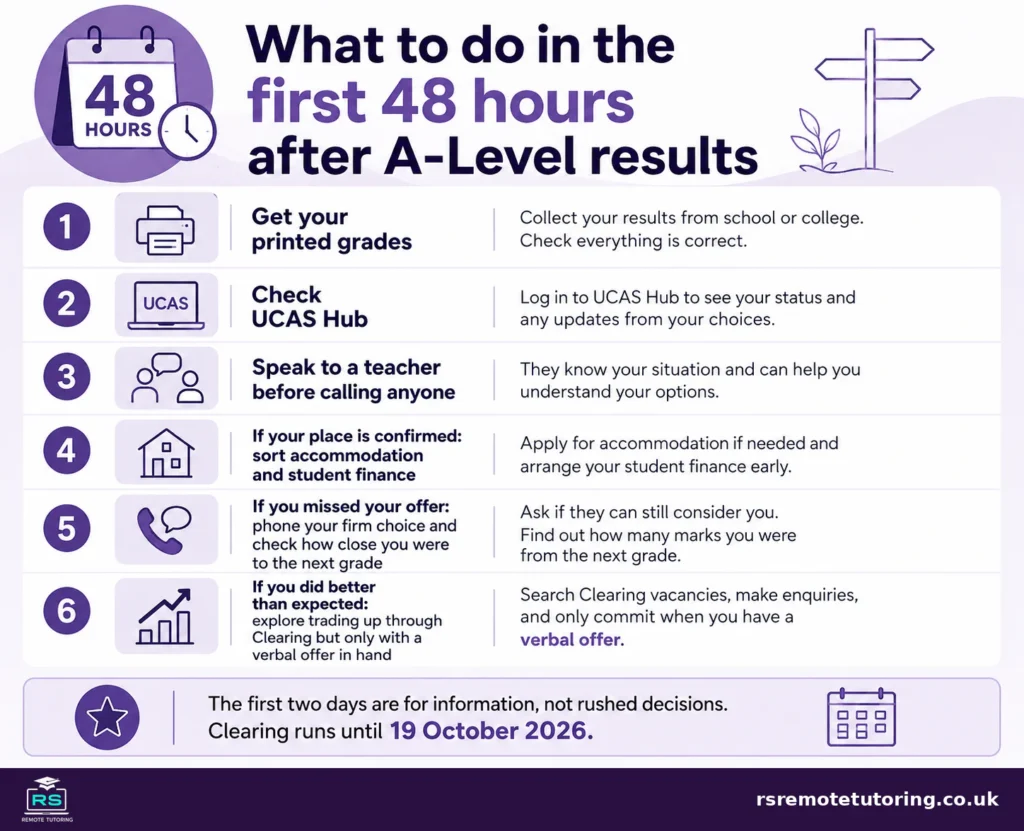
Get your printed grades, check your UCAS Hub, and speak to a teacher before you phone anyone. The first two days are for information, not decisions. Clearing runs until 19 October, so the pressure you feel that morning is mostly manufactured.
Three situations, three very different responses.
If your place is confirmed
Nothing urgent, but two things are worth doing that week: sort accommodation and check your student finance application has actually gone through. Places get confirmed all the time by students who then arrive in September with no room and no maintenance loan. Student Finance England takes roughly four weeks to process, and you never needed a confirmed place to apply.
If you missed your offer
Phone your firm choice before you assume anything. Universities confirm places for students who missed by a grade every single year, particularly on courses that are undersubscribed. Ask directly. One call.
If the answer is no, work out how close you were, because that decides whether a review of marking is worth the money. Our full walkthrough of results day timings, UCAS statuses and remark deadlines covers the mechanics, including the 20 August priority deadline that catches people out.
If you did better than expected
You can trade up through Clearing, and thousands do. But the “Decline my place” button is permanent, and the university you leave has no obligation to take you back. Only press it with a verbal offer already in hand from somewhere you genuinely want to go.
What are your options after A-Level results in 2026?
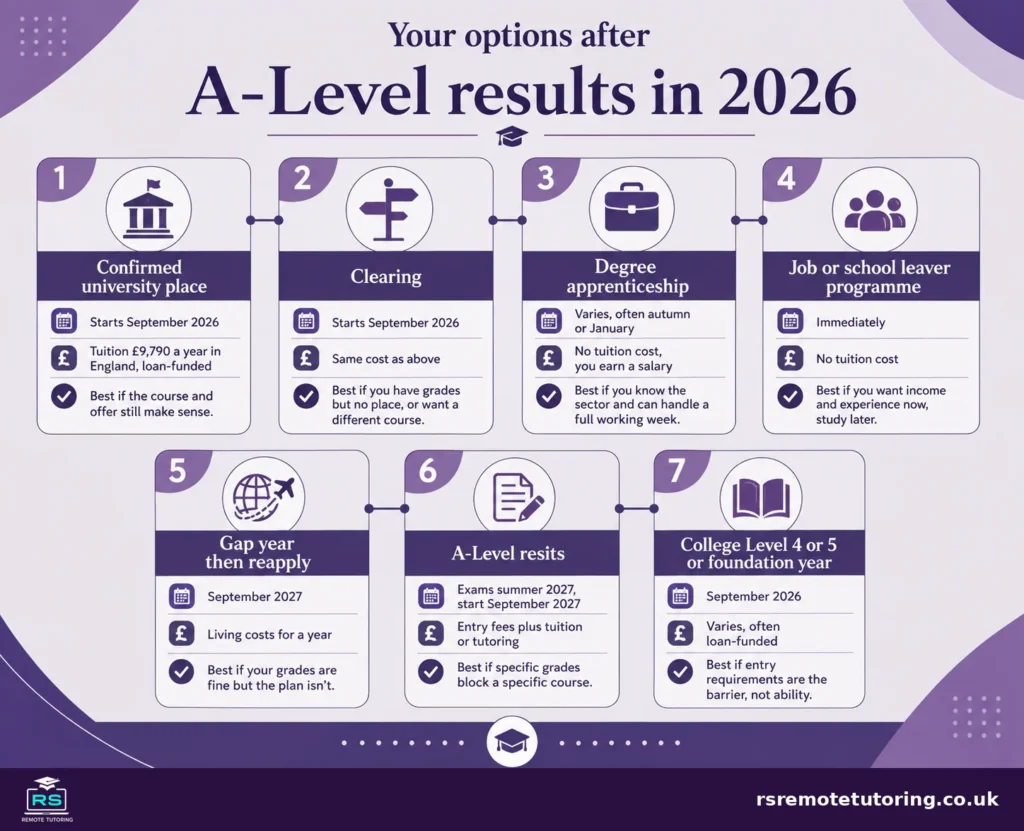
Seven routes are genuinely open to you: starting your confirmed course, Clearing, a degree apprenticeship, a job or school leaver programme, a gap year with reapplication, resitting in summer 2027, or a college-based Level 4 or 5 qualification. Each has a different cost and timeline.
| Route | When it starts | What it costs you | Best if |
| Confirmed university place | September 2026 | £9,790 a year tuition in England, loan-funded | The course and the offer both still make sense |
| Clearing | September 2026 | Same as above | You have grades but no place, or want a different course |
| Degree apprenticeship | Varies, often autumn or January | Nothing. You earn a salary | You know the sector and can handle a full working week |
| Job or school leaver programme | Immediately | Nothing | You want income and experience now, study later |
| Gap year, then reapply | September 2027 | Living costs for a year | Your grades are fine but the plan isn’t |
| A-Level resits | Exams summer 2027, start September 2027 | Entry fees plus tuition or tutoring | Specific grades block a specific course |
| College Level 4/5 or foundation year | September 2026 | Varies, often loan-funded | Entry requirements are the barrier, not ability |
Nobody tells you the awkward part: three of these routes need a decision within about three weeks, and the other four need one within three months. Drifting is the only option with no deadline, and it’s also the only one that reliably wastes a year.
How do you decide which route actually fits you?
Ask four questions: is the subject the point or is the degree the point, how close were your grades, can your household absorb a year without student income, and what would you actually do with twelve months. Answer honestly and most of the seven routes eliminate themselves.
Is the course the point, or the qualification?
If you want to be a physiotherapist, the specific course matters and a resit may be worth a year. If you want a degree in something broadly business-shaped, Clearing will find you one this September and the institution matters less than people pretend.
How close were you?
Two marks off a B is a different conversation from two grades off. Ask your subject teacher for raw marks, not just the letter. That number decides whether you’re talking about a remark, a resit, or a rethink.
Can you afford the year?
A gap year costs money even when you’re working, and a resit year usually means part-time earnings at best. Some families can absorb that easily. Some can’t, and there’s no shame in that being the deciding factor.
What would you fill it with?
“I’ll figure it out” is not a gap year plan. Universities and employers can tell the difference between a structured twelve months and a long holiday, and so can you, in about February.
I’d add a fifth, less comfortable one: are you choosing this route, or avoiding a conversation with your parents? A surprising number of resit years are the second thing.
Should you still go to university this year?
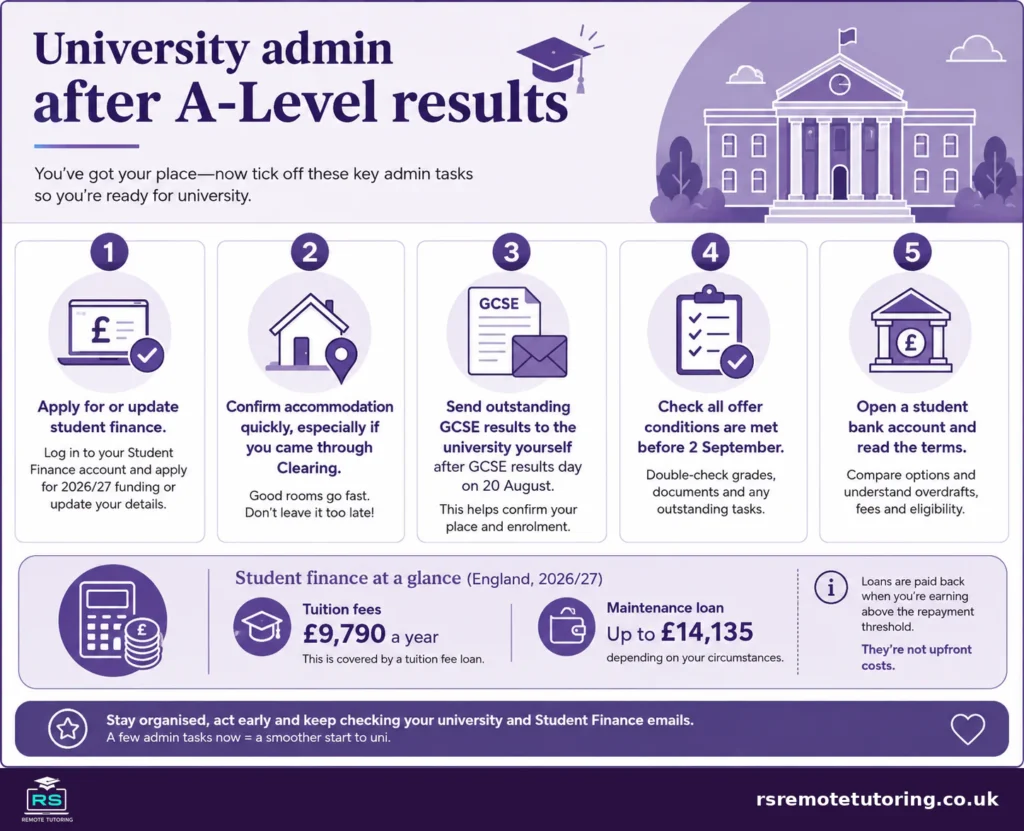
For most students holding a confirmed place, yes. Tuition in England rises to £9,790 a year for 2026/27 entry, covered in full by a tuition fee loan, with maintenance loans of up to £14,135 depending on household income and where you live. You repay 9% of anything you earn above £25,000.
The admin that actually matters in the fortnight after results:
- Apply for or update student finance at GOV.UK if you haven’t. No confirmed place needed, and it takes about four weeks.
- Confirm accommodation with the university, and do it the same week if you came through Clearing. Rooms go fast.
- Send outstanding GCSE results to your university yourself when GCSE results day 2026 lands on 20 August. UCAS does not forward them.
- Check your offer conditions are all met before 2 September, which is the hard deadline.
- Open a student bank account and read the actual terms rather than the free railcard.
One flag worth raising. If a grade 4 in GCSE maths or English is the condition standing between you and the course, you have options beyond waiting: a November resit, or a Level 2 Functional Skills qualification, which many universities and nearly all apprenticeship providers accept. We’ve set out how Functional Skills Level 2 compares with GCSE if that’s your situation, and focused GCSE resit tutoring is usually faster than it sounds.
Is a degree apprenticeship a realistic option after A-Level results?
Yes, and more so every year, but the timing rarely aligns with results day. England recorded 353,500 apprenticeship starts in 2024/25, up 4.1% on the previous year, with 60,350 of those at Level 6 and 7, which is degree and master’s level (Department for Education). Level 6 and 7 starts grew 20.4% in a single year.
You earn a salary, pay no tuition, and finish with the same degree as someone who took the university route. That combination is exactly why competition is brutal. Large employers in engineering, finance, law and tech often receive hundreds of applications for a handful of places, and they recruit on their own calendar, mostly between September and February.
What that means in practice:
- Very few degree apprenticeships start in September 2026 and are still open in August
- Most of what you find now will start in January 2027 or September 2027
- Apply through Find an Apprenticeship on GOV.UK and directly on employer sites, not through UCAS
- Nearly all require GCSE maths and English at grade 4 or above, or a Level 2 equivalent
- Assessment usually means online tests, a video interview and an assessment centre, so it takes weeks
Treat a degree apprenticeship as a plan for 2027 that you start building in September 2026. Treating it as a results-day rescue is how people end up with neither an apprenticeship nor a university place.
When does resitting A-Levels make sense?
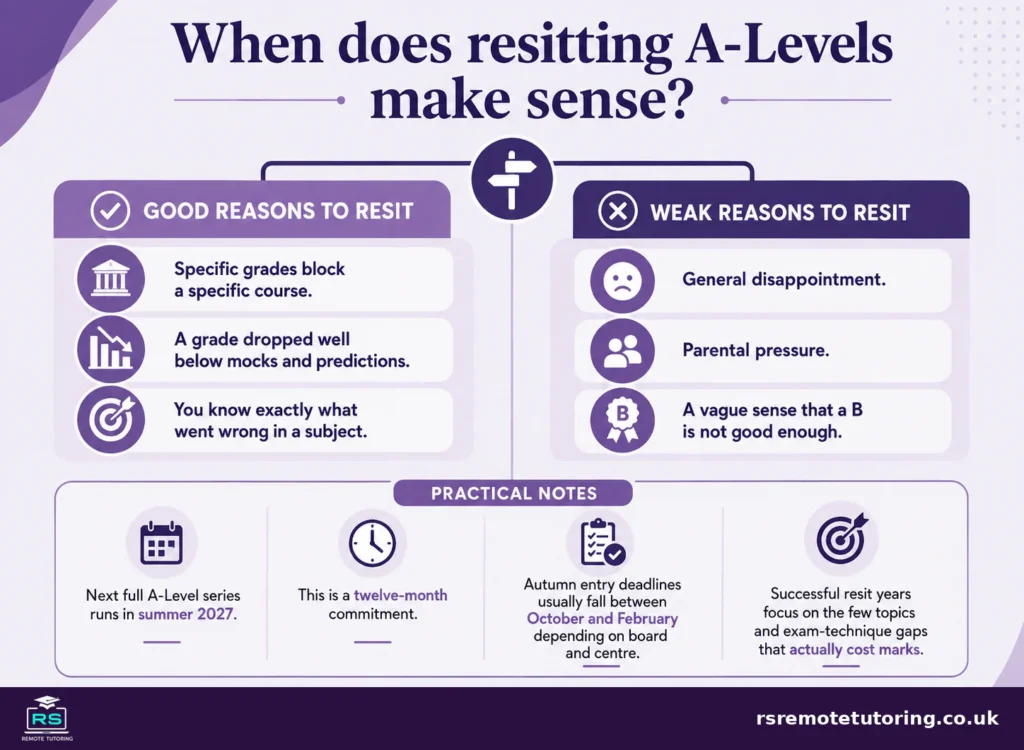
Resit when a specific grade blocks a specific course you actually want, and when you can name the topics that cost you the marks. The next full A-Level series runs in summer 2027, so this is a twelve-month commitment, not a quick fix.
Good reasons to resit: medicine, dentistry, veterinary science and other courses with fixed grade requirements. A grade that dropped well below your mocks and predictions. A subject where you know exactly what went wrong.
Weak reasons: general disappointment, parental pressure, or the vague sense that a B “isn’t good enough” when the course you want asks for a B.
The practical detail people get wrong is entry. If you’ve left your school or college, you may need to register as a private candidate with an exam centre, and autumn entry deadlines usually fall between October and February depending on the board. Check the A-Level exam and resit dates alongside the 2027 exam timetable before you commit to anything, because a missed entry deadline costs you the whole year.
A resit year done properly is not a repeat of Year 13. Re-teaching an entire syllabus you already sat is the single most common way to end up with the same grade twice. The students who move up two grades work on three or four topics and their exam technique, which is what a structured month-by-month A-Level preparation plan is designed around.
What can you do in a gap year that strengthens your application?
Work, save, gain experience related to your subject, and reapply in autumn 2026 with achieved grades rather than predictions. Applying with real results removes the guesswork admissions tutors have to do, and it opens doors that predicted grades sometimes didn’t.
What genuinely helps:
- Paid work of any kind, because employers and admissions tutors both read reliability into it
- Sector-relevant experience, even a few hours a week: a lab, a ward, a studio, a site
- Volunteering with a consistent commitment rather than a one-week burst
- An online course or qualification that plugs an obvious gap in your application
- Travel, if you can fund it, and if you can talk about it as something other than a holiday
What doesn’t: a personal statement that lists four months of “reflection”. Admissions tutors read thousands of these and they can spot an empty year in one paragraph.
Apply from September 2026 for 2027 entry. And keep an eye on the fee position, because the confirmed cap rises again to £10,050 for 2027/28, which is roughly £780 across a three-year degree.
What are the alternatives to university and apprenticeships?
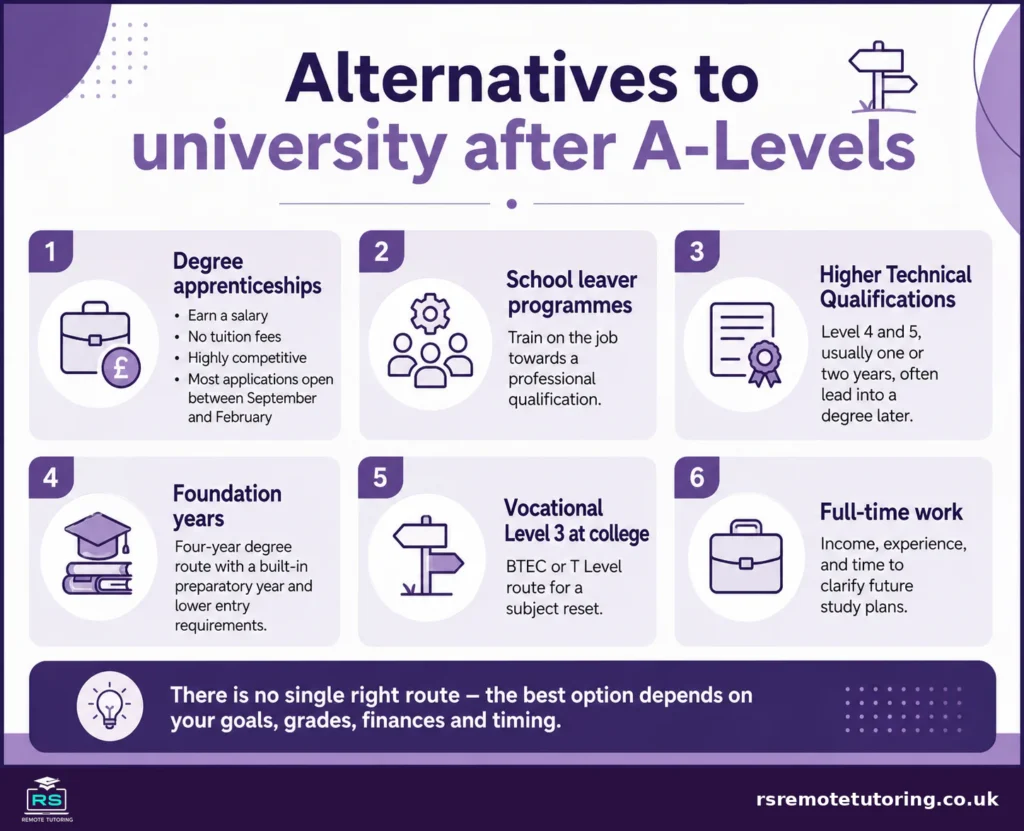
Full-time work, school leaver programmes, Higher Technical Qualifications, foundation years and college-based Level 4 or 5 courses all lead somewhere real. Around a third of UK 18-year-olds go into higher education, which means most of your year group is doing something else.
School leaver programmes. Large firms in accountancy, law and consultancy run these as an alternative to graduate schemes. You train on the job towards a professional qualification and often end up chartered at the age your friends graduate.
Higher Technical Qualifications. Level 4 and 5 qualifications approved for meeting employer skills needs, taught at colleges and some universities, usually one or two years. Many articulate into the second year of a degree if you change your mind.
Foundation years. A four-year degree with a built-in preparatory year. Entry requirements are lower, plenty are still available through Clearing in August, and fees are loan-funded.
Vocational Level 3 at college. If your grades were far off and you want a different subject entirely, a BTEC or T Level route is a real reset rather than a consolation prize. We’ve compared the academic and vocational routes in more depth if you’re weighing that up.
Full-time work. Underrated. Two years of income, no debt, and a much clearer idea of what you want to study if you go back at 20.
Which deadlines matter between now and October?
Five dates decide most of it: 2 September for outstanding offer conditions, 24 September for a new 2026 application, 19 October to add a Clearing choice, and 21 October for universities to make Clearing decisions. Autumn resit entry deadlines follow in October and November.
| Date (2026) | What closes |
| 13 August | A-Level and Level 3 results; UCAS Hub from 08:00; Clearing choices from 13:00 |
| 20 August | GCSE results day; deadline for priority reviews of marking |
| 13 to 28 August | Exam Results Helpline open on 0800 100 900 |
| 2 September | Remaining offer conditions must be met; last day to use “Decline my place” |
| 24 September | Final date to submit a 2026 UCAS application, 18:00 |
| 19 October | Last date to add a Clearing choice |
| 21 October | Last date for universities and colleges to make Clearing decisions |
| October to February | Exam board entry deadlines for summer 2027 A-Level resits |
Source: UCAS Confirmation and Clearing 2026 key dates. Resit entry deadlines vary by exam board and centre.
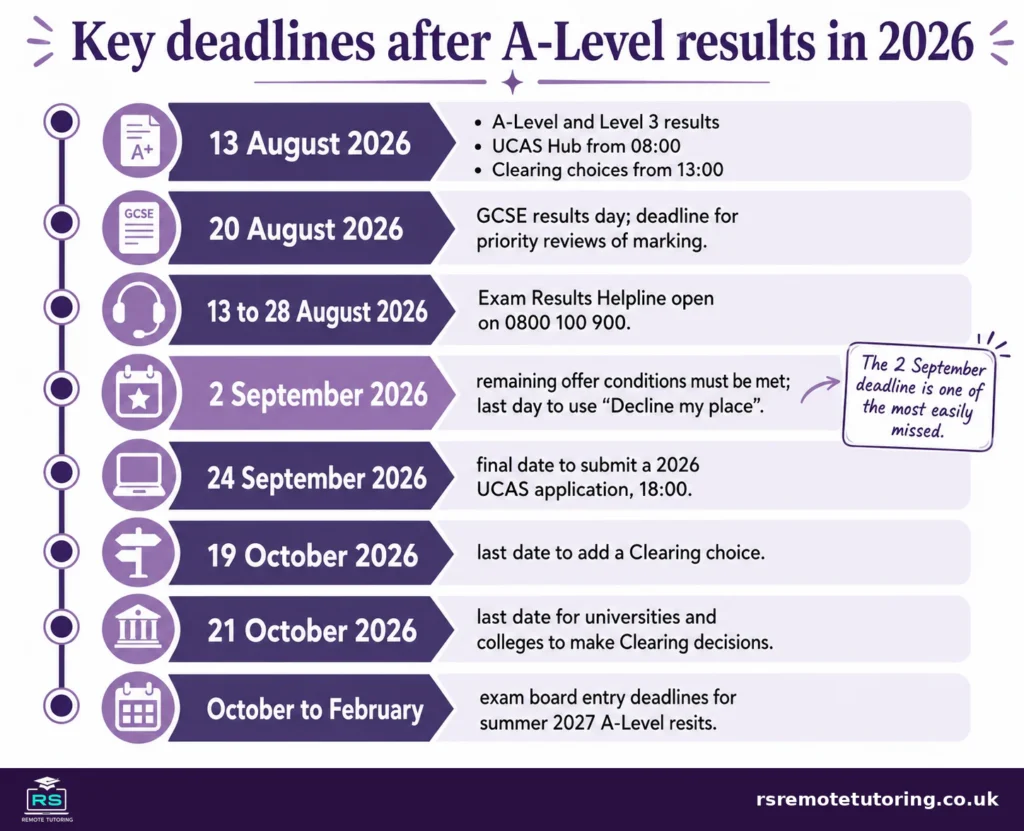
The one people miss is 2 September. Every year a group of students assume an unmet condition will be quietly waived, and some of them are right, and some of them lose the place in the first week of September.
How can parents help without making it worse?
Drive them there, know the deadlines, and stay quiet for the first hour. Practical help lands better than reassurance on results day, and almost every useful thing a parent can do is logistical rather than emotional.
Things that help: having UCAS login details written down, keeping the phone free, knowing that 2 September exists, and being willing to sit in a car park for twenty minutes while nothing gets said.
Things that don’t: ringing relatives before your teenager has processed it, comparing with a sibling, or suggesting a remark within ten minutes of seeing the grades when nobody yet knows the raw marks.
If the reaction seems disproportionate to the results, that’s usually two years of accumulated pressure arriving at once rather than a verdict on three letters.
What if you still don’t know what to do?
Call the Exam Results Helpline on 0800 100 900, open from 13 to 28 August 2026 and staffed by qualified careers advisers from the National Careers Service. It’s free, it’s independent, and almost nobody uses it.
Your school careers adviser is available too, usually for longer than students assume, and they’ve seen several hundred versions of your exact situation.
One rule I’d hold to: make a decision within two weeks. Not the perfect decision, just a decision you can act on. The students who recover fastest from a bad results day are the ones who commit to something by the end of August, whether that’s a Clearing place, an apprenticeship search, or a resit plan. The ones still weighing options in October have usually lost the year to indecision rather than to grades.
If a resit is on the table, one-to-one A-Level tutoring is built for closing specific gaps rather than re-teaching a course you’ve already sat, and a free trial lesson will tell you fairly quickly whether the target grade is realistic.
Frequently Asked Questions
What should I do first after getting my A-Level results?
Collect your printed grades from your school or college, then check your UCAS Hub. Grades and application status come from two different places, and confusing them causes most of the panic on results morning.
Can I still go to university if I didn’t get the grades?
Often yes. Universities regularly confirm places for students who missed by one grade, and Clearing lists thousands of courses until 19 October 2026. Phone your firm choice before assuming the place is gone.
Is it worth resitting A-Levels in 2027?
Worth it when a specific grade blocks a specific course, and when you can name the topics that cost the marks. Less worth it as a general response to disappointment, since the next full series is a year away.
How do I apply for a degree apprenticeship after A-Levels?
Apply through Find an Apprenticeship on GOV.UK and directly with employers, not through UCAS. Most vacancies for the following year open between September and February, so August applications are usually for 2027 starts.
Do I need a confirmed university place to apply for student finance?
No. You can apply to Student Finance England without a confirmed place and update the details later. Processing takes around four weeks, so applying late risks money not arriving for the start of term.
How much is university in England for 2026 entry?
Tuition is capped at £9,790 a year for 2026/27, covered by a tuition fee loan. Maintenance loans reach £14,135 depending on household income and where you live during study.
What if I miss the 2 September deadline for offer conditions?
The university can withdraw the place. Contact admissions before the date if a condition is outstanding, explain the position, and ask directly whether they will still accept you.