A sixth-form offer asks for 6-6 in science. Your results slip says 5-5. Before buying another revision book, check what you actually need to retake. GCSE science resits work differently for Combined Science and separate Biology, Chemistry and Physics.
Combined Science entries in England rose 1.8% between summer 2025 and summer 2026, in Ofqual’s provisional entry figures. That measures entries, not resit success. For London families planning summer 2027, the useful questions are which papers to book, whether practical arrangements are covered and how to prepare differently.
Table of Contents
How do Combined Science and separate science resits differ?
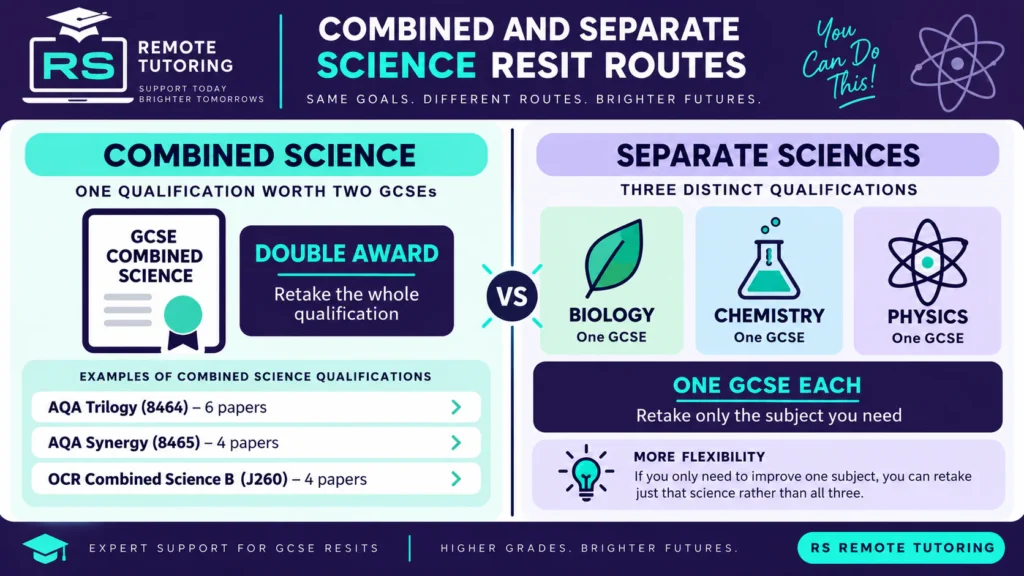
Combined Science is one qualification worth two GCSEs, so a resit covers the whole qualification. Separate sciences are individual GCSEs in Biology, Chemistry and Physics. You can retake just the separate subject you need, but must complete its required papers.
Combined Science means retaking the whole award
A grade such as 5-4 is a double grade from your overall performance. The numbers do not stand for separate biology and chemistry results. You cannot replace only the physics marks while keeping last year’s biology and chemistry marks.
Paper counts depend on the specification, the board’s exact course. AQA Trilogy has six papers. AQA Synergy and OCR Twenty First Century Combined Science B use four. Check the code, not just “Combined Science”.
Separate sciences let you target one qualification
If you achieved Biology 6, Chemistry 4 and Physics 6, a Chemistry resit can target that grade alone. AQA GCSE Chemistry requires both written papers again.
| Route | Qualification outcome | Resit commitment |
|---|---|---|
| AQA Combined Science: Trilogy, 8464 | Two GCSEs, double grade | All six papers |
| AQA Combined Science: Synergy, 8465 | Two GCSEs, double grade | All four papers |
| OCR Combined Science B, J260 | Two GCSEs, double grade | All four papers at the chosen tier |
| Separate AQA Biology, Chemistry or Physics | One GCSE per subject | Both papers for each subject retaken |
Switching from Combined Science to GCSE Biology means preparing for a different qualification with extra subject content. Ask the receiving college whether it meets the requirement before switching.
When are GCSE science resits in summer 2027?
GCSE science resits in England take place in the summer exam series, alongside first-time candidates. Science is not offered in the November GCSE series. Your exact dates depend on the exam board, qualification code and papers entered by your centre.
AQA Combined Science: Trilogy dates
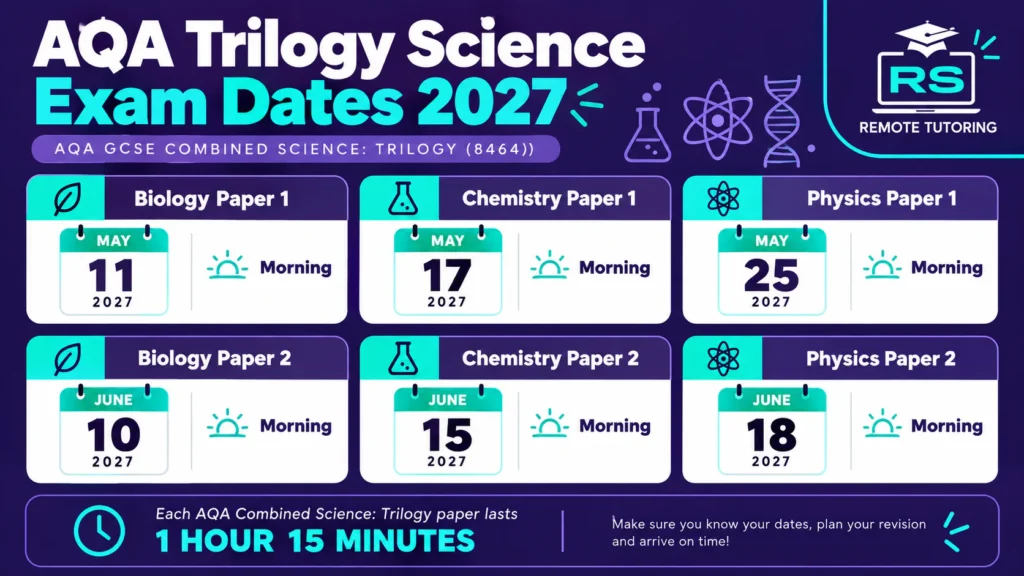
The published AQA Trilogy exam dates list these summer 2027 sessions for both Foundation and Higher. Each paper lasts 1 hour 15 minutes.
| Paper | Date | Session |
|---|---|---|
| Biology Paper 1 | 11 May 2027 | Morning |
| Chemistry Paper 1 | 17 May 2027 | Morning |
| Physics Paper 1 | 25 May 2027 | Morning |
| Biology Paper 2 | 10 June 2027 | Morning |
| Chemistry Paper 2 | 15 June 2027 | Morning |
| Physics Paper 2 | 18 June 2027 | Morning |
Use your centre’s statement of entry to confirm your own papers. This table is not a timetable for every science qualification.
Families weighing November against summer resits should separate the subjects: eligible students can tackle English Language or maths in November, while GCSE science preparation continues towards summer.
Should you choose Foundation or Higher for a science resit?
Choose the tier that allows your required grade and matches your performance in timed papers. Foundation Combined Science reaches 5-5, while Higher allows grades up to 9-9. A target of 6-6 therefore requires Higher, but ambition alone cannot establish readiness.
AQA Higher Combined Science normally awards 4-4 to 9-9, with an allowed 4-3 for candidates just below 4-4. Below that standard, the outcome is unclassified. Higher is not automatically the safer choice.
For a 4-4 target, compare recent Foundation and Higher work with a teacher. Check accuracy, unfinished questions and whether harder material is blocking marks on accessible content.
Subject-focused GCSE science tutoring can help identify whether the problem is knowledge, calculations or written explanations before the centre confirms your tier.
How do private candidates book GCSE science resits in London?
Private candidates enter through an approved school, college or exam centre while studying elsewhere. Find a centre that accepts your exact science specification, confirms practical arrangements and gives you a written total price. Offering GCSE exams does not guarantee science availability.
- Confirm the goal. Get the required qualification and grade from the college or course provider.
- Identify the entry. Supply the board, specification code, previous result and proposed tier.
- Contact centres. Ask your former school and two accessible London alternatives.
- Resolve practicals and support. Discuss previous laboratory work and any access arrangements before paying.
- Check the quote. Confirm all papers, fees, deadlines and cancellation terms.
- Check your entry statement. Verify your name, codes, tier and every exam session.
When choosing a London exam centre for a private candidate, test the morning journey as well as the price. Six cross-city trips can make a distant booking less attractive.
What should the fee include?
Ask for board entry, administration, invigilation, practical provision and any separately charged support. Confirm whether the price covers the full Combined Science award or one separate subject. No single London-wide 2027 fee applies.
Centre booking deadlines can be earlier than board deadlines. Ask for the last standard-fee booking date in writing.
If you previously had extra time or other access arrangements, tell the new centre at first contact. Ask which records or assessments it needs. Previous support does not mean a new centre can simply copy the arrangement without checking the evidence.

Do science resitters need to repeat required practicals?
Do not assume either that every experiment must be repeated or that practical work can be ignored. GCSE practical knowledge is assessed in written papers, but the entering centre must confirm how your practical history meets the requirements of your specification.
For AQA Trilogy, private-candidate practical requirements say centres must provide for the required activities. The specification includes 21 required practicals. Written assessment does not mean practical experience is optional.
Tell the exams officer what you completed at school. Ask what evidence they need and whether further sessions are necessary, especially if you are changing board or qualification. Get the answer before buying a laboratory package.
Revise methods, variables, graphs and improvements regardless. Watching a demonstration can support learning, but cannot establish that the centre’s entry requirements have been met.
How should you revise for a summer 2027 science resit?
Start with a marked diagnostic, identify why marks were lost and build a weekly plan around those weaknesses. Keep all examined sciences in rotation. Progress from topic questions to timed papers, then check whether the same mistakes return in unfamiliar questions.
Use the months for different jobs
| Period | Main task | Evidence of progress |
|---|---|---|
| September to December 2026 | Rebuild weak concepts and practical understanding | Correct answers without notes |
| January to March 2027 | Mix topics and practise longer explanations | Fewer repeated mistakes |
| April to final papers | Complete timed papers and targeted corrections | Stable performance across papers |
Keep an error log with three labels: knowledge, application and exam technique. “Revise chemistry” is too vague. “Balance equations without changing chemical formulae” gives the next session a purpose.
A starting week might contain three 40-minute topic sessions, one for each science, plus a 60-minute mixed-question session. That is three hours, before any tuition. Adjust it after the diagnostic rather than treating three hours as a promise of a particular grade.
For a student strong in biology but weak in chemistry, give chemistry more correction time without dropping biology entirely. After a week, retry the missed questions without notes. A correct answer immediately after reading the mark scheme is not yet evidence that the learning will hold.
Practise the marks you keep losing
- Biology: connect a named process to the question’s specific context.
- Chemistry: show calculation steps and check units.
- Physics: select the equation, rearrange it and substitute values carefully.
- Practical questions: explain the control variables and how the method improves reliability.
Equation sheets are provided for GCSE Physics and Combined Science in 2027. Practise with your board’s correct sheet; having equations available does not remove the need to use them accurately.
Structured one-to-one GCSE revision sessions are useful when a student needs feedback on why an answer missed marks. Rewriting neat notes cannot provide that feedback.
Is a science resit worth the extra workload?
A science resit is worth considering when a course or career requirement depends on a higher result. Check before committing. Science falls outside England’s maths and English condition of funding, so a low science grade does not automatically require a resit.
Ask the receiving college for its exact rule, including whether it accepts Combined Science and a later result. A summer 2027 result cannot satisfy an unconditional requirement for September 2026 entry.
If the concern is an incorrectly marked paper, a review of marking rather than a resit addresses a different problem. Ask the original centre about deadlines and the risk of the grade falling.
For students proceeding with a retake, RS Remote Tutoring’s online GCSE resit tutoring supports Combined and separate sciences. Bring your board, result and target grade to the free 30-minute first session. Lessons and exam-centre entry are separate arrangements.
Frequently asked questions
Can I resit only Biology within Combined Science?
No. Improving the Combined Science award requires the full qualification’s assessments. Taking standalone GCSE Biology is a different entry with additional subject content.
Can adults resit GCSE science in London?
Yes. Adults can enter as private candidates through a centre that accepts their qualification and can meet its requirements.
Can I take GCSE science in November 2026?
No, not England’s GCSE science qualifications. International GCSE availability can differ, so check the exact qualification rather than relying on an advert saying “science resit”.
Can I change exam boards for my resit?
Yes, if a centre accepts the new entry. Compare the content, paper structure and practical requirements before changing; your old revision checklist may leave gaps.
Is a higher science grade guaranteed after tutoring?
No. Tutoring can address gaps and improve preparation, but the awarded grade depends on exam performance and the board’s grading decisions.

Raja specializes in Physics and Maths, with over 5 years of experience. He offers KS2, KS3, and GCSE Science and Maths lessons. He graduated from one of the top universities in the UK.