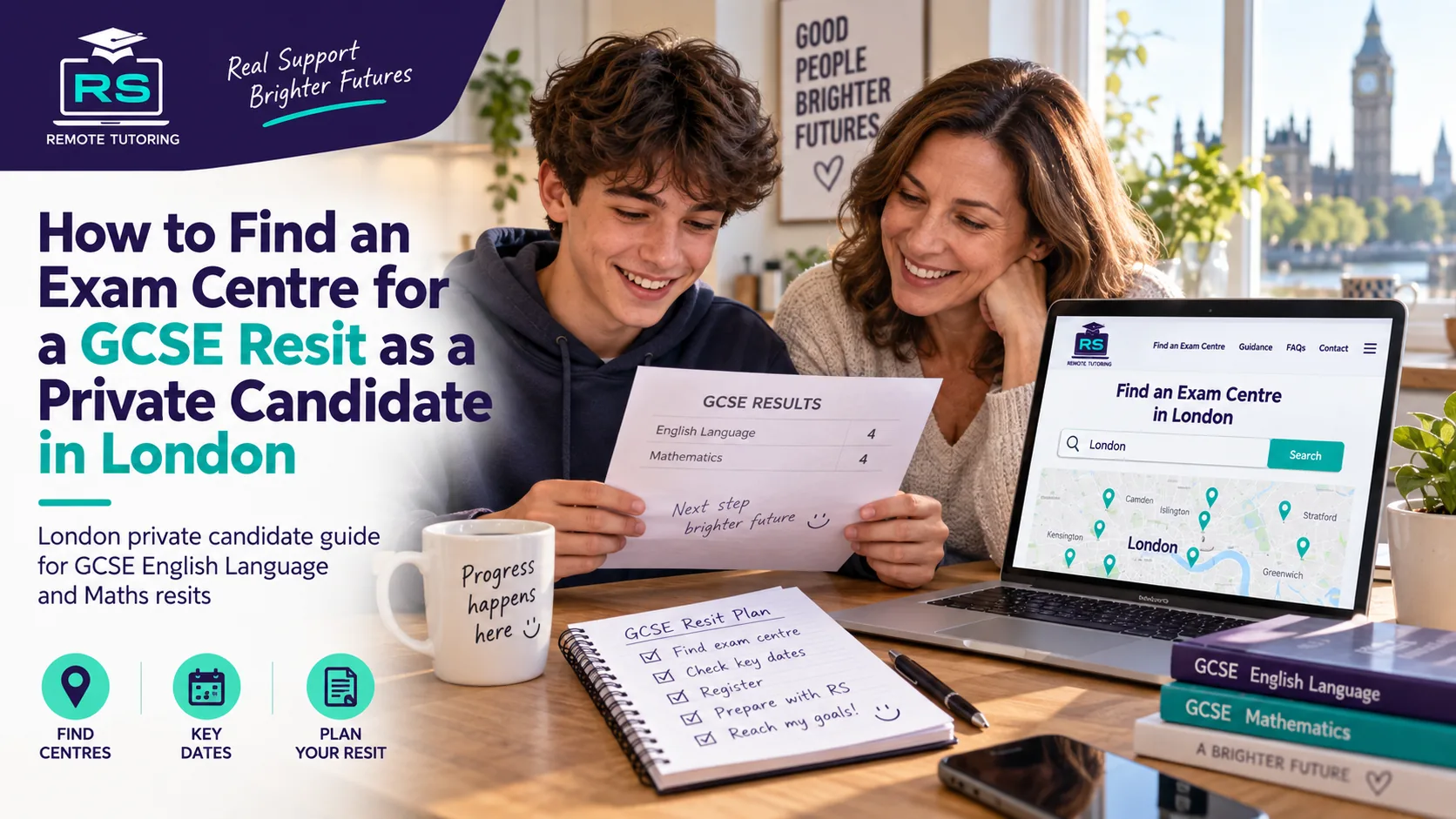
A grade 3 in maths, a results slip on the kitchen table, and a sixth form that has already said it won’t enter you in November. That’s where most London families are when they first search how to find an exam centre for a GCSE resit as a private candidate. And the clock is tighter than it looks. The exam boards close November 2026 entries on 4 October, but plenty of London centres shut their own lists weeks earlier. One East London centre stops taking November bookings on 26 September. A college in the City closed its list on 8 September.
You’re in a large crowd, at least. The Department for Education’s provisional figures put total GCSE English Language and maths entries at 161,480 for November 2025, up 5.8% on November 2024. A decent share of those came through colleges and independent centres rather than schools.
This guide covers where London’s centres actually are, what they charge, what to ask before you hand over money, and what goes wrong in the six weeks between now and the first paper on 3 November.
Jump to Section
What does “private candidate” mean for a GCSE resit?
A private candidate sits GCSE exams at an approved school, college or exam centre without being enrolled there as a student. For resits, that covers anyone whose old school won’t enter them, adult learners, home-educated students, and anyone who has left education completely.
JCQ, the body that speaks for AQA, Pearson Edexcel, OCR and WJEC, includes home-schooled students, the self-taught, people with private tutors, distance learners, part-time students and anyone resitting an exam in that definition. The last group is by far the biggest in September.
One rule catches resitters out. AQA states that you cannot be entered as both an internal and a private candidate at the same school or college in the same exam series. So if your college is entering you for maths, it can’t also process a private entry for English Language on the side. You’d need a second centre for that.
Age matters too. For the November series, AQA only allows entries for GCSE English Language and maths from students who were at least 16 on 31 August of that year. A Year 11 student who wants an early second go has to wait for summer.
And November is a restricted series. English Language and maths only. Science, history, languages and everything else wait until May and June 2027, which changes the whole shape of the choice between November 2026 and summer 2027 for anyone resitting more than the two core subjects.
Where do you start looking for a London exam centre?
Start with the JCQ private candidate search, which lists 190 centres nationally that have confirmed they take private candidates, then contact two or three London options on the same day. Add your old school and the nearest adult education college, because neither is guaranteed to appear on that list.
The JCQ private candidate search
The JCQ private candidate search lets you enter a postcode and filter by qualification type, awarding body and subject, and it returns the full list ordered by distance from you. As of this month it shows 190 centres that have confirmed they will accept private candidates this year.
Treat it as a starting list, not a directory. JCQ itself warns that the list is refreshed only once a year in December or January, that some centres on it may have stopped accepting private candidates, and that others which do accept them may not appear at all. JCQ also holds no further information about centres and can’t help you find one beyond the tool. So a page-one result for Ilford is no guarantee of a seat in Ilford.
Filter by GCSE, then by your board, then by English Language or Mathematics. The London results thin out fast once you do. That’s normal.
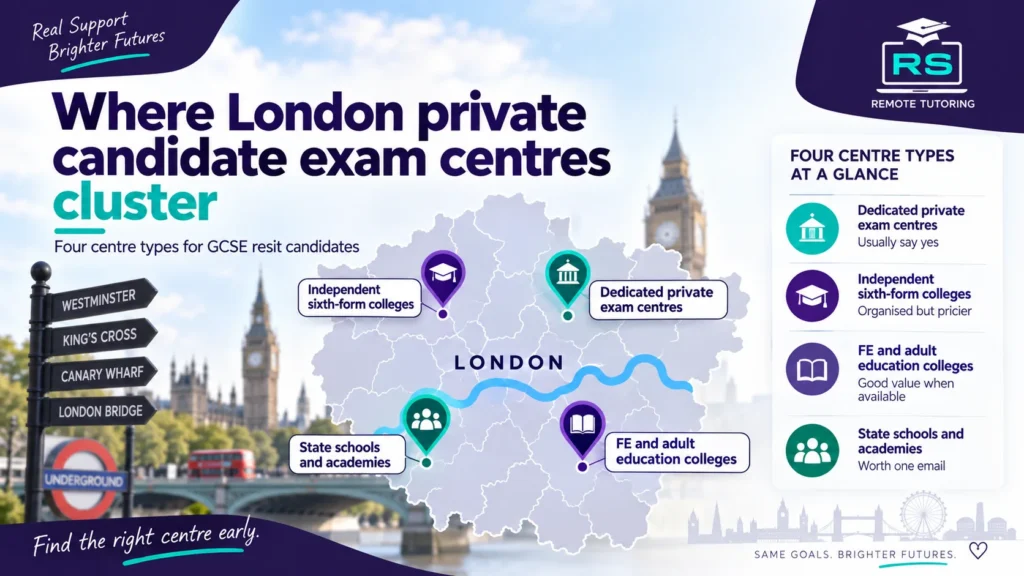
Four kinds of London centre that take resit candidates
- Dedicated private exam centres. These exist to take external candidates and nothing else. One operator runs sites in Ilford and Forest Gate, close to transport hubs, and is open seven days a week. Another national network has a Wimbledon site. Prices are higher than a school’s admin fee, but the answer is usually yes.
- Independent sixth-form colleges. Several central London colleges run a private candidate service alongside their own students. They tend to be the most organised and the most expensive.
- Further education and adult education colleges. Good value when they say yes, but they prioritise their own enrolled 16 to 19 resit cohort and often close early.
- State schools and academies. Most take only their own former pupils, if anyone. Worth one email, and no more than that.
Your old school is the cheapest option nobody tries
Schools already hold your UCI number, your previous entry and your access arrangements file. Their administration fee, if they charge one, is usually a flat sum in the tens of pounds. The catch is that their exams officer is busy with 200 of their own Year 11s and has no obligation to help you. Send a short, polite email to the exams officer by name, with your spec code and tier in the subject line. If the answer is no, you’ve lost ten minutes.
When do you need to book a November 2026 resit by?
The exam boards’ deadline for November 2026 GCSE English Language and maths entries is 4 October 2026, with late fees from 5 October and very late fees after 25 October. Every London centre sets an earlier internal cut-off, and several have already passed.
Here is the picture as of 19 September.
| Deadline | Date | What it means for you |
| David Game College (City of London), standard entry | 8 September 2026 | Already passed; late applications considered at a higher fee if space remains |
| Exam Centre London (Ilford / Forest Gate), standard entry | 26 September 2026 | One week away; late fees from 27 September |
| AQA board entry deadline, November series | 4 October 2026 | Centre must have submitted your entry by this date |
| AQA late entry fee applies | From 5 October 2026 | Extra 100% of the entry fee, on top |
| AQA very late entry fee applies | After 25 October 2026 | Extra 150% of the entry fee, on top |
| Exam Centre London high late fee | From 25 October 2026 | Centre’s own surcharge, in addition to the board’s |
| First English Language paper (AQA) | 3 November 2026 | Second paper 5 November |
| Maths papers (AQA) | 4, 6 and 9 November 2026 | Paper 1 is non-calculator |
| Results | January 2027 | Certificates follow later in the year |
The board dates and fee percentages come from AQA’s published fee schedule for November 2026. The two centre dates are taken from each centre’s own published deadlines page, and both are restricted to English Language and maths retakes for candidates aged 16 or over.
Read the table as a pattern. The board date is the one that appears in every blog. The centre date is the one that decides whether you sit the exam. Ask for it on your first call.
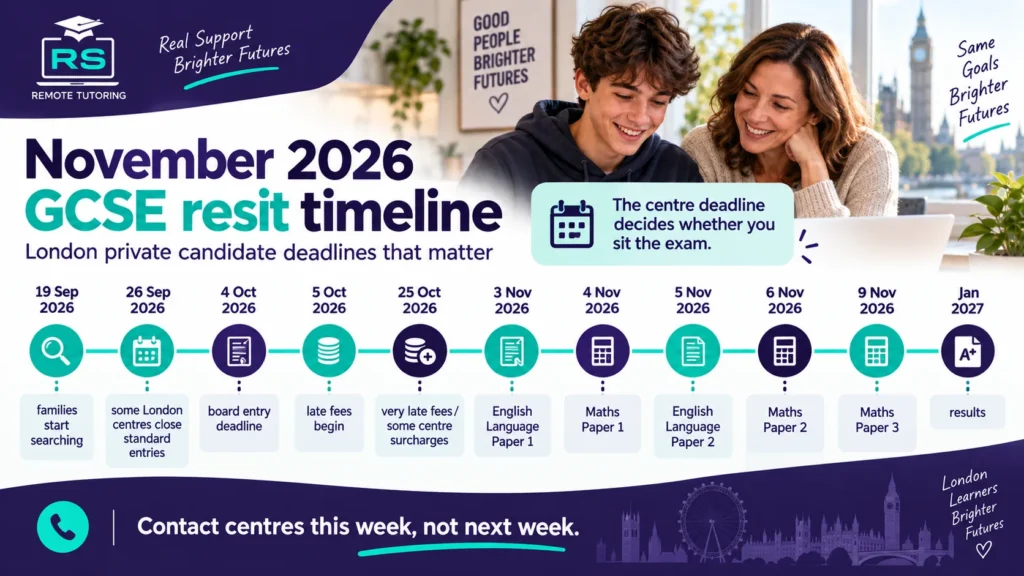
Miss November altogether and your next chance is summer 2027, with results the following August. Planning around GCSE resit results day in January is only possible if the entry goes in now.
How much does a GCSE resit cost as a private candidate in London?
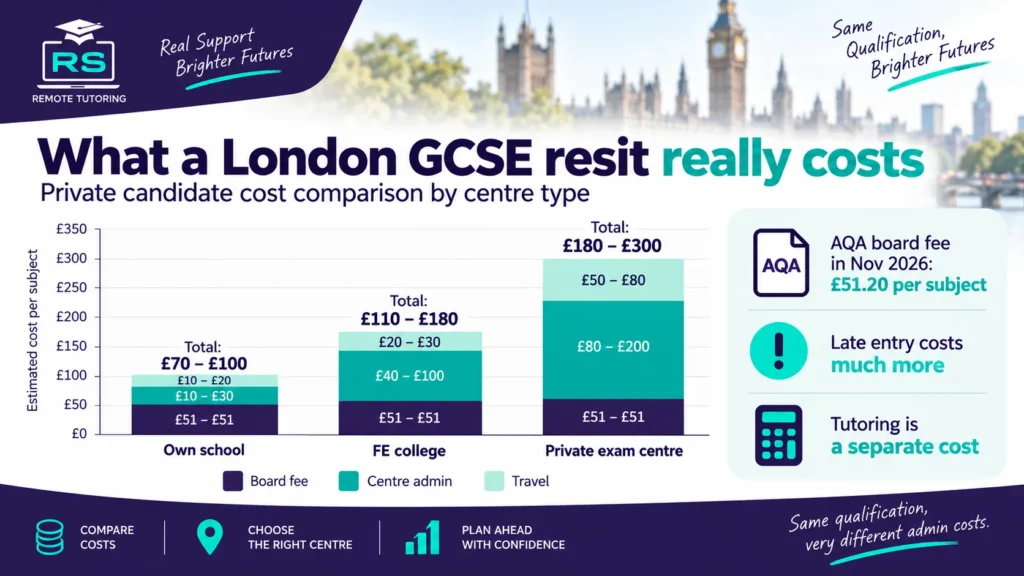
Expect to pay somewhere between £100 and £300 per subject for a November 2026 GCSE resit at a London centre. The board’s own fee is a small part of that. The rest is the centre’s administration and invigilation charge, and it varies enormously between a school and a dedicated exam centre.
AQA’s UK entry fee for GCSE English Language (8700) and Mathematics (8300F or 8300H) in November 2026 is £51.20 per subject. That figure is fixed wherever you sit it. Everything on top is set by the centre.
Two real London examples show the spread. David Game College charged a standard exam entry fee of £290 for its November 2026 GCSE entries, rising to £425 for late applications. Exam Centre London offers an interest-free instalment plan because it recognises that fees can be a stretch for some candidates. A former pupil entered by their own state school might pay the board fee plus £15 to £30. Same paper, same grade on the certificate, four times the price at one end.
| Cost line | Typical London range | Who sets it |
| Exam board entry fee | £51.20 per subject (AQA, November 2026) | The board |
| Centre administration and invigilation | £20 to £240 per subject | The centre |
| Late entry surcharge | 100% to 150% of the board fee, plus centre’s own | Board and centre |
| Access arrangements assessment (if needed) | £0 to £250 | The centre |
| Travel across London on paper days | £5 to £15 per day | You |
The funding question comes up every year, so here’s the plain answer. Students required to resit English or maths because they missed a grade 4 usually don’t pay, but only while they are in full-time education with a school or provider that covers the cost. Voluntary resitters and anyone outside that system generally do pay. A private candidate is, by definition, outside that system.
Budget the tutoring separately. An online GCSE tutor in London charges £30 an hour at RS Remote Tutoring and needs no room hire, so the total for six weeks of weekly lessons plus the exam entry usually lands under £500.
How do you register with a London exam centre, step by step?
Registering takes about a week if you do it in the right order: gather your previous entry details, shortlist three centres, contact all of them on the same day, pay the one that confirms first, then check the statement of entry line by line.
- Find your last statement of results. It shows your UCI (unique candidate identifier), the board, and the specification code you sat. AQA and OCR print the UCI on the certificate and the statement, while Pearson Edexcel prints it only on the statement of results. If you’ve never sat a GCSE before, the centre will allocate a new UCI.
- Decide the tier. Foundation (grades 1 to 5) or Higher (grades 4 to 9) for maths. Almost every November resitter belongs on Foundation. If your target is a 4 or a 5, don’t let pride put you on Higher.
- Write down the exact codes. AQA maths is 8300F or 8300H, AQA English Language is 8700. Edexcel maths is 1MA1 and English Language is 1EN0. A centre can’t quote you without them.
- Run the JCQ search, pick two London results, and add your old school as the third.
- Email all three the same afternoon. Subject, board, spec code, tier, date of birth, whether you need access arrangements, and a question about their internal deadline and total fee.
- Pay the first centre that confirms availability at a price you can live with. Get a receipt that separates the board fee from the admin fee.
- Hand over photo ID. Photo ID is a firm requirement to book, and centres will point you to an alternative verification route if you don’t hold any.
- Check the statement of entry within a week of paying. JCQ tells private candidates to make sure they receive and check their statement of entry carefully. Wrong tier or wrong board on that document is your problem on results day, not the centre’s.
Once the entry exists, the real work starts. A GCSE resit tutor who knows the AQA or Edexcel paper can plan six weeks around the topics that cost you marks last time, rather than teaching the whole course again.
What should you ask a centre before you pay?
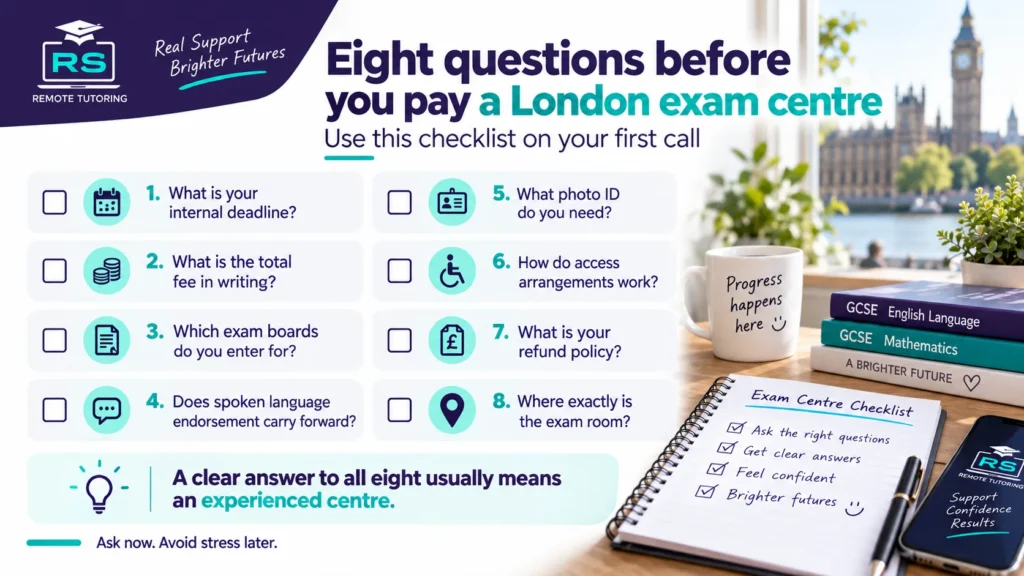
Ask eight things on the first call: their internal deadline, the total fee in writing, which boards they enter for, whether your spoken language endorsement carries forward, what ID they need, how access arrangements work, their refund policy, and where exactly the exam room is.
- The internal deadline for November, and the date their own late fee starts. Two London centres already differ by 18 days on this.
- The total fee in writing, and whether it’s per subject or per paper. Maths has three papers; per-paper pricing triples it.
- Which boards they can enter you with. Some centres are Pearson-only. If you sat AQA last time and want the same specification, that matters.
- Whether they need evidence of your GCSE English Language spoken language endorsement. David Game College only accepts English Language private candidates who already hold a Pass, Merit or Distinction for the spoken endorsement and asks for the certificate or statement as proof. If you never sat it, the centre has to run it, and many won’t.
- What photo ID they accept, and whether they need it at registration, on exam day, or both.
- How access arrangements work, and their deadline for evidence. David Game College required all extra-time applications, with supporting documents, by 1 September 2026. JCQ places responsibility for access arrangements with the centre, and you must raise them at the point of entry.
- The refund policy if you withdraw or fall ill. AQA itself won’t refund entries withdrawn after 25 October 2026 except partially on medical grounds with evidence.
- The exact site, arrival time and start time. One London centre asks morning candidates to arrive by 8:15am for a 9:00am start. Ilford at 8:15 on a Tuesday is a different journey from Ilford at noon on a Saturday.
A centre that answers all eight without fuss has done this hundreds of times. A centre that gets vague on the fee is telling you something.
What goes wrong for London private candidates, and how do you avoid it?
The most common failures are a centre being full by the time you decide, a wrong tier on the entry, a missing spoken language endorsement, a name on your ID that doesn’t match your UCI record, and an exam-morning journey across London that you never rehearsed.
Being full is the one people don’t expect. AQA is candid that finding a place can take time because not every school or college can take private candidates. Dedicated centres cap their rooms, and the November series is small enough that one large college’s own cohort can fill a hall. Contact three centres, not one.
Wrong tier is the quiet killer. A Higher entry with a bad day can come back as a U, because the lowest Higher grade is a 4. On Foundation, the same performance is a 3 or a 4. Ask your tutor which tier before you pay, not after.
Name mismatches sound trivial until an invigilator refuses to seat you. Middle names, hyphens and a passport that still shows a previous surname all cause trouble. Send the centre a copy of your ID when you register and ask them to confirm the name on the entry matches it.
Then there’s the journey. The maths non-calculator paper is first thing on a Wednesday. Do the trip once at the same time of day the week before. Anyone who has entered a child for GCSEs while homeschooling will tell you this is the step that separates calm exam mornings from frantic ones.
Finally, don’t book two centres “to be safe.” Double entries with the same board get flagged, and you’ll pay twice with nothing to show for it.
What happens after you’ve booked?
After booking, you’ll receive a statement of entry, then nothing from the centre until a timetable and seating details arrive in late October. Use the gap for a targeted revision plan built around your previous paper, and keep the January results date in mind when you plan the next step.
Six weeks is enough. It isn’t enough to redo two years of content, and that’s not what a resit needs. Pull your summer paper if you can get it, find the three or four topics that cost the most marks, and drill those. A student two marks off a 4 needs a different programme from one 25 marks off, and if you’re that close, it’s also worth checking whether a remark rather than a resit would have been the smarter route before the review window closes.
Weekly one-to-one lessons with an online GCSE resit tutor fit this window well because there’s no travel and the lesson can be built on the exact paper and board you’re entered for. Targeted GCSE English Language tutoring, for example, can spend four of the six weeks on Paper 2 writing if that’s where the marks went.
Results land in January 2027. If the grade is a 4 or above, you’re done with the resit cycle. If it isn’t, entries for summer 2027 open in the spring, and the whole cycle above starts again, with more time and more centres to choose from.
Frequently asked questions
Can I sit a November GCSE resit as a private candidate if I’m under 16?
No, not in the November series. AQA restricts November English Language and maths entries to students who were at least 16 on 31 August that year. Younger disabled students can be entered as a reasonable adjustment in limited circumstances. Everyone else waits for summer 2027.
Do I have to use a centre on the JCQ list?
No. JCQ says centres not on the list may still accept private candidates, and centres on it may have stopped. The list is a starting point. Your old school and your local college are worth an email even if neither appears.
Can I resit GCSE science, history or a language in November?
No. The November series covers GCSE English Language and maths only. Every other subject next runs in May and June 2027, with entry deadlines in February 2027 and results in August.
What if my old school says no?
Move on the same day. Schools have no obligation to enter former pupils, and some have written policies that exclude everyone but their own current students. A dedicated private exam centre or an independent college is the reliable fallback in London, at a higher price.
Do private candidates get extra time or a reader?
Yes, but only through the centre. JCQ places the responsibility for access arrangements with the centre and requires you to raise them when you make the entry. Raise it on the first call, with your evidence ready, because centres set their own cut-off for assessments.
Can I take my GCSE resit online?
No. GCSE exams must be sat in person at an approved centre. Functional Skills Level 2 is the online-friendly alternative that many colleges and employers accept in place of a grade 4. Check with whoever needs the qualification before switching routes.
Is it too late to book for November 2026?
Not yet, but it’s close. The board deadline is 4 October 2026, with late fees from 5 October. At least one East London centre closes standard entries on 26 September. Contact three centres this week rather than next.